
Industrial Pump Troubleshooting Guide
Industrial pump troubleshooting guide: diagnose low flow, cavitation noise, seal leakage, vibration, overheating and motor overload with a systematic symptom-to-cause process.
Most industrial pump problems share a small set of root causes: suction starvation or cavitation, dry running, air ingress, misalignment, and wear in the impeller, rotors, seals or bearings. Diagnose systematically — verify rotation, prime, suction supply and the duty point first, then work toward the mechanical condition of the pump — and most failures are found without dismantling anything.
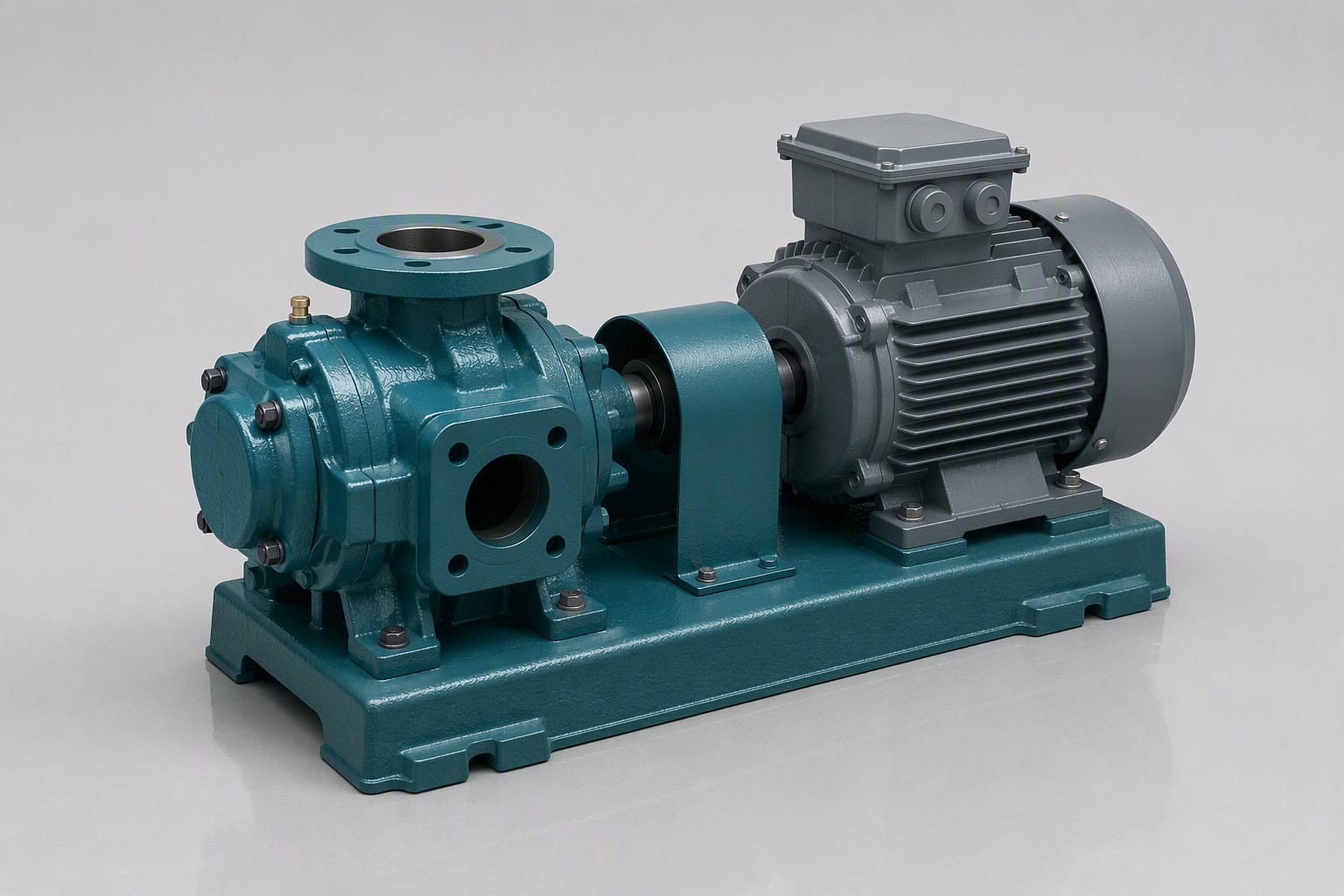
Diagnose the System Before You Blame the Pump
Pumps fail inside a system, and the system is usually the cause. Before inspecting the machine itself, confirm the four basics that generate almost every misleading symptom: the motor rotates in the correct direction, the casing is fully primed, the suction valve is open and the strainer is clean, and the discharge path is not blocked or throttled by an upset downstream. Then compare the running flow and pressure with the pump's performance curve at the actual speed. A pump that is mechanically perfect can still deliver no flow if it is starved, air-bound or running against a closed discharge.
- Check rotation — a reversed three-phase motor runs a centrifugal backwards at low output.
- Confirm prime — lost prime shows as normal speed with zero flow and no discharge pressure.
- Open the suction path — a clogged strainer or half-closed valve starves the pump silently.
- Compare against the curve — the running point tells you whether the problem is hydraulic or mechanical.
Symptom-to-Cause Quick Reference
Use the table to shortlist the likely causes, then work the checks in order from cheapest to most invasive:
Industrial Pump Symptom Quick Reference
| Symptom | Most likely causes | First checks |
|---|---|---|
| No flow or low flow | Lost prime, air lock, wrong rotation, blocked suction, closed valve, cavitation, worn internals | Rotation, prime, suction valve and strainer, discharge valve, curve comparison |
| Low pressure or head | Worn impeller or rotors, excessive internal clearance, wrong speed, vapour in the liquid, recirculation | Speed, duty point on curve, clearances, liquid vapour pressure |
| Noise, crackling or gravel sound | Cavitation, air ingestion, mechanical looseness, bearing wear | NPSH margin, suction lift, air leaks, strainers, liquid temperature |
| Seal leakage | Dry running, misalignment, wrong flush supply, contamination, out-of-envelope operation | Flush pressure and flow, alignment, leak rate history |
| Vibration | Misalignment, imbalance, bearing wear, cavitation, resonance, loose foundations | Baseline and trend, alignment, coupling, foundation bolts |
| Overheating | Low-flow recirculation, lost cooling, over-tight packing, wrong viscosity at start-up | Minimum-flow bypass, cooling supply, packing adjustment |
| Motor overload | Wrong specific gravity or viscosity, mechanical binding, stuck relief valve, misalignment | Motor current vs curve, isolate the drive, relief-valve setting |
Cavitation and Suction Problems: The Noise Is the Clue
Cavitation sounds like gravel or crackling inside the pump and brings fluctuating flow, pressure and vibration. It is a suction-side failure: the pressure at the impeller eye falls below the liquid's vapour pressure, vapour bubbles form and then collapse violently against the impeller or rotor surfaces. It happens when available NPSH drops below the pump's requirement — through a raised suction lift, a clogged strainer, a long or undersized suction line, air leaks, or a higher liquid temperature that raises vapour pressure. Fix the suction condition first: restore the NPSH margin, then inspect the impeller for pitting. Air ingestion produces similar noise and symptoms; check the suction line joints, the stuffing box and the tank level for vortexing.
Dry Running Is the Fastest Pump Killer
Dry running destroys pumps faster than almost any other fault because the liquid is what lubricates and cools the seal faces, and in many designs the internal running clearances depend on it. A mechanical seal running dry overheats and fails within minutes, and a progressive-cavity screw pump is even less forgiving — the elastomeric stator can be ruined within seconds without liquid. Protect the pump with a low-level cut-out on the supply tank, a suction-pressure switch or a flow switch, and never rely on an operator to catch a lost suction in time. In liquid ring vacuum service the equivalent rule is to maintain the sealing-liquid supply: the 2BV series is rated with sealing water at or below 30 °C, so a hot or interrupted sealing-water feed degrades vacuum performance before any mechanical fault appears.
Mechanical Seal Leakage: Read the Pattern
A mechanical seal is the most common wear point on a modern pump, and most of its failures are preventable. Leakage that appears shortly after installation usually points to dry running, misalignment or an incorrect flush supply; leakage after long service usually means the seal faces or elastomers have exceeded their pressure, temperature or chemical envelope, or abrasives have entered the seal chamber. Establish the correct appearance for the duty — many single seals emit a fine vapour mist — and investigate any change in rate, colour or sound rather than tightening the seal. Keep the flush or barrier fluid at the pressure and flow specified, align the pump and motor, and confirm the seal-face and elastomer grades are compatible with the actual medium.
Vibration, Bearing Temperature and Overload
Vibration and bearing temperature trend together: both rise with misalignment, imbalance, bearing wear, cavitation and looseness, and both are best judged against a baseline taken at commissioning. Measure at the same point and duty each time, and investigate any sudden jump rather than any absolute number. Bearing overheating usually means lubrication loss, contamination or pre-load from misalignment — relubricate to the manual's grade and interval, and never over-grease. Motor overload is often hydraulic rather than electrical: a denser or more viscous liquid than specified, mechanical binding, or a stuck relief valve on a positive displacement pump. Compare the motor current with the curve at the running point before changing the motor.
Gather the Data and Call In the Manufacturer
When the fault survives the basic checks, the fastest route is a good data pack: the pump type and model, the duty point (flow, head, speed), the liquid and its temperature and viscosity, the running history, and the readings taken during the fault. That evidence lets a manufacturer's engineer separate application error from hardware failure. The selection and operating guides for chemical process pumps, heavy-oil transfer, boiler feed, food-grade and LPG transfer pumps explain the correct duty envelope for each service, and the liquid ring vacuum pump selection guide covers wet-vacuum troubleshooting from the vacuum pump range. Qingdao Green Power engineers support the screw pump and centrifugal pump ranges with application engineering — contact the team with your symptom history and duty data for a diagnosis.
Frequently Asked Questions
What should I check first when an industrial pump delivers no flow or low flow?
Verify the basics before opening the pump: rotation direction, that the casing is fully primed, that the suction valve and strainer are open and clean, and that the discharge path is not blocked. Then compare the running flow and pressure with the performance curve — a cavitating or air-ingesting pump loses capacity even though the pump itself is mechanically sound.
Why does my pump make a crackling or gravel-like noise?
That sound is typically cavitation or air ingestion. Cavitation happens when available NPSH falls below the pump's requirement — check the suction lift, strainers and filters, liquid temperature and any air leaks, and restore the NPSH margin before inspecting the impeller for pitting. Also check for vortexing at the tank outlet or a partially blocked strainer.
Why does my mechanical seal keep leaking or failing early?
The usual causes are dry running, shaft misalignment, an incorrect flush or barrier-fluid supply, contamination in the pumped liquid, and operation beyond the seal's pressure or temperature envelope. Keep the flush correct, align the pump and motor, and never run the pump without liquid — dry running overheats seal faces within minutes.
Can Qingdao Green Power help me troubleshoot a pump problem?
Qingdao Green Power engineers can assist with diagnosis, maintenance planning and spare-parts selection across its centrifugal, screw, chemical, thermal-oil and vacuum pump ranges. Provide the pump type, duty point, operating history and observed symptoms; confirm current support scope and model specifications with Qingdao Green Power for your specific pump.
Describe the symptom, the duty point and what changed just before the fault — the engineering team will help you isolate the cause and get the pump back on line.
Get a Quote
Send your pump details and fault history. Engineers reply within 24 hours.
Contact Us →💬 WhatsApp NowRelated Products
- Industrial Screw Pump
- Centrifugal Pump
- Vacuum Pump
Related Articles
Heavy Oil Transfer Pumps
Viscous hydrocarbon duties
Chemical Process Pump Selection
Materials and sealing
Liquid Ring Vacuum Pump Selection
Wet vacuum duties