
Food Grade Pump Selection Guide
A complete food grade pump selection guide: profile the product and duty, choose between positive displacement and centrifugal classes, verify hygienic materials, seals, CIP and vacuum-assisted duties, then apply the buying checklist.
A food grade pump selection guide begins with a product and duty profile, not a model number. Viscosity at working temperature, shear sensitivity, solids, flow, pressure and cleaning method define which hygienic pump class can serve the line.
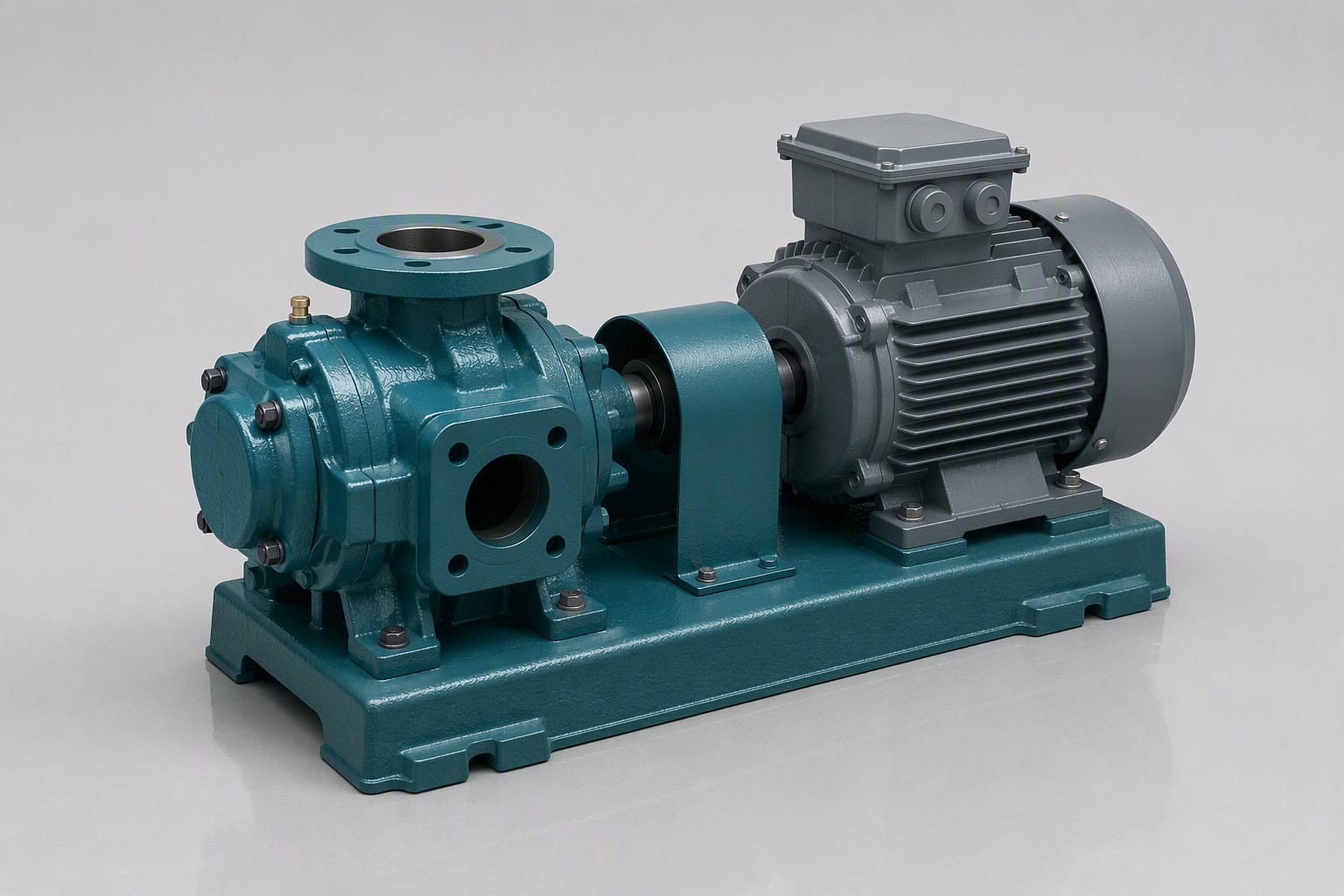
What "Food Grade" Means for a Pump
A food grade pump is more than a stainless machine. Every surface that touches the product must be food-contact safe — smooth stainless steel with crevice-free welds and polished finishes — and every wetted elastomer (O-rings, stators, diaphragms, seal faces) must suit both the food and the detergents used against it. No pocket may trap product, and no route may let lubricant reach the food.
How a machine proves food-contact suitability depends on the destination market's regulations, so treat documentation as a selection criterion. State the required compliance scope in your quotation request to Qingdao Green Power.
Build a Product and Duty Profile First
Every selection guide in this library repeats the same instruction: gather fluid data before looking at pumps. Food is the hardest case because behaviour changes with temperature, shear history and recipe. The table lists the minimum dataset to assemble.
Duty Data to Collect Before Selection
| Criterion | Why it matters | What to record |
|---|---|---|
| Viscosity behaviour | Decides PD vs centrifugal and speed range | cP at minimum and maximum temperature; shear-thinning notes |
| Flow requirement | Sizes the pump and motor | Peak m³/h from batch size or filler speed |
| Pressure and suction | Fixes head, NPSH and seal loading | Static lift, line losses, filter state, suction head |
| Temperature envelope | Sets materials, clearances and cold-start behaviour | Product temperature range (minimum to maximum) |
| Solids and shear limits | Selects rotor type and internal clearances | Particle size, fibre content, maximum allowed shear |
| Cleaning regime | Confirms CIP/SIP rating and elastomer choice | CIP/SIP temperatures, detergent types, cycle frequency |
Choose the Pump Class: PD or Centrifugal
Food processing divides into two pump classes. Centrifugal pumps add energy with an impeller and deliver high flow of thin liquid in a smooth stream — the economical workhorse for milk, juice, clarified syrups and CIP rinse water. Qingdao Green Power's centrifugal pump range is published at 1.5–1600 m³/h and 2–125 m head up to 80 °C, with the practical rule to move to positive displacement above roughly 150 cSt.
Positive displacement pumps trap a fixed volume per revolution, so flow stays steady against pressure and speed can be turned down without losing prime. Within the PD family, progressive cavity machines — the G-type screw pump line, published at 0.1–150 m³/h and 0.6–2.4 MPa — carry heavy pastes and slurries smoothly through a rotating rotor inside an elastomer stator, while rotary lobe designs suit shear-sensitive emulsions and particulate foods. The absolute rule of the PD class: never run it dry — a progressive cavity pump loses its stator within seconds without liquid.
Hygienic Design, Seals and the Cleaning Cycle
Cleanability is a design property, not an option. Look for a drainable casing, hygienic clamped connections and internal surfaces that a brush or spray can actually reach. Select mechanical seals for the product and the cleaning chemistry together — an elastomer that survives the food may fail in hot caustic, and a seal chosen for product alone may leak during the CIP phase.
Plan the cleaning cycle with the pump. CIP circulates detergent and rinse water through the assembled line, suiting a hygienic, full-drain design; steam sterilisation (SIP) adds temperature limits that every gasket and seal face must meet. Confirm the maximum cleaning temperature and chemical compatibility of the specific configuration with the manufacturer.
Include Vacuum-Assisted Duties in the Scope
A food plant's pumping problem is rarely a single transfer line. Deaeration before filling, vacuum transfer of sauces, vacuum cooling of cooked product and modified-atmosphere packaging all pull moist, condensable vapour into the pump. A liquid ring vacuum pump tolerates that duty — its rotating sealing-water ring handles wet gas and condensable vapour that would damage a dry mechanical pump. Qingdao Green Power's 2BV liquid ring vacuum pump series is published at 0.45–8.33 m³/min with an ultimate vacuum of 0.097 MPa absolute.
Food Grade Pump Selection Checklist
Use this checklist when comparing quotations.
- Product profile complete — viscosity range, shear limit, solids size and temperature window documented and agreed.
- Duty point realistic — peak flow and worst-case discharge pressure with fouled filters and cold starts.
- Materials verified — stainless grade and finish, elastomer compounds, and certificates for the destination market.
- Seal strategy defined — seal type, flush arrangement and behaviour during the CIP/SIP cycle.
- Protection fitted — relief valve or drive interlock so a PD pump cannot dead-head against a closed valve.
- Cleaning cycle confirmed — CIP/SIP temperature and detergent compatibility signed off by the manufacturer.
- Spares and service agreed — rotor, stator or impeller spares, seal kits and the manufacturer's maintenance schedule.
The Same Data-First Method Serves Other Fluids
The data-first method in this guide is the same one applied in the chemical process pump selection guide and the boiler feed pump selection guide — start from the fluid and the duty, then verify materials and protection against the real operating envelope.
Frequently Asked Questions
Should a food plant choose positive displacement or centrifugal pumps?
It depends on the product. PD pumps deliver a fixed volume per revolution, so flow holds steady against pressure and viscous or shear-sensitive foods transfer reliably; centrifugal pumps are cheaper for thin liquids. Most food plants use both classes.
Why is a liquid ring vacuum pump used in food processing?
Liquid ring vacuum pumps tolerate wet gas and condensable vapour, suiting deaeration before filling, vacuum transfer, vacuum cooling and modified-atmosphere packaging, where water vapour enters the pump and the rotating water ring carries it away. Qingdao Green Power's 2BV series is published at 0.45–8.33 m³/min with an ultimate vacuum of 0.097 MPa absolute.
How is the cleaning method decided for a food grade pump?
The cleaning method follows the product and line design. Hygienic connections, a drainable casing and smooth internal surfaces allow cleaning in place, while steam-sterilisable designs need seals and elastomers rated for the sterilising temperature. Confirm the temperature, chemical and cycle compatibility of the configuration with Qingdao Green Power.
How do you control flow on a food grade positive displacement pump?
Flow on a PD pump is proportional to speed, so a variable-speed drive is the cleanest, gentlest control. A bypass with a pressure-relief valve protects the pump when flow is throttled or stopped — never run a PD pump against a closed discharge. Confirm the control and relief arrangement with Qingdao Green Power when you order.
Send your product and duty profile — viscosity, flow, pressure, temperature and cleaning regime — and the engineering team will return a food grade pump specification with the checklist above answered.
Get a Quote
Send your product data and duty point. Engineers reply within 24 hours.
Contact Us →💬 WhatsApp NowRelated Products
- Industrial Screw Pump
- Centrifugal Pump
- Liquid Ring Vacuum Pump
Related Articles
Chemical Process Pump Selection Guide
Material-first selection method
Boiler Feed Pump: Selection & Applications
Head and NPSH sizing
Heavy Oil Transfer Pump Selection Guide
Viscosity-led pump selection