
2BV Liquid Ring Vacuum Pump: Applications and Selection
2BV liquid ring vacuum pump selection: ultimate vacuum, pumping speed, sealing-liquid temperature and wet-gas capability for filtration, distillation, degassing and drying duties.
A liquid ring vacuum pump generates vacuum with an eccentrically mounted impeller rotating inside a casing partially filled with sealing liquid, usually water. Centrifugal force throws the water against the casing to form a moving ring; the space between the impeller blades and the ring changes volume with each revolution, drawing gas in, compressing it and expelling it. The 2BV series publishes 0.097 MPa absolute ultimate vacuum and 0.45–8.33 m³/min max flow.
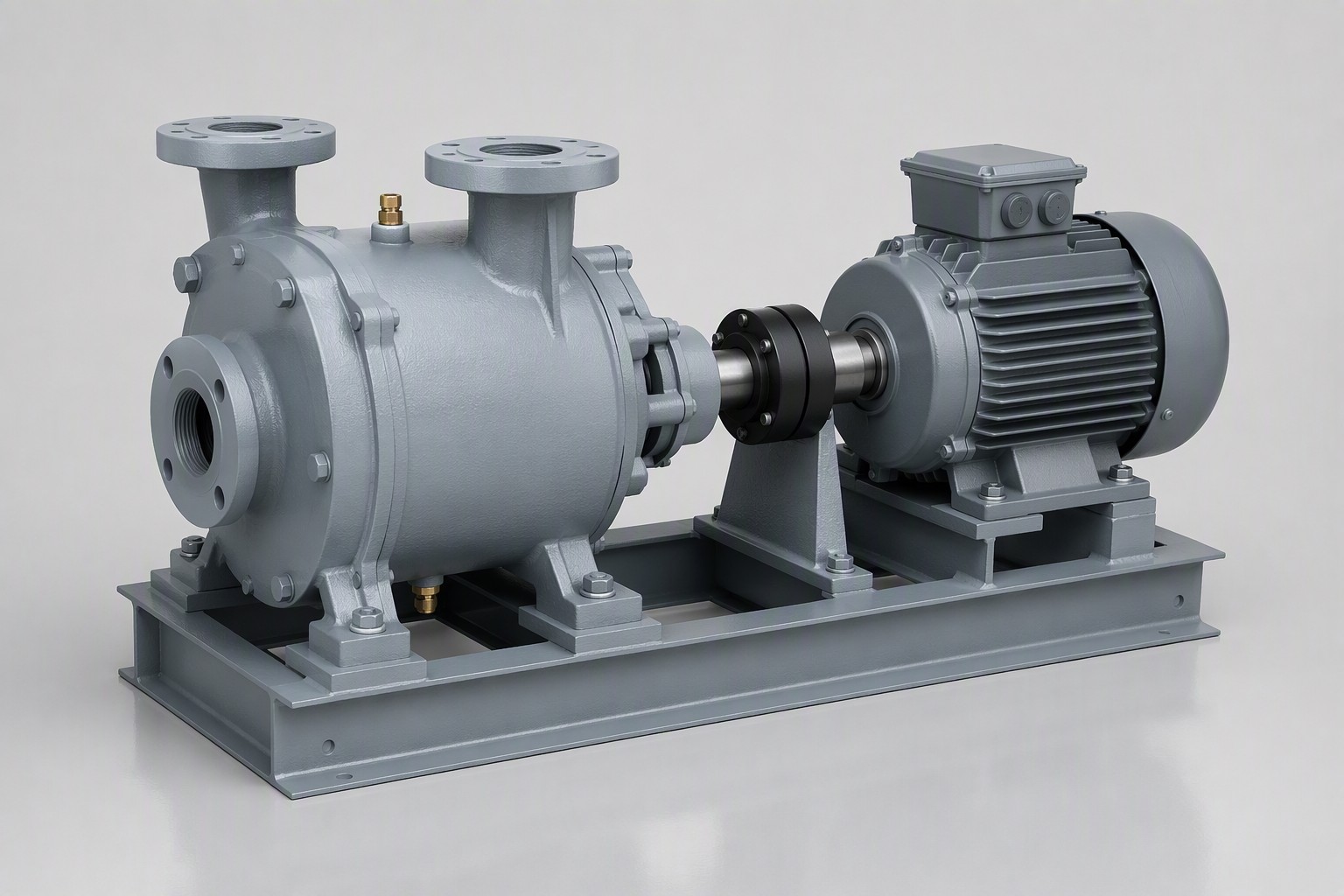
How the Liquid Ring Principle Helps Real Processes
The liquid ring makes the 2BV series unusually tolerant of wet gas streams. Because compression happens against a liquid rather than between dry metal parts, condensable vapours, droplets and even small entrained particles pass through without the seizure or wear risk of a dry mechanical pump. This is why liquid ring pumps are the default choice for:
- Vacuum filtration — keeping cake-forming slurries moving on filters and belt filters.
- Vacuum distillation — handling solvent vapours that condense inside the pump.
- Degassing and de-aeration — removing dissolved air or gas from liquids.
- Paper machine forming sections and felt conditioning.
- Chemical and pharmaceutical vacuum processes where vapours and droplets are present.
- Food packaging vacuum and general industrial vacuum generation.
2BV Series Key Specifications
Published 2BV Series Range
| Parameter | Value |
|---|---|
| Max flow rate | 0.45–8.33 m³/min |
| Ultimate vacuum | 0.097 MPa (absolute) |
| Power | 0.81–15 kW |
| Inlet / outlet | 25–80 mm (1–3 in) |
| Sealing liquid | Water (standard); compatible liquids for special service |
| Sealing water temperature | ≤30°C for rated performance |
Selection Checklist
1. Ultimate pressure vs working pressure
Confirm the required working vacuum, not just the ultimate vacuum. The 2BV series reaches 0.097 MPa absolute (approximately 3.3 kPa absolute). Operating continuously near the ultimate point is inefficient — select a model whose capacity curve is strong at the actual working pressure, typically between 5 kPa and 80 kPa absolute for liquid ring pumps.
2. Pumping speed at the working pressure
Manufacturers quote capacity at a stated pressure, not a single "free-air" number. For a vessel-evacuation duty, calculate the average pumping speed needed over the operating pressure range, including air in-leakage through joints and product out-gassing.
3. Sealing-liquid temperature
Sealing water temperature directly controls achievable vacuum: warmer water raises the vapour pressure in the ring and reduces ultimate vacuum. Keep sealing water at or below 30°C for rated performance. In hot climates, a small heat exchanger or fresh-water make-up is often needed.
4. Wet gas, solvents and corrosion
For condensable or corrosive vapours, confirm the sealing-liquid and wetted-material compatibility. Water is standard; compatible sealing liquids can be specified for special service. At inlet pressures below about 80 mbar, fit an anti-cavitation protection pipe as recommended by the manufacturer.
5. Motor and installation
Published motor power across the range is 0.81–15 kW with inlet/outlet connections from 25 to 80 mm. Confirm the supply voltage, mounting arrangement and whether a separator tank or closed-loop sealing-water system is required for the site.
Frequently Asked Questions
What is the ultimate vacuum of the 2BV series?
The published ultimate vacuum is 0.097 MPa absolute. Continuous operation at inlet pressures below 80 mbar requires an anti-cavitation protection pipe.
Why choose a liquid ring pump over a dry vacuum pump?
The water ring tolerates condensable vapours, droplets and wet gases that would damage dry mechanical pumps. Liquid ring pumps are therefore a robust choice for vacuum filtration, distillation and paper-machine duties.
What sealing liquid does the 2BV pump use?
Water is the standard sealing liquid. Sealing water should be kept at or below 30°C for rated performance. Compatible liquids can be used for special service.
What applications suit the 2BV pump?
Industrial vacuum generation, vacuum filtration, vacuum impregnation, degassing of liquids, vacuum distillation, paper machine forming sections, chemical and pharmaceutical vacuum processes, and food packaging vacuum.
Send your vacuum level, required pumping speed, gas composition and site conditions — the engineering team will confirm the right 2BV model, sealing-water arrangement and accessories.
Get a Quote
Send your process data and duty point. Engineers reply within 24 hours.
Contact Us →💬 WhatsApp NowRelated Products
- 2BV Vacuum Pump
- Claw Pump
Related Articles
2BV Liquid Ring Applications
Application guide
Industrial Vacuum Selection
How to choose a vacuum pump
Industrial Pump Troubleshooting
Maintenance guide