
Best Pump for High-Viscosity Liquids
How to choose the best pump for high-viscosity liquids: screw, gear and lobe positive displacement options, the viscosity limits of centrifugal pumps, and the selection data that matter for thick fluids.
For high-viscosity liquids the best pumps are positive displacement machines — screw, gear and lobe pumps — because each revolution displaces a fixed volume, so flow does not collapse as pressure and viscosity rise. Screw pumps cover the widest duty band: the G-type single screw (progressive cavity) pump is published at 0.1–150 m³/h and 0.6–2.4 MPa, and the 3GB triple screw pump at 2.4–241.7 m³/h up to 350°C. Above about 150 cSt, centrifugal pumps give way to gear or screw designs.
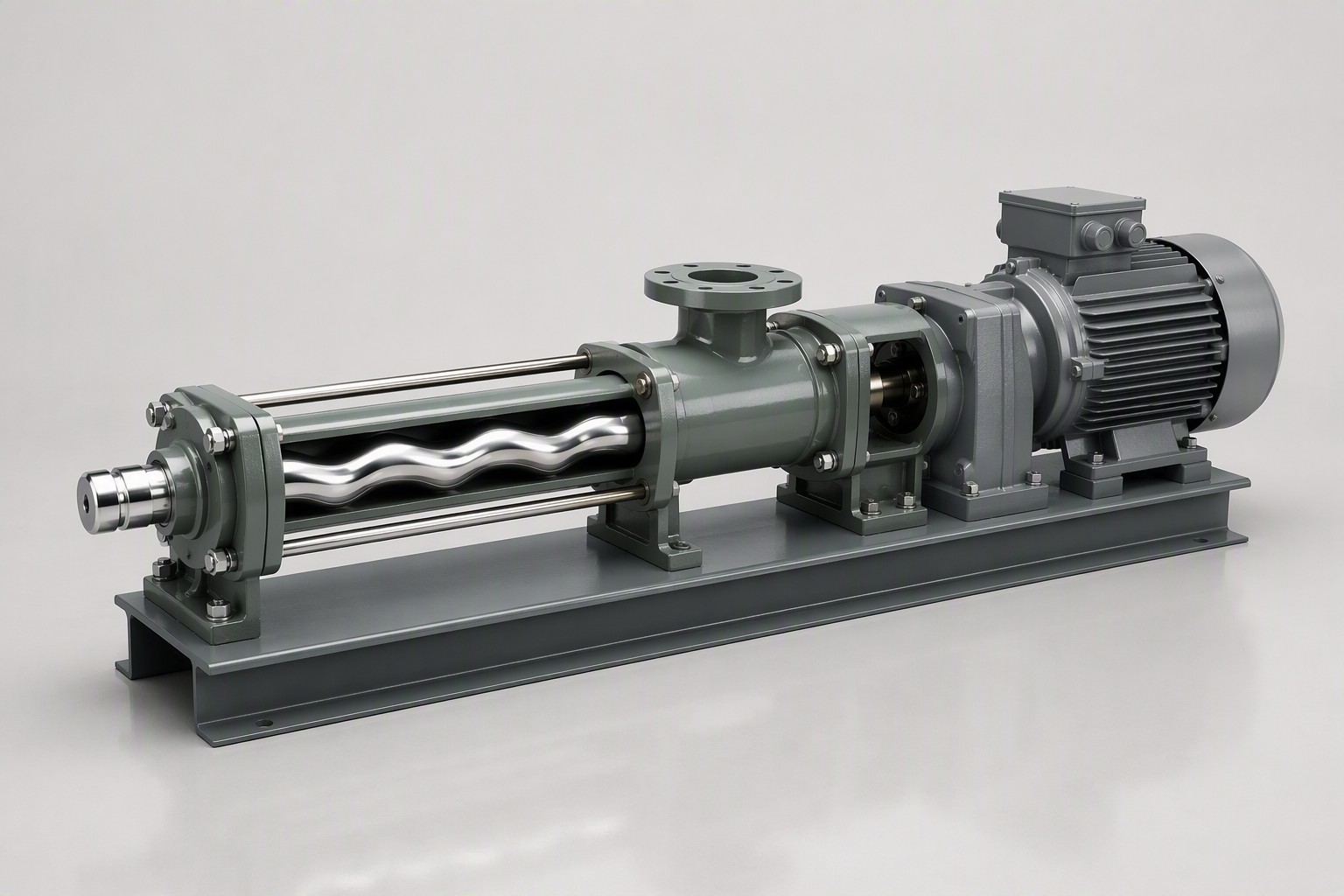
Why High-Viscosity Liquids Need a Different Pump
Viscosity is a liquid's internal resistance to flow, usually expressed in centistokes (cSt). Water sits near 1 cSt; heavy fuel oils, resins, food pastes and bitumen reach thousands or millions of centistokes.
A centrifugal pump converts impeller velocity into pressure, so friction in a thick liquid makes head and flow fall while efficiency drops. A positive displacement (PD) pump works the opposite way: each revolution traps and pushes a fixed volume, and a thicker liquid actually seals the internal clearances better, holding volumetric efficiency high. Viscosity is therefore a first-order decision in high-viscosity pump selection, and the practical methods in our guide to pumping extremely viscous fluids build on the same PD principle.
Pump Technologies Compared for Thick Liquids
Four PD families — screw, gear, lobe and progressing-cavity designs — dominate viscous transfer, each with a natural territory. The table maps them against Qingdao Green Power's published reference data.
Pump Technology vs Liquid Viscosity
| Technology | Where it fits | QGP reference |
|---|---|---|
| Centrifugal (IS/ISW) | Water and low-viscosity process liquids; continuous non-pulsating flow | 1.5–1600 m³/h, temperature ≤80°C; above ~150 cSt switch to gear or screw |
| G single screw (progressive cavity) | High-viscosity, shear-sensitive, abrasive and sludge media | 0.1–150 m³/h; 0.6–2.4 MPa |
| 3GB triple screw | Clean low-viscosity oil at high temperature | 2.4–241.7 m³/h; up to 350°C |
| External gear pump | Clean oils and fuels at medium-to-high viscosity and pressure | Confirm current model availability and specifications with Qingdao Green Power |
| Rotary lobe pump | Shear-sensitive and hygienic products needing gentle, low-pulsation flow | Confirm current model availability and specifications with Qingdao Green Power |
Within the QGP range, the two screw-pump families cover most viscous duties, and both are described on the G and 3GB industrial screw pump product page.
G-Type Single Screw: Built for Thick and Delicate Media
The G-type single screw pump is a progressive cavity machine: a helical metal rotor turns inside an elastomeric stator, forming a series of sealed cavities that travel steadily from suction to discharge. Flow is smooth, nearly pulseless and low in shear.
Qingdao Green Power publishes the G-type for high-viscosity oils and resins above about 1500 cSt, sludge, slurry, bitumen, food pastes, biological fluids and shear-sensitive polymers, plus abrasive liquids provided solids stay below the minimum flow passage dimension — at 0.1–150 m³/h and 0.6–2.4 MPa. The stator elastomer (NBR, EPDM or FKM) must be matched to the chemistry and temperature of the liquid. One rule is absolute: never run a G-type pump dry, because the rubber stator is destroyed within seconds.
3GB Triple Screw: Hot Oil at High Temperature
Where the G-type excels with thick media, the 3GB triple screw pump is engineered for clean, low-viscosity oil that must be moved at high temperature. Three intermeshing screws convey the fluid axially with balanced loads, giving quiet, low-pulsation flow up to 350°C at 2.4–241.7 m³/h — a natural fit for hot-oil circulation and heavy oil pump selection duties where the oil is kept thin by heat and lubricates the screws.
Selection Checklist for a Viscous Duty
- Viscosity and temperature at the worst case: a cold, thick start raises torque and suction losses — size for the highest viscosity, not the running average.
- Flow and pressure: PD flow rises with speed and is largely independent of discharge pressure; confirm the maximum pressure and fit relief protection.
- Solids and shear sensitivity: abrasive or fragile products point to a progressive cavity or lobe design; confirm solids stay below the minimum passage.
- Elastomer and seal selection: match stator rubber and seal type to the chemistry, temperature and cleanliness of the liquid.
- Heating and suction conditions: heating the line or the tank outlet keeps thick fluid feeding the pump and prevents starvation.
Frequently Asked Questions
What is the best pump for high-viscosity liquids?
Positive displacement pumps are the best choice for high-viscosity liquids because each revolution displaces a fixed volume regardless of pressure. Screw pumps — the G-type progressive cavity and the 3GB triple screw — plus gear pumps and rotary lobe pumps lead the field; Qingdao Green Power publishes 0.1–150 m³/h at 0.6–2.4 MPa for the G-type and 2.4–241.7 m³/h up to 350°C for the 3GB.
Can a centrifugal pump handle high-viscosity liquid?
Poorly. Friction in the impeller makes head and flow fall and efficiency drop as viscosity rises, so Qingdao Green Power's published guidance for its IS/ISW centrifugal range is to switch to a gear or screw pump above about 150 cSt. Centrifugal pumps are best for water and low-viscosity process liquids.
What is the difference between a G single screw pump and a 3GB triple screw pump?
The G-type single screw (progressive cavity) pump uses a helical metal rotor inside an elastomeric stator to move thick, shear-sensitive, abrasive and sludge media; it is published at 0.1–150 m³/h and 0.6–2.4 MPa and must never run dry. The 3GB triple screw pump conveys clean low-viscosity oil through three intermeshing screws at 2.4–241.7 m³/h up to 350°C.
Which pump suits very thick, shear-sensitive products such as resins and food pastes?
Progressive cavity screw pumps and rotary lobe pumps suit shear-sensitive products because they move liquid in large, gentle cavities with low shear. The G-type screw pump is published for high-viscosity oils and resins above about 1500 cSt, sludge, slurry, food pastes and shear-sensitive polymers; select the stator elastomer (NBR, EPDM or FKM) for the fluid and confirm the model with Qingdao Green Power.
Tell us your liquid's viscosity, temperature, flow and discharge pressure — the engineering team will recommend the pump technology and model that fits your duty.
Get a Quote
Send your fluid data and duty point. Engineers reply within 24 hours.
Contact Us →💬 WhatsApp NowRelated Products
- Industrial Screw Pump (G / 3GB)
- Centrifugal Pump
Related Articles
How to Pump Extremely Viscous Fluids
Practical methods for thick media
High-Viscosity Pump Selection
Sizing for thick fluids
Bitumen and Asphalt Transfer Pump
Heated transfer systems