
How to Pump Extremely Viscous Fluids
How to pump extremely viscous fluids: why positive displacement pumps beat centrifugal designs, how G-type and 3GB screw pumps are applied, and the heating, suction and protection rules that keep thick media flowing.
To pump extremely viscous fluids reliably you need a positive displacement pump, not a centrifugal one. A PD pump traps a fixed volume of liquid each revolution, so flow holds up as viscosity climbs, whereas a centrifugal impeller loses head and flow through internal friction. Qingdao Green Power's G-type single screw (progressive cavity) pump is published at 0.1–150 m³/h and 0.6–2.4 MPa for media above about 1500 cSt, and its IS/ISW centrifugal guidance is to switch to a gear or screw pump above roughly 150 cSt.
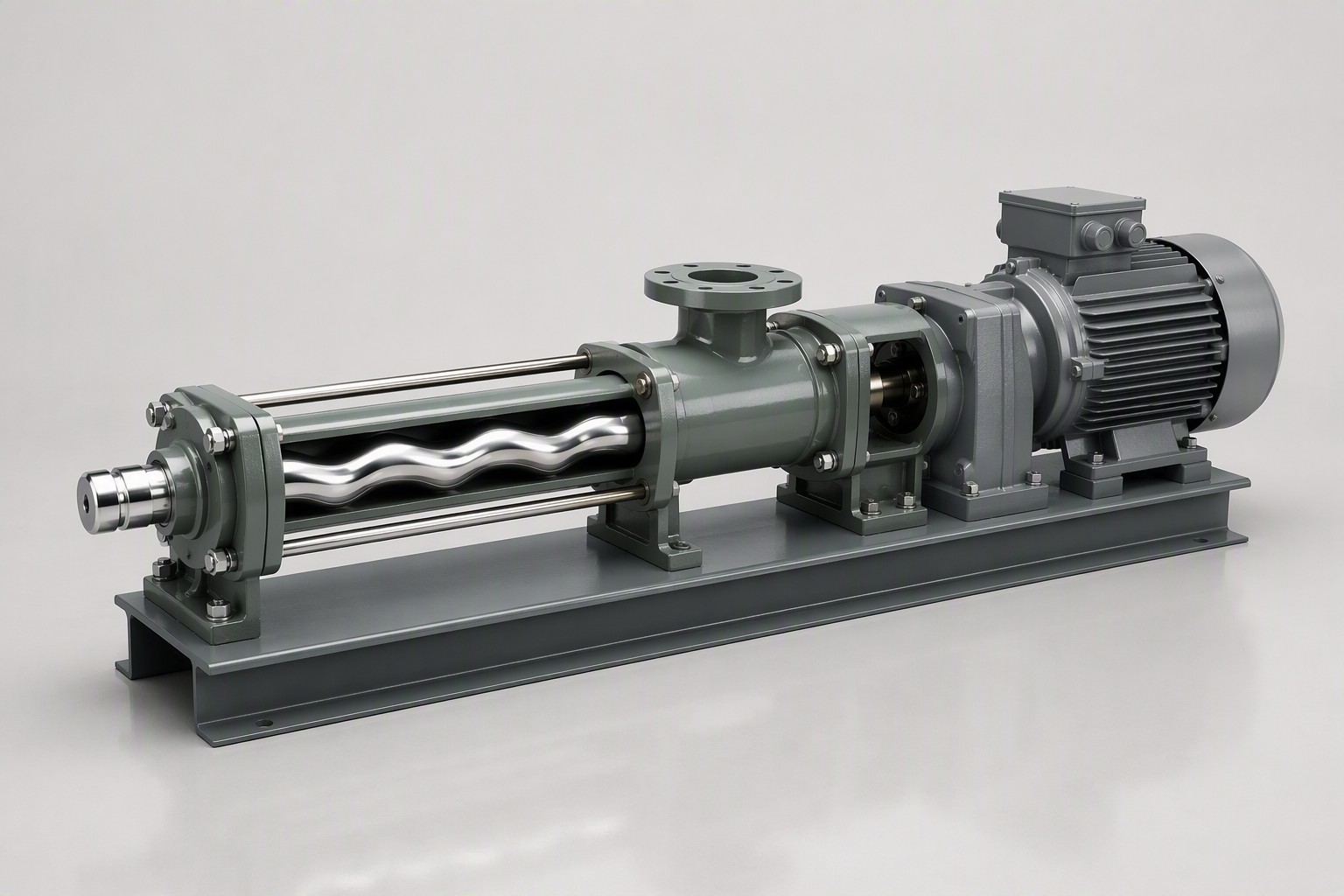
Why Extremely Viscous Fluids Defeat Centrifugal Pumps
Viscosity is a liquid's internal resistance to flow, usually quoted in centistokes (cSt). Water sits near 1 cSt, while heavy fuel oil, resins, food pastes and bitumen reach hundreds of thousands — sometimes millions — of centistokes. The thicker the liquid, the more energy friction wastes.
A centrifugal pump converts impeller velocity into pressure, so a thick liquid cannot reach impeller speed cleanly: head and flow fall, efficiency collapses and the pump may stall. Qingdao Green Power publishes its IS/ISW centrifugal pump range for water and low-viscosity process liquids, with explicit guidance to change to a gear or screw pump above about 150 cSt.
Start with Positive Displacement Technology
Positive displacement (PD) pumps work the opposite way: each revolution displaces a fixed volume of liquid, so flow follows speed rather than discharge pressure. The thick liquid even seals internal clearances, holding volumetric efficiency high — which is why screw, gear and lobe machines dominate thick-liquid transfer. Practical sizing detail is covered in high-viscosity pump selection.
Screw Pumps: The Workhorse of Thick-Liquid Transfer
Qingdao Green Power's two screw families cover most extremely viscous duties, and both are documented on the industrial screw pump page.
Pump Technology vs Liquid Viscosity
| Technology | Where it fits | QGP reference |
|---|---|---|
| Centrifugal (IS/ISW) | Water and low-viscosity process liquids; continuous non-pulsating flow | 1.5–1600 m³/h, temperature ≤80°C; above ~150 cSt switch to gear or screw |
| G single screw (progressive cavity) | Extremely viscous, shear-sensitive, abrasive and sludge media | 0.1–150 m³/h; 0.6–2.4 MPa |
| 3GB triple screw | Clean low-viscosity oil at high temperature | 2.4–241.7 m³/h; up to 350°C |
| External gear pump | Clean oils and fuels at medium-to-high viscosity and pressure | Confirm current model availability and specifications with Qingdao Green Power |
| Rotary lobe pump | Shear-sensitive, food-grade and hygienic thick products | Confirm current model availability and specifications with Qingdao Green Power |
G-Type Single Screw: The Progressive Cavity Principle
The G-type single screw pump moves liquid by progressive cavity action: a helical metal rotor turns inside an elastomeric stator, forming sealed cavities that travel steadily from suction to discharge. The flow is smooth and low in shear, suiting thick and delicate media. Qingdao Green Power publishes the G-type for high-viscosity oils and resins above about 1500 cSt, sludge, slurry, bitumen, food pastes, biological fluids and shear-sensitive polymers, plus abrasive liquids within the solids limit of the flow passage.
Two rules matter on a G-type duty. Match the stator elastomer — NBR, EPDM or FKM — to the fluid's chemistry and temperature, and never run the pump dry, because the rubber stator is destroyed within seconds. Keep the suction flooded on bitumen and asphalt transfer and resin transfer systems.
3GB Triple Screw: Clean Oil Kept Thin by Heat
Where the liquid is a clean oil that is viscous mainly in cold starts, the 3GB triple screw pump is the proven choice. Three intermeshing screws convey the fluid axially with balanced loads, giving quiet, low-pulsation flow at 2.4–241.7 m³/h up to 350°C. Because the oil lubricates the screws, the 3GB suits heavy oil pump selection duties where tank and line heating keeps the oil thin enough to pump.
Practical Rules for Handling Extremely Viscous Fluids
- Heat the liquid, not just the pump: jacketed or traced tanks and lines cut viscosity sharply, so the pump receives a liquid instead of a plug.
- Give the suction side an easy life: keep suction lines short, large-bore and flooded, and avoid fine-mesh strainers that block instantly on cold thick media.
- Size for the cold start: torque and suction losses peak at the lowest temperature, so design for the worst-case viscosity.
- Control by speed, not throttle: PD flow is proportional to speed, so a variable-speed drive matches flow cleanly without throttling losses.
- Fit relief protection: a relief valve or bypass protects the pump and line if a discharge valve closes against a running PD machine.
- Never run a progressive cavity pump dry: fit a low-level switch on the suction tank.
Frequently Asked Questions
What type of pump is best for extremely viscous fluids?
Positive displacement pumps are the practical answer because each revolution displaces a fixed volume, so flow survives high viscosity and pressure without the internal slip losses that cripple a centrifugal impeller. Qingdao Green Power's G-type single screw (progressive cavity) pump is published for media above about 1500 cSt at 0.1–150 m³/h and 0.6–2.4 MPa, while the 3GB triple screw pump moves clean hot oil at 2.4–241.7 m³/h up to 350°C.
Why can't a centrifugal pump handle extremely viscous fluids?
As viscosity rises, friction in the impeller and casing makes head and flow collapse while efficiency falls, so a centrifugal pump can stall or starve on thick liquid. Qingdao Green Power's guidance for its IS/ISW centrifugal range is to switch to a gear or screw pump above about 150 cSt; centrifugal pumps suit water and low-viscosity process liquids best.
What is the difference between the G single screw and the 3GB triple screw pump?
The G-type single screw pump is a progressive cavity machine — a helical metal rotor turning inside an elastomeric stator — built for thick, shear-sensitive, abrasive and sludge media; it must never run dry because the rubber stator fails within seconds. The 3GB triple screw pump uses three intermeshing screws to convey clean low-viscosity oil at high temperature, published at 2.4–241.7 m³/h up to 350°C.
Do I need to heat extremely viscous fluids before pumping?
Usually yes. Heating cuts viscosity sharply and lets the liquid feed the pump reliably, which is why bitumen, heavy fuel oil and molasses systems use jacketed or traced tanks and lines. Size the pump for the worst cold-start condition and confirm the heating arrangement, materials and stator elastomer with Qingdao Green Power.
Tell us the liquid, its viscosity, flow and discharge pressure — engineers will recommend the screw pump type and configuration for your duty.
Get a Quote
Send your fluid data and duty point. Engineers reply within 24 hours.
Contact Us →💬 WhatsApp NowRelated Products
- Industrial Screw Pump (G / 3GB)
- Centrifugal Pump
Related Articles
High-Viscosity Pump Selection
Sizing for thick fluids
Heavy Oil Pump Selection
Hot-oil and fuel-oil duties
Bitumen and Asphalt Transfer
Heated transfer systems