
High-Viscosity Pump Selection Guide
High-viscosity pump selection guide: choose screw, gear or centrifugal technology from viscosity, temperature, flow, pressure and shear-sensitivity data.
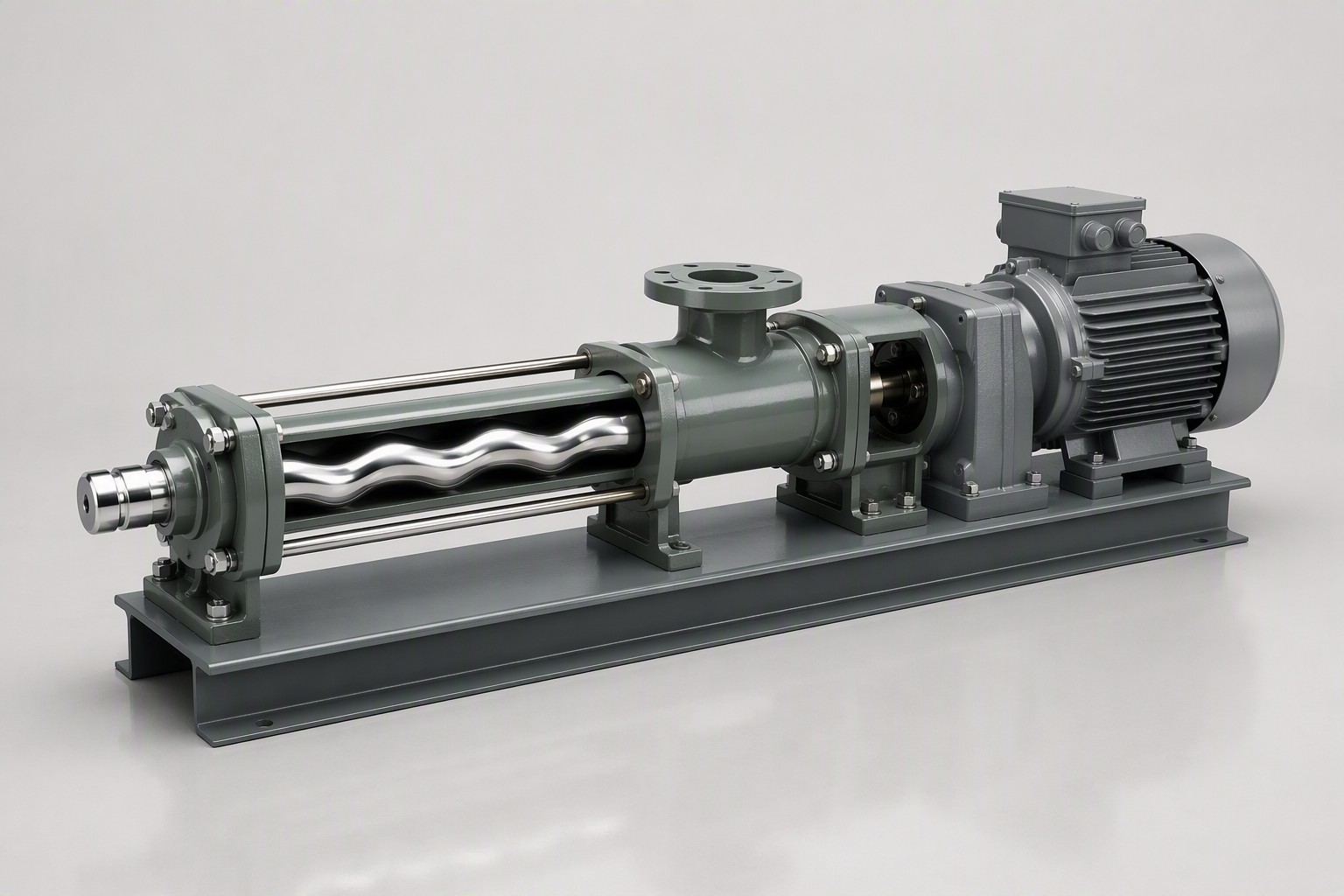
Selecting a pump for a high-viscosity liquid means choosing a positive displacement machine whose flow is set by displacement volume, not by impeller dynamics. The deciding data are viscosity at cold start and operating temperature, fluid chemistry, flow, discharge pressure and shear sensitivity. Qingdao Green Power publishes its G-type single screw (progressive cavity) pump at 0.1–150 m³/h and 0.6–2.4 MPa for thick, shear-sensitive and abrasive media, and its 3GB triple screw pump at 2.4–241.7 m³/h for clean oil up to 350°C.
What Makes High-Viscosity Pump Selection Different
Viscosity changes how every pump technology behaves. In a centrifugal pump, friction inside the impeller makes head, flow and efficiency fall quickly as the liquid thickens, so Qingdao Green Power's published guidance for its IS/ISW centrifugal pump range is to switch to a gear or screw pump above about 150 cSt. In a positive displacement (PD) pump the opposite happens: a thicker liquid seals internal clearances better, so volumetric efficiency holds and discharge pressure simply rises with system resistance.
That is why viscous fluids are matched with screw, gear and lobe pumps; the wider comparison is drawn in our guide to the best pump for high-viscosity liquids.
Collect the Duty Data First
For every high-viscosity application, gather:
- Viscosity profile: value at the coldest credible condition and at operating temperature — one number is never enough for a thick fluid.
- Fluid chemistry and temperature: the medium, its corrosiveness, and the temperature range the pump will see.
- Flow and pressure: required average and peak flow, discharge pressure or head, and any pressure spikes.
- Shear sensitivity and solids: whether the product is damaged by shear and whether solids are present.
- Suction conditions: flooded inlet or lift, available NPSH, and inlet pipe length and diameter.
Comparing Pump Technologies for Viscous Liquids
Screw, Gear and Centrifugal Technology Compared
| Characteristic | G single screw (progressive cavity) | 3GB triple screw | Gear / lobe pump | Centrifugal (IS / ISW) |
|---|---|---|---|---|
| Operating principle | Helical rotor in elastomeric stator | Three intermeshing screws | Meshing teeth / rotating lobes | Impeller velocity energy |
| Published flow | 0.1–150 m³/h | 2.4–241.7 m³/h | Confirm current model availability and specifications with Qingdao Green Power | Best below about 150 cSt |
| Pressure / temperature | 0.6–2.4 MPa; media-dependent | Up to 350°C | Confirm current model availability and specifications with Qingdao Green Power | Water and process liquids to 80°C |
| Typical duty | Thick, shear-sensitive, abrasive, sludge | Clean hot low-viscosity oil | Clean oils and gentle handling duties | Water and thin process liquids |
Both screw-pump families are shown on the G and 3GB industrial screw pump product page. For clean oil at moderate viscosity a gear pump is often the compact answer; for gentle handling of very thick media, progressive cavity and lobe machines lead. Oil, bitumen and resin duties are compared in our heavy oil pump selection and resin transfer pump selection guides.
Selecting the Screw Pump Family
The G-type single screw pump is a progressive cavity machine: a helical rotor turns inside an elastomeric stator, and sealed cavities carry the liquid from suction to discharge with low shear. Qingdao Green Power publishes it at 0.1–150 m³/h and 0.6–2.4 MPa, for high-viscosity oils and resins above about 1500 cSt, sludge, slurry, bitumen, food pastes and shear-sensitive polymers. Because the stator is elastomeric, match its grade (NBR, EPDM or FKM) to the chemistry and temperature, and protect the pump from dry running — the stator fails within seconds without liquid.
The 3GB triple screw pump is selected for the opposite profile: clean oil kept hot so it stays thin. Three intermeshing screws convey the fluid axially at 2.4–241.7 m³/h and up to 350°C with quiet, low-pulsation operation, and because the pumped oil lubricates the screws the medium must stay clean. Hot-fuel duties are covered in our high-viscosity oil transfer pump article.
Common Selection Mistakes to Avoid
- Sizing on warm viscosity only. The pump must also start at the coldest viscosity the line will ever see.
- Ignoring suction limitation. Viscous liquids generate high inlet friction — keep the suction short, large-bore and flooded.
- Choosing a centrifugal pump above the viscosity limit. Above about 150 cSt the IS/ISW range should give way to a gear or screw pump.
- Forgetting dry-run protection. A progressive cavity stator fails within seconds without liquid.
- Skipping elastomer and material checks. Confirm stator grade and wetted materials against the fluid and temperature.
For asphaltic media with heating and jacketing demands, our bitumen and asphalt transfer pump guide applies the same logic to one of the most demanding fluids in the field.
Frequently Asked Questions
How do you choose the right pump for a high-viscosity liquid?
Define the duty first: viscosity at the coldest condition and at operating temperature, chemistry, temperature, flow, discharge pressure, shear sensitivity and solids content. Then match the technology — Qingdao Green Power publishes its G-type single screw pump at 0.1–150 m³/h and 0.6–2.4 MPa for thick, shear-sensitive media, and its 3GB triple screw at 2.4–241.7 m³/h for clean oil up to 350°C; for other duties confirm current model availability and specifications with Qingdao Green Power.
At what viscosity does a centrifugal pump stop being practical?
Qingdao Green Power's published guidance for its IS/ISW centrifugal pump range is to switch to a gear or screw pump above about 150 cSt. Below that, centrifugal pumps provide efficient, non-pulsating flow for water and low-viscosity process liquids.
When should I select a screw pump over a gear pump?
Choose a screw pump when viscosity is high, the fluid is shear-sensitive or abrasive, or suction behaviour must be smooth — the G-type single screw is published at 0.1–150 m³/h and 0.6–2.4 MPa and the 3GB triple screw at 2.4–241.7 m³/h up to 350°C. Gear pumps are compact for clean oils at moderate viscosity; confirm current model availability and specifications with Qingdao Green Power for either choice.
What data do you need to select a high-viscosity pump?
You need the fluid name and viscosity at both cold start and operating temperature, maximum and minimum temperature, required flow and discharge pressure, NPSH or suction conditions, shear sensitivity, and solids or abrasive content. Send these to Qingdao Green Power so the pump size, speed, stator elastomer and wetted materials can be matched to the duty.
Send the viscosity curve, temperature, flow and pressure — the engineering team will confirm the pump technology and size for your duty point.
Get a Quote
Send your fluid data and duty point. Engineers reply within 24 hours.
Contact Us →💬 WhatsApp NowRelated Products
- Industrial Screw Pump (G / 3GB)
- Centrifugal Pump
Related Articles
Best Pump for High-Viscosity Liquids
PD options for thick fluids
Heavy Oil Pump Selection
Fuel and crude duties
Resin Transfer Pump Selection
Shear-sensitive polymers