
Chemical Process Pump Selection Guide
Chemical process pump selection guide: how to match pump type, wetted materials and shaft sealing to the chemical duty — IH stainless steel and IHF fluoroplastic-lined pumps, positive displacement alternatives and seal strategy.
Chemical process pump selection matches three things to the fluid: the pump type, the wetted materials, and the shaft-sealing arrangement. The decision starts with the chemical's identity, concentration and temperature, which set corrosion severity and therefore whether a stainless steel or lined pump is safe. Qingdao Green Power's IH series (SS304/SS316L) serves mild chemicals, dilute acids and alkalis up to 80°C, while the IHF fluoroplastic-lined series handles strong acids, strong alkalis and oxidising agents up to 100°C; viscous, abrasive or shear-sensitive media move the choice to a positive displacement pump instead.
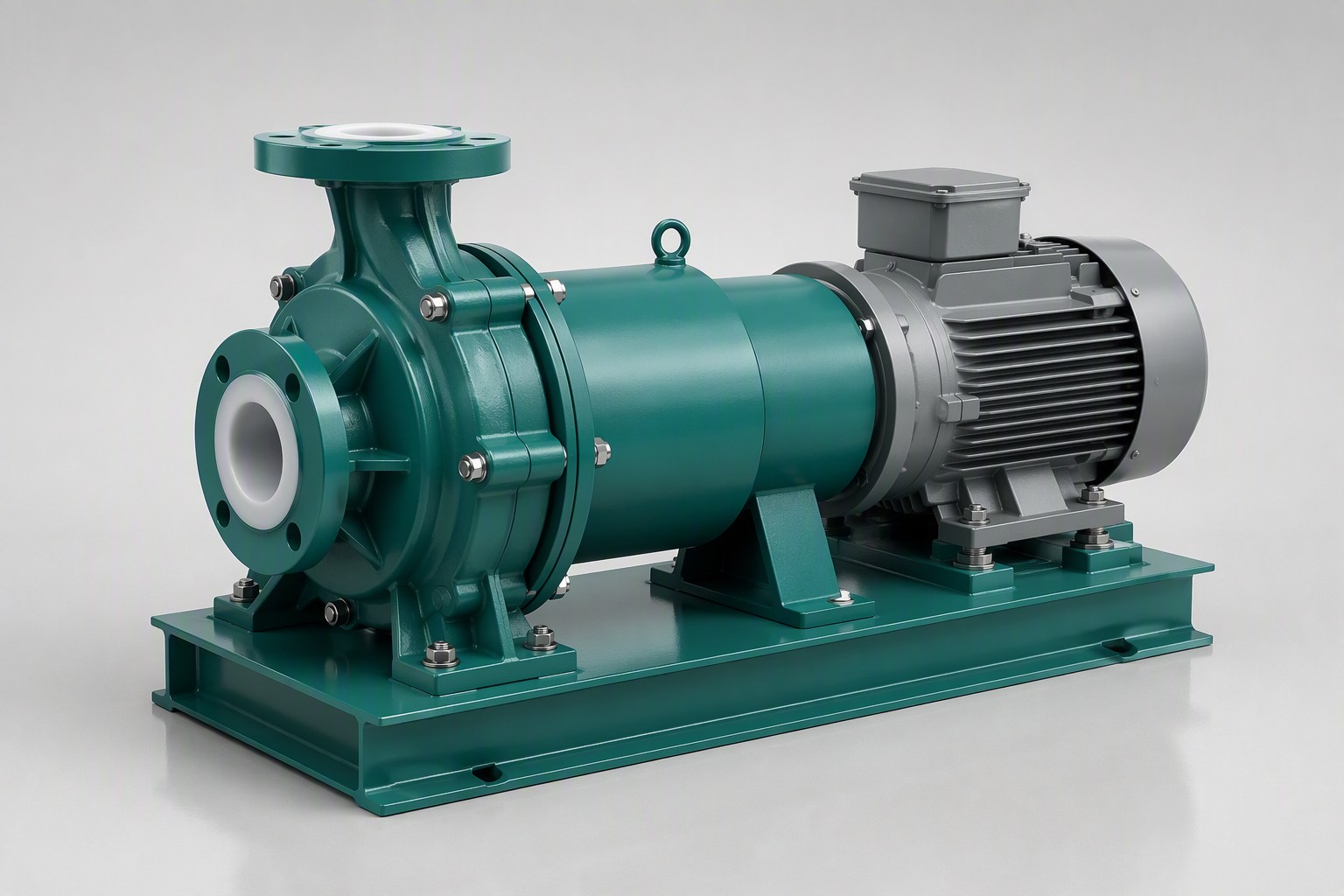
Frame the Duty Before You Choose the Pump
A chemical process pump is specified from the fluid, never from a generic best-pump label. Three fluid facts drive almost every downstream decision — the chemical identity, its concentration and its operating temperature — because corrosion behaviour changes sharply with each. A dilute acid that stainless steel handles easily can attack the same alloy quickly when concentrated, and corrosion rates climb with temperature. Write down the full duty before contacting any supplier:
- Chemical name, concentration and impurities — the basis for every wetted-material decision.
- Normal and maximum temperature — including startup, shutdown, cleaning and any heat tracing.
- Flow, discharge head and suction conditions — normal, minimum and maximum values for sizing.
- Viscosity, solids, vapour pressure and shear sensitivity — these decide the pump type, not just the materials.
- Hazard and leakage class — toxic, flammable or valuable media tighten the sealing requirements.
Centrifugal or Positive Displacement?
Once the fluid is understood, the first technology decision is between a centrifugal pump and a positive displacement (PD) pump. For clean, low- to medium-viscosity process liquids needing continuous, non-pulsating flow, the centrifugal pump is normally the economical first choice: simple construction, smooth flow and easy control by throttling or variable speed. The published rule of thumb for the range is to switch to a gear or screw pump once viscosity rises above roughly 150 cSt, where centrifugal efficiency falls away.
- Viscous chemicals and pastes: a PD pump keeps flow stable regardless of pressure; Qingdao Green Power's G-type single screw pump, published at 0.1–150 m³/h and 0.6–2.4 MPa, handles high-viscosity and abrasive media.
- Hot viscous hydrocarbons: the 3GB triple screw pump, published at 2.4–241.7 m³/h for low-viscosity oils at high temperature (up to 350°C), suits fuel-oil style duties.
- Slurries, sludge and crystallising media: an open-impeller centrifugal or a screw pump tolerates solids better than a closed-impeller design.
- Metering and shear-sensitive fluids: PD machines give repeatable volumetric delivery where centrifugals cannot.
Match Wetted Materials to the Chemical
For corrosive liquids that stay within centrifugal territory, the core decision is wetted material: an all-metal pump or a fluoroplastic-lined pump. Qingdao Green Power publishes two complementary families: IH in stainless steel and IHF with a fluoroplastic lining. Neither is universally corrosion-proof — compatibility always depends on the exact concentration and temperature.
IH Stainless vs IHF Fluoroplastic-Lined Chemical Pump
| Characteristic | IH series (stainless) | IHF series (fluoroplastic-lined) |
|---|---|---|
| Wetted materials | SS304 / SS316L | PTFE / FEP / PFA lining |
| Typical media | Mild chemicals, dilute acids and alkalis, salt solutions | Strong acids such as sulfuric, hydrochloric, hydrofluoric and nitric acid, strong alkalis, oxidising agents |
| Max liquid temperature | 80°C | 100°C |
| Best role | General chemical and process transfer at moderate cost | Aggressive media that attack stainless steel |
The two families share a published series envelope of 3.5–400 m³/h flow and 4.5–125 m head across -20°C to 100°C, with single or double mechanical seals. Remember that the lining protects the casing — the impeller, shaft sleeve and seal faces must also be compatible with the chemical, and elastomer grades must survive both the medium and the temperature.
Build a Seal and Containment Strategy
The shaft seal is the most common leak point on any chemical process pump, and in chemical plants a leak is not just a maintenance nuisance — it can be a safety and environmental event. A single mechanical seal is standard for routine duties. A double mechanical seal with a barrier fluid is used where leakage must be contained, the medium is hazardous, or the suction has little margin. For leakage-critical service, seal-less magnetic-drive configurations remove the dynamic seal entirely by driving the impeller through a containment shell. Whichever arrangement is chosen, verify the seal-face and elastomer grades against the chemical and temperature rather than assuming the standard fitment will survive.
Apply the Same Logic Across the Plant
The selection logic in a chemical plant is consistent even when the fluids are very different: define the fluid, then choose pump type, materials and sealing. The same method appears in the guides to boiler feed pump selection for hot, high-pressure water; heavy oil transfer pump and asphalt and bitumen pump selection for viscous hydrocarbons; LPG transfer pumps for volatile liquefied gases; and food-grade pump selection where hygiene governs materials. Where the process needs vacuum for filtration, drying or distillation, the liquid ring vacuum pump selection guide covers that adjacent duty, with the vacuum pump range tolerating wet and condensable process vapours.
Confirm the Duty Before Procurement
No catalogue supersedes a compatibility check against the actual chemical. Provide the exact medium, concentration, temperature, viscosity, flow and head, and confirm the wetted materials, elastomers and seal arrangement with the manufacturer. Qingdao Green Power's engineers select from the current IH and IHF ranges — or a screw pump where viscosity and solids demand one — on the basis of the operating conditions you supply. Confirm current model availability and specifications before procurement, and validate the duty point against the selected model's performance curve.
Frequently Asked Questions
What is the first thing to define when selecting a pump for chemical process service?
The chemical itself — its identity, concentration and temperature — because these determine corrosion severity and therefore the wetted materials, seal type and pump family. Viscosity, solids content, vapour pressure and hazard class then decide whether a centrifugal or positive displacement pump is appropriate, and flow and head size the model against the performance curve.
When should a positive displacement pump replace a centrifugal pump in a chemical plant?
When the liquid becomes viscous — generally above roughly 150 cSt — or is abrasive, shear-sensitive or needs metering, a PD pump keeps flow stable where a centrifugal loses efficiency. Qingdao Green Power's G-type single screw pump is published at 0.1–150 m³/h and 0.6–2.4 MPa for high-viscosity and abrasive media; confirm the duty and model with Qingdao Green Power.
How do I choose between IH stainless steel and IHF fluoroplastic-lined chemical pumps?
Choose IH (SS304/SS316L) for mild chemicals, dilute acids, weak alkalis and salt solutions up to 80°C. Choose IHF (PTFE/FEP/PFA-lined) for strong mineral acids such as sulfuric, hydrochloric, hydrofluoric and nitric acid, strong alkalis and oxidising agents up to 100°C. Always confirm the exact concentration and temperature against the compatibility data before specifying.
What published range do the IH and IHF chemical pump series cover?
The IH and IHF series share a published envelope of 3.5–400 m³/h flow and 4.5–125 m head across -20°C to 100°C, with single or double mechanical seals. Confirm current model availability, materials and specifications with Qingdao Green Power before procurement.
Send the chemical name, concentration, temperature, viscosity, flow and discharge head — the engineering team will confirm the pump type, wetted materials and seal arrangement for your duty.
Related Products
- Centrifugal Pump
- Screw Pump
- Vacuum Pump
Related Articles
Boiler Feed Pump Selection
Hot high-pressure water
Heavy Oil Transfer Pumps
Viscous hydrocarbon duties
LPG Transfer Pumps
Volatile liquefied gas