
LPG Transfer Pump for Liquefied Petroleum Gas
LPG transfer pump selection and system design: how liquefied petroleum gas is moved as a pressurised liquid, why NPSH and vapour pressure dominate the duty, and the sealing, safety and vacuum-support practices that keep transfer safe.
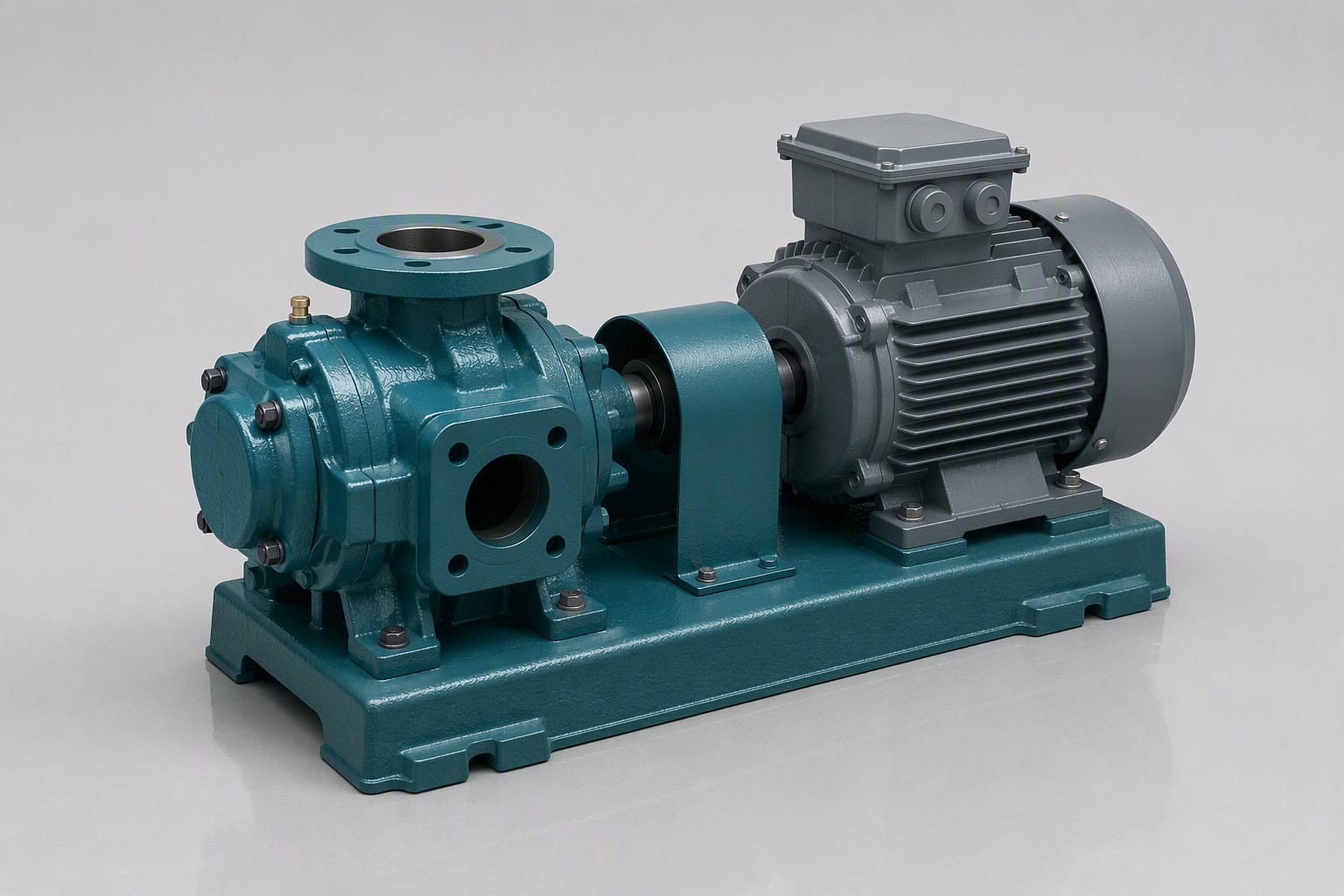
An LPG transfer pump moves liquefied petroleum gas — mainly propane and butane — in liquid form while keeping it below its boiling point. Because LPG is stored at or near its own vapour pressure, every transfer system is designed around net positive suction head (NPSH) so the volatile liquid never flashes, cavitates or leaks to atmosphere.
What Makes LPG Transfer Different
LPG is stored as a boiling liquid under pressure or refrigeration: at atmospheric pressure, commercial propane boils near −42 °C and butane near −0.5 °C, while commercial propane at 20 °C develops roughly 8 bar absolute. Any suction-side pressure drop, temperature rise or vapour pocket can flash part of the load into gas, so the pump must always see solid liquid, the suction piping must keep pressure above vapour pressure, and the plant must handle the vapour released when lines are filled, drained, purged or disconnected.
Vapour Pressure, NPSH and Cavitation
The governing number is net positive suction head: the system provides NPSHa from liquid level, tank pressure and piping, while the pump demands NPSHr to fill its inlet without vapour. Because LPG sits at its boiling point the margin is small — if NPSHa falls below NPSHr, vapour bubbles form and collapse in the impeller, eroding the metal and cutting capacity.
Standard cures are flooded suction from below the minimum liquid level, a short large-bore suction line with few fittings, no high points for gas, a vertical-can or submerged pump when the tank bottom is low, and subcooling by holding tank pressure above the vapour pressure — with margin at every flow rate, not only design flow.
Centrifugal or Positive Displacement for LPG?
Bulk transfer — unloading a road tanker or moving product between storage spheres — usually falls to a low-NPSH vertical-can or inducer centrifugal pump moving large flows at moderate pressure, while cylinder filling, car refuelling and dosing use a positive displacement gear or screw pump whose fixed volume per revolution gives repeatable delivery at higher pressure. Both need the same respect for suction conditions; neither should run on vapour.
Centrifugal vs Positive Displacement on LPG Service
| Characteristic | Centrifugal pump (low-NPSH type) | PD gear or screw pump |
|---|---|---|
| Flow vs pressure | Flow falls as discharge head rises | Near-constant flow at fixed speed |
| Suction requirement | Low-NPSH, vertical-can and inducer designs | Good suction needed; no vapour tolerance |
| Typical LPG role | Bulk tank-farm and tanker transfer | Cylinder filling, metering, high-pressure duty |
| Viscosity behaviour | Best on thin, light liquid | Handles colder butane-rich blends better |
The circuit also needs a vapour-return line so vapour displaced from the receiving tank can balance the system, plus a relief or thermal-expansion valve wherever cold liquid can be trapped between closed valves.
Sealing, Materials and Safety
LPG is a light hydrocarbon with a strong tendency to leak and flash, so the shaft seal is critical: single mechanical seals suit simple duties, while double or tandem arrangements with a proper flush plan control fugitive emissions. Elastomers must resist hydrocarbons and stay ductile at low temperature.
Area classification, gas detection, grounding and bonding are part of the system: the pump area is a classified zone and a leaking seal on a hot housing is an ignition source. Dry running and dead-heading must be prevented — a PD pump can overheat or burst its casing in seconds.
Vacuum Support for LPG Tanks and Piping
LPG plants use vacuum pumps for jobs the transfer pump cannot do: evacuating a vessel or line before maintenance, recovering vapour instead of flaring it, and drying piping after repair. The service is wet — hydrocarbon vapour, water and air — exactly what a liquid ring pump tolerates. Qingdao Green Power's 2BV liquid ring vacuum pump covers 0.45–8.33 m³/min with an ultimate vacuum of 0.097 MPa absolute, and its water ring handles condensable vapour that would destroy a dry mechanical pump.
Where completely oil-free, dry vacuum is wanted on clean gas, the claw pump is the alternative: Qingdao Green Power lists claw vacuum pumps from 100–1500 m³/h with an ultimate vacuum of 1 mbar absolute. Choose the liquid ring pump when liquid carryover or condensing vapour is possible, and the claw for clean, dry gas needing oil-free operation. See the vacuum pump product range for details.
Troubleshooting Common LPG Pump Problems
- Noise, vibration and falling flow: usually flashing or cavitation — check NPSH margin, tank pressure, strainer and suction valves.
- Loss of prime or vapour lock: vent the highest point of the suction run and restore flooded conditions.
- Seal leakage: verify the seal flush and chamber condition; use a double or tandem seal on persistent duties.
- Overheating or dead-heading: a closed discharge against a running PD pump overheats quickly — check the relief valve and interlock against closed block valves.
- Poor performance on cold, butane-rich product: viscosity rises with heavier blends — confirm the pump and driver suit winter composition or step up to a screw or gear pump.
Frequently Asked Questions
What type of pump is used for LPG transfer?
Bulk LPG transfer between storage tanks, tankers and loading gantries typically uses low-NPSH centrifugal pumps, often vertical can or inducer designs with flooded suction. Filling, metering and higher-pressure duties use positive displacement gear or screw pumps. In every case the pump must be kept fully primed with liquid and given a real NPSH margin.
Why does an LPG transfer pump cavitate or lose prime?
LPG is stored as a liquid at or near its vapour pressure, so any pressure drop in the suction line can make it flash to vapour. The bubbles collapse inside the impeller (cavitation), causing noise, vibration and flow loss, while vapour in the line makes the pump lose prime. Keep the suction flooded and short, and maintain a positive NPSH margin at every flow rate.
Do LPG transfer systems need a vacuum pump?
Yes — for evacuating tanks and piping before maintenance, for vapour recovery and for purging loading arms. A liquid ring vacuum pump such as Qingdao Green Power's 2BV range (0.45–8.33 m³/min, ultimate vacuum 0.097 MPa absolute) tolerates wet, condensable vapour, while the claw pump (100–1500 m³/h, ≤1 mbar absolute) gives dry, oil-free vacuum for clean gas service.
Are LPG transfer pumps available from Qingdao Green Power?
LPG transfer is treated on this site as a special-application and system-design topic. Confirm current model availability and specifications with Qingdao Green Power before procurement; its verified auxiliary ranges for vapour service are the 2BV liquid ring and claw vacuum pumps.
Send your LPG duty — composition, flow, discharge pressure and tank arrangement — and the engineering team will advise on pump type, NPSH margin and vacuum support.
Get a Quote
Send your fluid data and duty point. Engineers reply within 24 hours.
Contact Us →💬 WhatsApp NowRelated Products
- Industrial Screw Pump
- Centrifugal Pump
- Vacuum Pump
Related Articles
Chemical Process Pump Selection Guide
Sealing and materials guidance
Heavy Oil Transfer Pump Selection Guide
Tank-farm transfer practice
2BV Liquid Ring Vacuum Pump: Applications and Selection
Vapour-handling vacuum guide