
Asphalt Pump for Bitumen Transfer
Asphalt pump selection for bitumen transfer: why heated bitumen needs positive displacement pumps, how jacketed gear and screw pumps compare, plus seals, emulsions and common faults.
Heated bitumen is transferred with positive displacement pumps: jacketed external gear pumps are the classic asphalt transfer pump, and metal triple-screw pumps suit lower-viscosity hot bitumen. Bitumen must be heated to a pumpable temperature, typically around 130–180°C, and every component from tank outlet to discharge flange must stay hot and insulated. Centrifugal pumps rarely fit: bitumen viscosity is too high for efficient impeller operation.
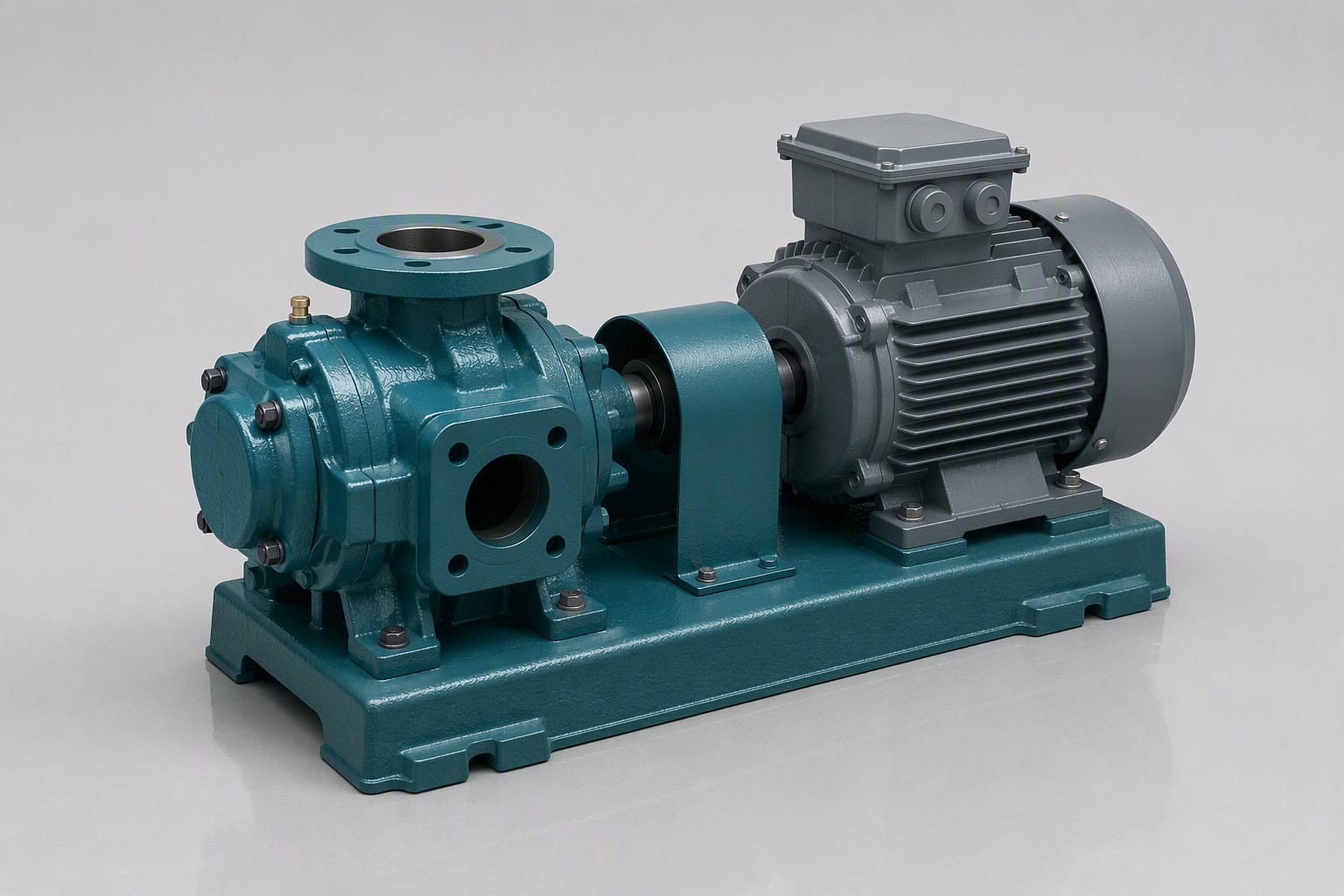
Why Bitumen Transfer Needs a Positive Displacement Pump
Bitumen is a viscoelastic semi-solid whose viscosity, even when heated, stays far above the range where a centrifugal pump works efficiently. Positive displacement (PD) pumps deliver a fixed volume per revolution, producing flow against high pipe friction without the efficiency loss an impeller suffers. External gear pumps are the traditional choice for heavy oil and bitumen transfer duties: close-tolerance gears give strong suction and steady flow, and the casing can be jacketed to hold temperature.
Bitumen transfer covers tanker and rail-car unloading, storage-tank movement, asphalt plant feed, road-tanker loading and drum decanting, and each task sets a different balance of flow, pressure, temperature and running pattern.
Heating Comes First: Temperature and Viscosity
Viscosity is the controlling variable and changes steeply with temperature. Storage and transfer temperatures are normally held near 130–180°C so the product flows readily without degrading.
- Heat the suction, not just the pump — a cold line or tank outlet starves the pump even with a jacketed casing.
- Keep the whole path hot — traced, insulated piping from tank to discharge prevents solidification during short stops.
- Never mix water with hot bitumen — trapped water flashes violently to steam; drain and steam-out before any work.
Jacketing is normally supplied with steam or thermal oil and must extend over the pump head and relief-valve area, where bitumen cools and sets first.
Pump Options for Bitumen and Asphalt Transfer
Transfer Pump Options at a Glance
| Option | Typical duty | Notes |
|---|---|---|
| External gear pump | Hot bitumen, tanker unloading | Classic jacketed PD choice; steady flow, moderate pressure |
| Triple screw pump (3GB) | Lower-viscosity hot bitumen | QGP 3GB range: 2.4–241.7 m³/h, low-viscosity oils to 350°C |
| Single screw pump (G) | High-viscosity media, cooler service | QGP G range: 0.1–150 m³/h, 0.6–2.4 MPa; elastomer stator limits temperature |
| Centrifugal pump | Rare on bitumen | Only for exceptionally thin bitumen; sealing and heating difficult |
Qingdao Green Power publishes the G-type single screw pump (0.1–150 m³/h, 0.6–2.4 MPa) for high-viscosity media and the 3GB triple screw pump (2.4–241.7 m³/h) for low-viscosity oils up to 350°C. Because the G-type uses an elastomeric stator, it is listed for bitumen service only where the product temperature stays within the stator limit; hot molten bitumen normally requires an all-metal rotating element. Confirm the grade, temperature and current availability in the industrial screw pump range before procurement.
Seals, Materials and the Jacketed System
A mechanical seal on hot bitumen needs a compatible flush or barrier plan — a dry or blocked seal chamber quickly fills with cooled asphalt — and packed glands suit heavy, dirty or polymer-modified grades that tolerate a controlled weep and re-tightening. Polymer-modified bitumen carries abrasive carbon black and elastomer particles that wear soft faces and open up gear clearances over time. Fit a relief valve, keep strainers clean, and never dead-head the pump while the product is cooling.
Where tank vapour recovery or vacuum priming is used, a liquid-ring vacuum pump tolerates the wet hydrocarbon vapours that would damage a dry machine — the 2BV liquid ring vacuum pump selection guide covers that part of the system.
Emulsions, Cutbacks and Lower-Temperature Grades
Not all bitumen moves hot. Bitumen emulsion — bitumen dispersed in water — is handled near ambient temperature and is shear-sensitive: recirculating it through a centrifugal pump or an over-speeding PD pump can break the emulsion, so gentle positive displacement transfer with adequate line sizes is the safe approach. Cutback bitumen is fluxed with solvents to pump cold or warm; the solvent lowers viscosity but raises vapour pressure, so seals and suction must account for flash risk and elastomer swelling. State clearly whether the duty is molten bitumen, emulsion or cutback — the three behave like different fluids and need different pumps.
Asphalt Pump Selection Checklist
- Product form — molten, polymer-modified, emulsion or cutback; each changes the pump family.
- Temperature and viscosity at the pump — include the cold-start worst case.
- Heating medium — steam or thermal oil for jacketing pump, head and suction piping.
- Seal plan — flush, barrier or packing matched to temperature and product cleanliness.
- Safety — relief valve, steam-out connections, water exclusion and vapour handling.
- Duty pattern — continuous plant feed or intermittent tanker unloading sets the drive sizing.
Frequently Asked Questions
What pump is best for transferring hot bitumen or asphalt?
Heated bitumen is normally moved with positive displacement pumps: external gear pumps are the classic jacketed asphalt transfer pump, and metal triple-screw pumps suit lower-viscosity hot bitumen on continuous duties. Centrifugal pumps are used only where the bitumen is hot enough to be thin and the duty is continuous. Confirm the model with the manufacturer against your viscosity at pumping temperature.
At what temperature should bitumen be pumped?
Bitumen must be heated before pumping — typical handling temperatures are around 130–180°C, at which viscosity drops to a pumpable level. The exact target depends on the grade and the pump type. Keep the entire suction line, pump and discharge piping heated and insulated, and never introduce water into hot bitumen, which causes violent steam foaming.
Can Qingdao Green Power screw pumps handle bitumen?
The Qingdao Green Power G-type single screw pump (0.1–150 m³/h, 0.6–2.4 MPa) is listed for high-viscosity media including bitumen where temperature stays within the elastomer stator limit. The 3GB triple screw pump (2.4–241.7 m³/h) suits low-viscosity oils at high temperature up to 350°C. Confirm the bitumen grade, temperature and current model availability with Qingdao Green Power.
Why does my bitumen pump keep losing suction?
Inadequate heating is the most common cause: if bitumen in the suction line cools below its pour point, flow stops. Pump speed that is too high for the viscosity, a clogged strainer, or air entering through seals and fittings also causes cavitation-like behaviour. Heat and insulate the suction, keep strainers clean, and operate within the pump's net positive suction head limit.
Send the bitumen grade, product form, pumping temperature, flow and discharge pressure — the engineering team will confirm the pump type, jacketing and seal arrangement for your asphalt duty.
Get a Quote
Send your fluid data and duty point. Engineers reply within 24 hours.
Contact Us →💬 WhatsApp NowRelated Products
- Industrial Screw Pump
- 2BV Vacuum Pump
Related Articles
Heavy Oil Transfer Pump
Viscous fuel and oil duties
Chemical Process Pumps
Systematic pump selection
LPG Transfer Pump
Hydrocarbon handling topics