
How to Select a Hygienic Process Pump
How to select a hygienic process pump: profile the product and duty, match positive displacement or centrifugal technology, then verify stainless materials, hygienic seals, connections and cleaning-in-place capability.
A hygienic process pump is a sanitary machine for food, beverage and pharmaceutical lines: smooth, crevice-free wetted parts in food-grade stainless steel, hygienic seals, and a design that drains and cleans in place. Selection starts from the product — viscosity, shear sensitivity, temperature — because a lobe pump suits viscous cream or chocolate, a single screw pump handles thick pastes, and a centrifugal pump suits thin liquids such as milk and juice.
What Makes a Pump Hygienic?
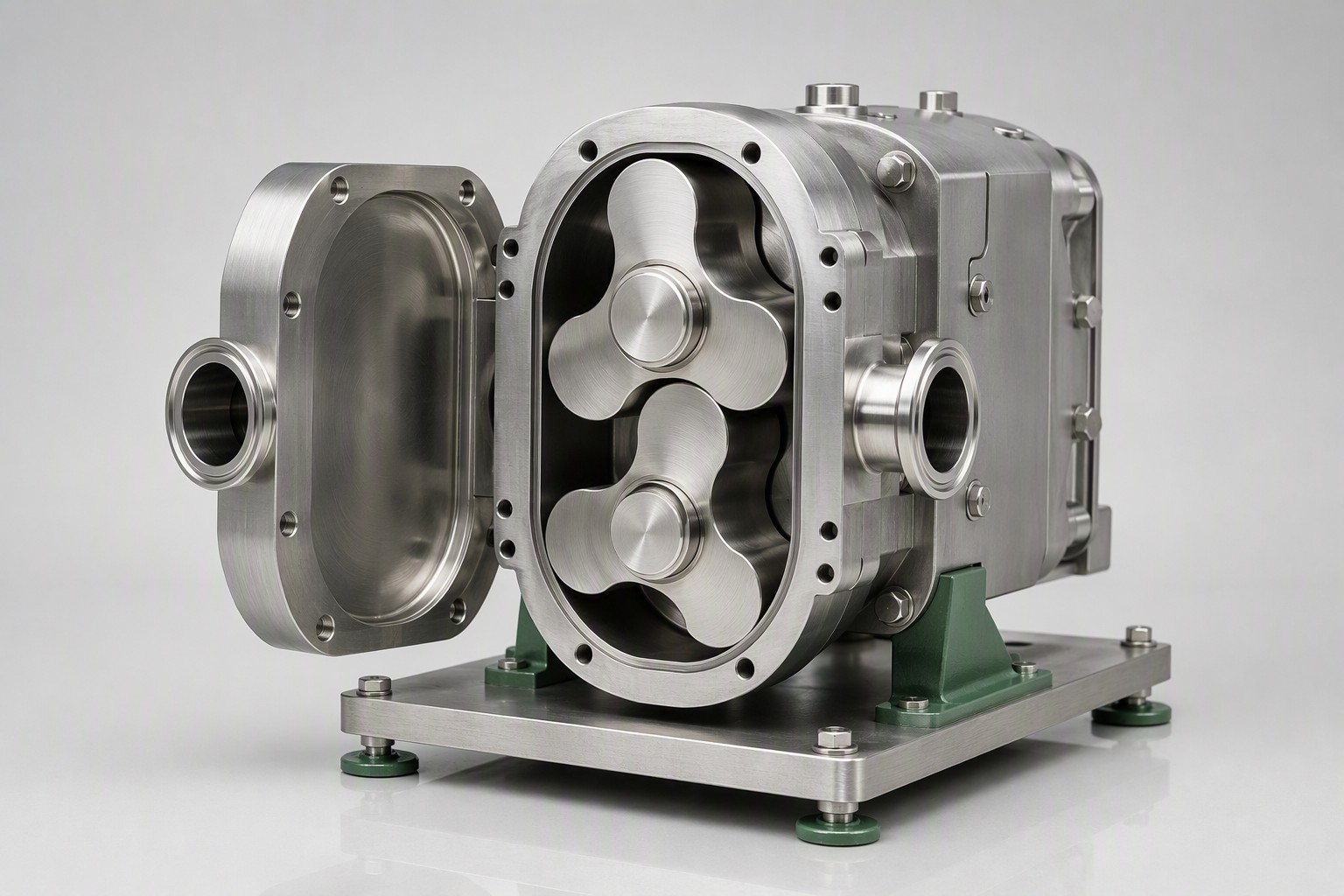
Hygiene is engineered into the pump, not added afterwards. A hygienic process pump has smooth, crevice-free wetted surfaces, a casing that drains completely, and connections, seals and elastomers that tolerate the product and the cleaning chemicals used between batches.
For the wider class comparison, see our food grade pump selection guide; here we work through four steps.
Step 1: Profile the Product and the Duty
Start by profiling the product: viscosity at pumping temperature, shear sensitivity, solids, temperature, and the required flow and discharge pressure. Shear-sensitive foods such as cream and mayonnaise degrade in tight clearances, while honey and chocolate need slow transfer through large cavities. Thin liquids behave differently, so no single pump class does everything.
Step 2: Match the Pump Class to the Product
Positive displacement pumps suit viscous, delicate or solids-bearing products; hygienic centrifugal pumps suit thin liquids.
Hygienic Pump Class vs Product
| Technology | Typical hygienic duty | QGP reference |
|---|---|---|
| Hygienic centrifugal (IS/ISW type) | Thin liquids: water, milk, juices, CIP rinse — continuous non-pulsating flow | 1.5–1600 m³/h, temperature ≤80°C; above ~150 cSt switch to a screw or lobe design |
| Rotary lobe pump | Viscous, shear-sensitive foods: cream, chocolate, syrups, sauces, pastes | Confirm current model availability and specifications with Qingdao Green Power |
| G single screw (progressive cavity) | Thick pastes and fillings with gentle low-shear flow | 0.1–150 m³/h; 0.6–2.4 MPa |
Rotary Lobe Pumps: Gentle Handling for Hygienic Products
The rotary lobe pump is the classic hygienic PD machine: two synchronised tri-lobe rotors rotate in opposite directions without touching each other or the casing, so liquid is carried in large, low-shear cavities and discharged with low pulsation — gentle on shear-sensitive emulsions and capable of soft solids. See the rotary lobe pump food processing guide for the technology, applied to syrup and sauce, cream and dairy and chocolate duties.
Lobe pumps add self-priming within their vacuum limit, reversible flow for line flushing, and easy inspection via front-loading seals. Compare them with the high-viscosity food pump options for very thick products.
Single Screw Pumps for Thick, Shear-Sensitive Pastes
When a hygienic product is thick enough to behave like a paste — meat emulsions, doughs, fruit fillings — a G-type single screw (progressive cavity) pump is a strong candidate. A helical rotor turns inside an elastomeric stator, and sealed cavities travel steadily from suction to discharge for smooth, low-shear flow. Qingdao Green Power publishes the G-type at 0.1–150 m³/h and 0.6–2.4 MPa; the food-grade stator elastomer must suit the product and cleaning chemicals, and the pump must never run dry because the stator is destroyed within seconds. See the industrial screw pump page for the series specification.
Hygienic Centrifugal Pumps for Thin Liquids
For water-like products the centrifugal pump stays the economical workhorse. Qingdao Green Power's IS/ISW-type centrifugal pump range, published at 1.5–1600 m³/h with temperatures up to 80°C, delivers continuous non-pulsating flow for milk, juice and rinse water — with guidance to move to a screw or lobe design above about 150 cSt. Confirm the polished stainless, sanitary-seal and hygienic-connection options with the manufacturer.
Step 3: Check Materials, Seals and Connections
- Wetted materials: stainless steel — commonly 316L-grade — with polished surfaces for food, beverage and pharmaceutical contact.
- Elastomers: gaskets, O-rings and stators must suit the product chemistry and the CIP chemicals, not just the temperature.
- Seals: hygienic single or flushed mechanical seals keep product in and cleaning media out.
- Connections: DIN 11851, SMS, Tri-Clamp or other hygienic fittings must match the plant's coupling standard.
Step 4: Design for Cleaning in Place
Most hygienic lines are cleaned in place, so the pump must be CIP-capable: fully drainable, reachable by cleaning solution, with seals and elastomers rated for the cleaning temperature and chemicals. PD hygienic pumps can be run slowly or reversed during CIP to flush the circuit, and casings must avoid standing rinse pockets. Confirm the CIP cycle and limits with the supplier before ordering.
Vacuum-Assisted Hygienic Processes
Some hygienic processes need vacuum as well as pumping: deaeration of viscous products before filling, vacuum transfer and vacuum packaging. Liquid ring pumps suit these wet duties: the rotating liquid ring tolerates condensable vapours and moisture. Qingdao Green Power's 2BV liquid ring vacuum pump is published at 0.45–8.33 m³/min with an ultimate vacuum of 0.097 MPa absolute.
Frequently Asked Questions
What is a hygienic process pump?
A hygienic process pump is a sanitary pump designed for food, beverage and pharmaceutical lines: wetted parts are smooth, crevice-free and drainable so product cannot lodge and bacteria cannot hide, with food-grade stainless materials and seals and usually full cleaning-in-place (CIP) capability. Rotary lobe, single screw (progressive cavity) and centrifugal designs are the common hygienic classes.
Rotary lobe or centrifugal pump — which suits a hygienic process?
Choose by product. Rotary lobe pumps are positive displacement machines with non-contacting rotors, so they move viscous, shear-sensitive foods such as cream, chocolate, syrups and pastes gently with low pulsation and can be cleaned in place. Centrifugal pumps are economical for thin low-viscosity liquids such as milk and juice; Qingdao Green Power's IS/ISW-type guidance is to switch to a screw or lobe design above about 150 cSt.
Which materials are used in hygienic process pumps?
Hygienic pumps typically use stainless steel wetted parts — commonly 316L-grade — with polished surfaces, together with elastomers and seals selected for food or pharmaceutical contact and for the cleaning chemicals used on the line. Confirm the exact material grades, elastomer compatibility and any required certificates with Qingdao Green Power for your application.
Can hygienic process pumps handle cleaning in place (CIP)?
Yes, when the design is made for it: smooth internal surfaces, a fully drainable casing, hygienic connections, and seals and elastomers rated for the cleaning temperature and chemicals allow the pump to be cleaned without dismantling. Positive displacement hygienic pumps can often be run slowly or reversed during CIP to flush the circuit; confirm the cycle temperature and chemistry with Qingdao Green Power.
Describe your product — viscosity, shear sensitivity, flow and cleaning regime — and engineers will recommend the hygienic pump class for your line.
Get a Quote
Send your fluid data and duty point. Engineers reply within 24 hours.
Contact Us →💬 WhatsApp NowRelated Products
- Industrial Screw Pump (G / 3GB)
- Centrifugal Pump
Related Articles
Food Grade Pump Selection
Sanitary selection checklist
Lobe Pumps in Food Processing
Gentle hygienic transfer
Cream and Dairy Pumping
Shear-sensitive product handling