
Pump Selection for Cosmetic Manufacturing
How to choose a pump for cosmetic manufacturing: low-shear transfer of lotions, creams, gels and shampoos in a hygienic 316L stainless build with CIP cleanability and no product hold-up.
A cosmetic manufacturing pump must move shear-sensitive emulsions and viscous gels without breaking their structure, and it must be cleanable to a hygienic standard. Rotary lobe and single-screw positive-displacement pumps transfer creams, lotions, gels and shampoos gently at controlled speed, while stainless wetted parts with smooth, fully drainable, dead-zone-free surfaces support cleaning-in-place (CIP) between batches.
Why Cosmetics Are a Difficult Pumping Duty
Cosmetic formulations are engineered products: their texture, stability and shelf appearance are part of the specification. A cream or lotion is an oil-in-water (or water-in-oil) emulsion whose quality depends on a fine, uniform droplet size. Shampoos and shower gels rely on surfactant networks for their viscosity. Toothpaste, masks and thick serums contain abrasive solids such as silica or micro-beads. A pump that shears, aerates or overheats these products during transfer can visibly degrade them before they reach the filling line.
- Emulsions and gels — creams, lotions and hair gels separate or thin out when the dispersed phase is crushed or rubbed.
- Wide viscosity range — a plant moves water-like toners and serums as well as pastes above 100,000 cP, often on the same skid.
- Hygiene and changeover — batch manufacturing means frequent product switches, so cleaning speed and full drainability matter as much as flow.
Core Requirements: Low Shear, Cleanability, No Dead Zones
Four engineering requirements dominate pump selection in cosmetic manufacturing: gentle product handling, corrosion-resistant hygienic materials, complete drainability, and compatibility with cleaning-in-place circuits.
Low shear protects the formulation
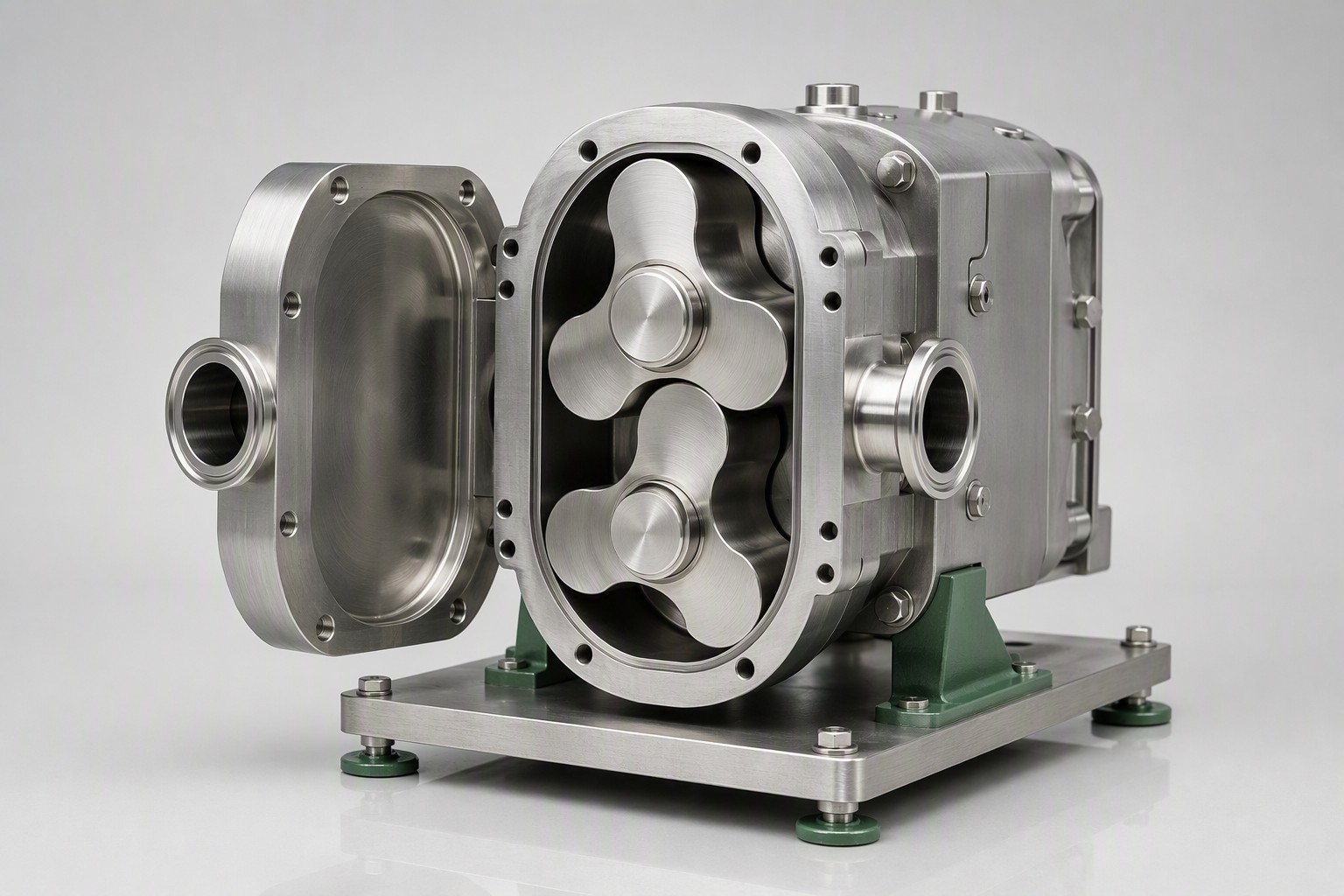
Shear-sensitive media are best served by positive-displacement pumps with large, open internal cavities. Rotary lobe pumps move the product between synchronised rotors that never touch each other or the casing, so emulsions and gels travel in large pockets instead of being worked between tight clearances. Flow is proportional to speed, which lets the line run slow for filling and dosing. Single-screw (progressive cavity) pumps give the same gentle, pulseless movement for thicker pastes.
Hygienic materials and surface finish
Wetted parts are typically machined in 316L stainless steel with smooth, crevice-free surfaces, polished welds and hygienic clamp connections so product and cleaning solution contact only inert, easily inspected metal. Elastomers and seals must be compatible with both the formulation and the cleaning chemicals — no product-zone lubrication is used in a true hygienic design.
No dead zones and CIP compatibility
Stagnant pockets trap product, breed microbes and slow down changeovers. A cosmetic pump should be self-draining, with no recesses where lotion can sit between batches. Because most rotary lobe pumps are bidirectional, reversing the rotation lets a CIP circuit flush the suction line as well as the pump chamber. For the cleanest duties the pump can be lifted out, but in-place cleaning is the norm in modern plants.
Matching the Pump Technology to the Formulation
No single pump covers every cosmetic product, so selection starts by classifying the formulation and its handling risk. The table below summarises the common approach.
Cosmetic Formulations and Typical Pump Approach
| Formulation | Handling risk | Pump approach |
|---|---|---|
| Lotions, body milks | Emulsion shear | Low-shear rotary lobe pump at controlled speed |
| Shampoos, shower gels | Aeration and viscosity | Rotary lobe pump; low-speed transfer avoids foaming |
| Toothpaste, thick masks | High viscosity, abrasives | Single-screw pump; confirm solids against stator size |
| Toners, water-like liquids | Low viscosity | Stainless centrifugal pump, or lobe pump for dosing |
| Scrubs with beads | Soft particulates | Lobe pump with generous cavities and low speed |
For low-viscosity liquids such as toners, rinse water and CIP supply, Qingdao Green Power's stainless centrifugal pump ranges cover flows from 1.5 to 1600 m³/h with heads from 2 to 125 m at temperatures up to 80°C. For viscous, shear-sensitive pastes and scrubs, the G-type single screw pump is rated for flows of 0.1–150 m³/h at pressures of 0.6–2.4 MPa. Where the gentle, hygienic rotary lobe technology is preferred for an emulsion duty, confirm current model availability and specifications with Qingdao Green Power before procurement.
Pump Selection Checks for a Cosmetic Line
Once the pump family is chosen, the duty point decides the size. Start with the structured food-grade pump selection method, which weighs product type, viscosity, temperature, flow, solids and cleaning needs together.
- Flow and speed control — positive-displacement flow rises with speed; variable-speed drives give gentle start-up, accurate filling and low-speed recirculation.
- Viscosity at cold start — creams and gels are more viscous at low temperature; confirm the worst-case condition before sizing the motor.
- Suction conditions — keep the suction line short and flooded where possible; self-priming lobe pumps lift product within their vacuum limit when tanks sit below the pump.
- Seal and elastomer choice — match the seal and O-ring material to the formulation, preservatives and CIP chemicals.
- Cleaning cycle — design for CIP flow, temperature and chemical compatibility; verify that seals survive hot caustic or sanitising washes.
Cross-check the duty against related experience before finalising: high-viscosity food pump guidance covers thick pastes and temperature-sensitive media, while rotary lobe pumps in food processing explain how hygienic positive displacement behaves on real production lines. For adjacent household and personal-care transfers — syrups, sauces and other shear-sensitive semi-liquids — the syrup and sauce transfer article is a useful reference.
Frequently Asked Questions
Why is low shear critical when pumping cosmetics?
Creams, lotions, gels and shampoos are emulsions or structured liquids whose texture depends on a fine, uniform internal structure. High shear breaks the droplets or polymer network, causing separation, thinning or a runny, unacceptable texture. Low-shear positive-displacement pumps move the product in large cavities at controlled speed, preserving the formulation.
Which pump types are used in cosmetic manufacturing?
Rotary lobe pumps are the reference for emulsions, creams, gels and shear-sensitive products because their non-contacting rotors transfer gently with low pulsation. Single-screw (progressive cavity) pumps suit thicker pastes and abrasive scrubs, while stainless centrifugal pumps handle water-like liquids such as toners, rinse water and CIP supply.
Can cosmetic transfer pumps be cleaned in place (CIP)?
Yes. Pumps for cosmetic duty are built with 316L stainless wetted parts and smooth, crevice-free, fully drainable surfaces, and reversing the rotor direction on a lobe pump helps flush the suction line. Confirm the cleaning temperature, chemicals and cycle time against the seal and elastomer materials with Qingdao Green Power.
Which Qingdao Green Power pumps handle cosmetic products?
For water-like and low-viscosity liquids Qingdao Green Power offers stainless centrifugal pump ranges (1.5–1600 m³/h, heads of 2–125 m, up to 80°C), and the G-type single screw pump covers viscous pastes at 0.1–150 m³/h and 0.6–2.4 MPa. For hygienic rotary lobe-style duties, confirm current model availability and specifications with Qingdao Green Power before procurement.
Tell us your formulation, viscosity, temperature, flow and CIP requirements — the engineering team will recommend the pump technology and hygienic configuration that fits your cosmetic line.
Get a Quote
Send your product data and duty point. Engineers reply within 24 hours.
Contact Us →💬 WhatsApp NowRelated Products
- Centrifugal Pump
- Screw Pump
Related Articles
Food-Grade Pump Selection
Selection framework
Lobe Pumps in Food Processing
Low-shear hygienic transfer
Cream and Dairy Pumps
Emulsion-safe pumping