
How to Choose a Food Grade Pump
How to choose a food grade pump: start from the product's viscosity and shear sensitivity, fix the flow and pressure duty, then verify hygienic stainless materials, seals and cleanability before you buy.
Choosing a food grade pump starts with the product, not the catalogue. First characterise the food — its viscosity at pumping temperature, its shear sensitivity and any solids it carries — then fix the flow and pressure duty. Only after that do you compare hygienic pump technologies on materials, seals and cleanability, because a machine that is ideal for thin juice is the wrong choice for honey.
Start with the Product: Viscosity, Shear and Solids
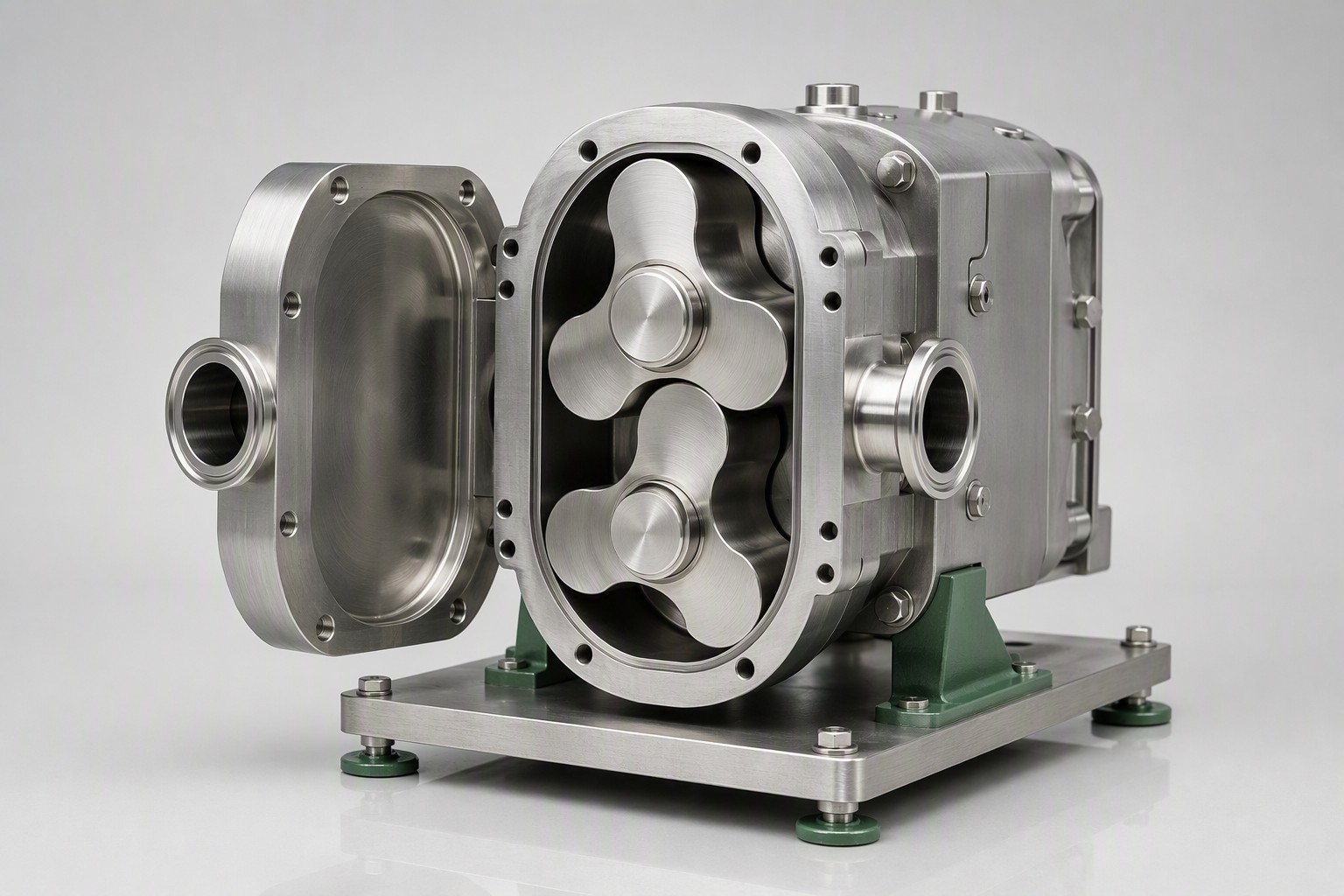
Every food product has its own handling personality, and the pump must respect it. Thin, water-like liquids such as milk, juice and rinse water behave one way, while viscous products such as honey, condensed milk, syrup and chocolate behave very differently. Shear-sensitive foods — cream, mayonnaise, yogurt, dressings — degrade when they are beaten, rubbed or forced through tight clearances, so the pump has to move them in large, gentle cavities rather than work them under pressure. Products that contain fruit pieces, pulp or other particulate need a pump whose flow passages are large enough to let those pieces through intact.
Write these three facts down before anything else: the viscosity range of the product, its shear sensitivity, and its solids content.
Turn the Duty into Numbers
The next step converts the recipe and the production schedule into a real duty point. Required flow comes from the batch size and the target transfer time — or from filler speed on a continuous line — normally expressed in cubic metres per hour. Required discharge pressure comes from static lift plus the resistance of pipework, fittings, filters, heat exchangers and the filling nozzle, not from a pump nameplate. Record the product temperature as well, because viscosity falls as temperature rises and most foods are pumped warm or hot.
Also note the suction condition — self-priming, gravity-flooded, or lifting product up a dry line. Flow, pressure, temperature, viscosity and suction data together form an enquiry that any pump engineer can quote against.
Match the Pump Technology to the Product
With the product profile and duty point defined, the field narrows to a few proven technologies. The table shows how the main families line up on food duty.
Food Pump Technologies Compared
| Technology | Best suited to | Main watch-out |
|---|---|---|
| Rotary lobe pump (PD) | Shear-sensitive, viscous and particulate foods; hygienic low-pulsation duty | Confirm current model availability and specifications with Qingdao Green Power |
| Progressive cavity / screw pump (PD) | Heavy pastes, dough-like products and food slurries | Never run dry — the elastomer stator is destroyed |
| Centrifugal pump | Thin low-viscosity liquids and CIP rinse water at large flow | Efficiency and life drop above roughly 150 cSt |
Within each family the exact machine is chosen from verified data. Qingdao Green Power's screw pumps — the G-type progressive cavity line is published at 0.1–150 m³/h and 0.6–2.4 MPa — handle viscous pastes and slurries that would stall an impeller. Its centrifugal pumps are published at 1.5–1600 m³/h, 2–125 m head and up to 80 °C, economical wherever the product stays below about 150 cSt. Where gentleness decides — cream, yogurt, fruit pulp — a rotary lobe pump for food processing is the reference, because its rotors never touch each other or the casing.
Verify Hygiene: Materials, Seals and Cleanability
Hygiene is the reason you are buying a food grade pump at all, so check the wetted end as carefully as the performance curve. Work through these points with the supplier before ordering:
- Food-contact materials — smooth, crevice-free stainless steel (304 or 316L) wetted parts, with 316L preferred where acidic products or chlorinated cleaners are used.
- Elastomers — O-rings, stators and seal faces must resist both the food and the cleaning chemicals (caustic, acid, peracetic), at cleaning temperature, not just product temperature.
- Mechanical seals — a hygienic single seal with a compatible flush suits most food duties; confirm the arrangement for your product with the manufacturer.
- Drainability and connections — the casing should drain fully, avoid dead pockets, and use hygienic clamped connections so nothing stagnates between batches.
- Cleaning-in-place — a CIP-compatible pump lets the cleaning circuit flush casing and line together; for steam sterilisation, confirm every material is rated for the SIP temperature.
A Practical Food-Grade Pump Selection Checklist
Work through these six steps to produce a specification suppliers can price without endless clarifications:
- 1. Name the product — including recipe extremes, not only the average batch, because viscosity swings change the pump requirement.
- 2. Measure viscosity — at the minimum and maximum pumping temperature, and note whether the product is thixotropic or shear-thinning.
- 3. Set the maximum flow — from batch size and transfer time, and note whether dosing accuracy or gentle filling limits the speed.
- 4. Calculate discharge pressure — from the worst-case line: static head, filters, heat exchanger and nozzle together.
- 5. Choose the technology — using the comparison above, then confirm solids passage and the shear limit against your product.
- 6. Confirm the cleaning duty — CIP/SIP or strip-down — and send the complete duty sheet for quotation.
For thick, sticky products such as honey, jam and dessert sauces, the dedicated syrup and sauce transfer pump guidance adds product-specific advice on heating, suction and flow control.
Frequently Asked Questions
What is a food grade pump?
A food grade pump keeps every product-contact surface food-safe — stainless steel with compatible elastomers and smooth, crevice-free finishes — and cleanable. It must neither contaminate nor degrade the food during transfer, so viscosity, shear sensitivity and the cleaning method drive the choice of technology.
Which pump type is gentlest on shear-sensitive food products?
Rotary lobe pumps. Their synchronised rotors never touch each other or the casing, so emulsions, yogurt, sauces and fruit pulp move in large rounded cavities instead of being crushed or smeared, with smooth low-pulsation flow. Confirm current lobe pump model availability and specifications with Qingdao Green Power before procurement.
Can a centrifugal pump be used for food products?
Yes, within limits. Centrifugal pumps suit thin, low-viscosity liquids such as milk, juice and CIP rinse water, and are economical at large flow. Qingdao Green Power's range is published at 1.5–1600 m³/h, 2–125 m head and up to 80 °C; above roughly 150 cSt a positive displacement pump fits better.
What data does Qingdao Green Power need to recommend a food grade pump?
Product composition, viscosity at minimum and maximum temperature, shear sensitivity, solids content and size, required flow, discharge pressure, operating temperature and the cleaning method. Send these through the contact page and the engineering team will propose a hygienic pump configuration for the duty.
Describe your food product — viscosity, shear sensitivity, flow, pressure and cleaning method — and the engineering team will recommend the food grade pump technology and configuration that fits your line.
Get a Quote
Send your product data and duty point. Engineers reply within 24 hours.
Contact Us →💬 WhatsApp NowRelated Products
- Industrial Screw Pump
- Centrifugal Pump
Related Articles
Rotary Lobe Pump for Food Processing
Low-shear hygienic transfer
Pump for Syrup and Sauce Transfer
Viscous food duties
Sanitary Pump vs Industrial Pump
Cleanability comparison