
Rotary Lobe Pump for Food Processing: Low-Shear Hygienic Guide
How to select a rotary lobe pump for food processing: gentle low-shear transfer of cream, yogurt, syrup, sauces, chocolate and fruit pulp in a hygienic, CIP-cleanable stainless build.
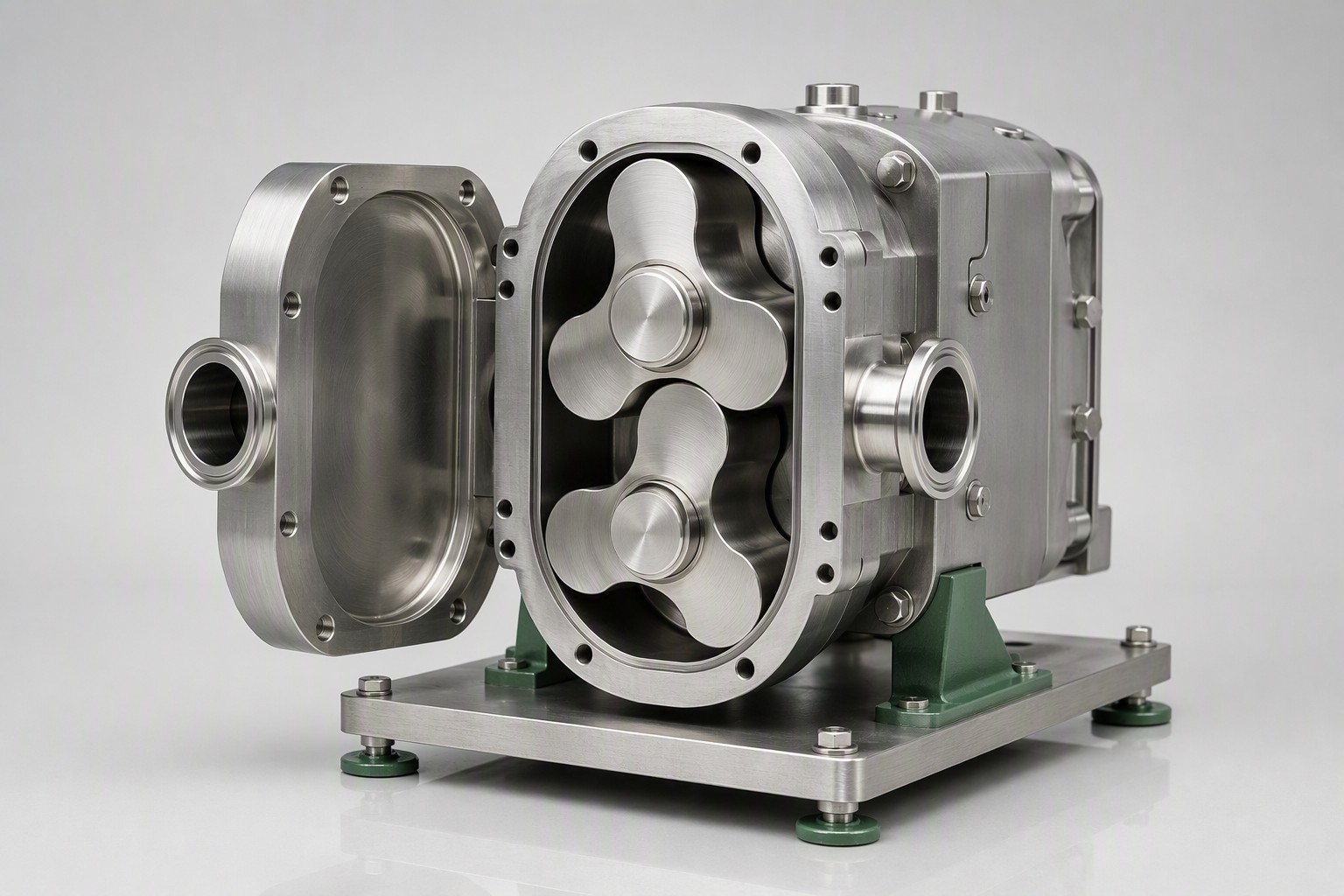
A rotary lobe pump suits food processing because two synchronised tri-lobe rotors transfer the product without metal-to-metal contact, giving low-shear, low-pulsation positive displacement that preserves shear-sensitive foods. Hygienic stainless wetted parts, self-priming behaviour and cleaning-in-place (CIP) capability make this pump family a reference technology for cream, yogurt, syrup, sauces, chocolate and fruit pulp.
Why Food Processing Favours the Lobe Pump
Cream and yogurt are emulsions that aggressive pumping can break; syrups, honey and chocolate are viscous; sauces and fruit pulp carry soft solids. A rotary lobe pump handles all of these with a simple idea: two synchronised tri-lobe rotors revolve in opposite directions inside a close-fitting casing, trapping a fixed volume of product between the lobes and the casing and carrying it from suction to discharge. Because the rotors never touch each other or the casing wall, the product is neither crushed nor rubbed — shear stays low and flavour, texture and colour remain intact. The working principle of a 3RP lobe pump explains these phases in more detail.
Hygiene and Cleanability Come With the Design
Food-grade pump selection is decided as much by cleaning as by pumping. A hygienic rotary lobe pump uses stainless wetted parts and smooth internal surfaces without crevices where product can lodge, so it can be cleaned in place (CIP) along with the rest of the line. Two details make CIP practical:
- Bidirectional flow — reversing the rotation flushes the suction line and pushes cleaning solution through dead ends.
- Non-contacting rotors — no intermeshing parts trap fibres, so cleaning solution reaches every wetted surface.
Food-grade elastomers such as EPDM suit the widest range of cleaning chemistries, and the seal must tolerate both the product and hot caustic or acid solutions. Confirm the CIP temperature, flow and chemical compatibility of the specific configuration with Qingdao Green Power.
What a Rotary Lobe Pump Handles Well
The lobe pump earns its place wherever product gentleness or hygiene is the deciding factor. Typical food duties include cream and dairy desserts, yogurt, fresh cheese, syrup, honey, molasses, sauces, chocolate, fruit pulp, pie fillings and preserves — products viscous enough to benefit from positive displacement and valuable enough that damaged texture means rejected batches. The pump also self-primes within its vacuum limit and gives smooth, low-pulsation flow that does not hammer delicate piping.
Lobe Pump vs Other Food Pump Technologies
Rotary Lobe vs Gear vs Screw Pump for Food Duty
| Characteristic | Rotary lobe pump | External gear pump | Screw pump |
|---|---|---|---|
| Rotor contact | Non-contacting (timing gears) | Meshing gear teeth | Screws or rotor in stator |
| Shear on product | Low — gentle | Higher shear | Low to moderate |
| Solids tolerance | Soft solids up to rotor clearance | Poor | Poor to moderate |
| CIP suitability | Excellent, bidirectional flush | Moderate | Moderate |
| Typical food duty | Cream, yogurt, sauces, pulp, chocolate | Clean oils and syrups | Very viscous pastes |
Gear pumps are compact and economical for clean, lubricating liquids, but their meshing teeth shear soft foods. A screw pump suits the heaviest pastes, yet the single-screw version's elastomeric stator needs care with dry running and CIP cycling. The lobe pump wins the middle ground: gentle enough for emulsions, open enough for soft solids, and simple to clean. For clean oils rather than shear-sensitive foods, a gear pump is usually the more economical machine; for very thick products, compare the industrial screw pump range.
Selection Checks for a Hygienic Lobe Pump Duty
- Flow and speed: flow rises with rotor speed — size for normal, minimum and maximum flow and keep speed low enough to avoid shear heating.
- Viscosity and temperature: record viscosity at pumping temperature and cold start-up; the cold condition often sets drive power and relief setting.
- Pressure: confirm maximum discharge pressure and set the relief valve below the pump's safe limit.
- Product and cleaning chemistry: match wetted stainless and food-grade elastomers to both the product and the CIP chemicals.
- Seal type: hygienic single mechanical seals suit most food duties; specify for product and cleaning cycle, and check any dry-running risk.
- Suction conditions: check NPSH and suction lift against the self-priming vacuum limit, and keep suction lines short.
Where industrial and sanitary lines run side by side, comparing sanitary vs industrial pump designs shows where the specification boundaries sit, and the food-grade pump selection guide applies the same structured duty data.
Confirm the Model With Qingdao Green Power
Rotary lobe pumps in the 3RP family are treated on this site as a technical-reference topic rather than a published catalogue range. Confirm current model availability and specifications with Qingdao Green Power before procurement, and send the duty checklist — product, viscosity, temperature, flow, pressure and CIP regime — so the recommended configuration matches the food safety and cleaning requirements of your line.
Frequently Asked Questions
Why are rotary lobe pumps used in food processing?
Because they transfer shear-sensitive products gently. Two synchronised tri-lobe rotors move the product without metal-to-metal contact, so emulsions such as cream and yogurt, plus syrups, sauces and fruit pulp, keep their structure instead of being crushed or whipped, and flow stays smooth and low-pulsation.
Can a rotary lobe pump be cleaned in place (CIP)?
Yes. A hygienic rotary lobe pump can be built with stainless wetted parts and smooth internal surfaces that suit cleaning-in-place circuits, and reversing the rotor direction helps flush the line. Confirm the cleaning temperature, flow rate and chemical compatibility of the specific configuration with Qingdao Green Power.
What food products are typically transferred with a lobe pump?
Viscous and shear-sensitive foods such as cream, yogurt, syrups, honey, sauces, chocolate, fruit pulp and pie fillings, plus hygienic and cosmetic products where preserving product integrity matters.
Are 3RP lobe pumps a current Qingdao Green Power core product?
3RP lobe pumps are treated on this site as a technical-reference topic. Confirm current model availability and specifications with Qingdao Green Power before procurement.
Describe your product, viscosity, flow, pressure and CIP regime — the engineering team will confirm whether a rotary lobe pump fits and how it should be configured for hygienic service.
Get a Quote
Send your fluid data and duty point. Engineers reply within 24 hours.
Contact Us →💬 WhatsApp NowRelated Products
- Industrial Screw Pump
- Centrifugal Pump
Related Articles
3RP Lobe Pump Working Principle
How the pump operates
Food-Grade Pump Selection
Selection framework
Cream and Dairy Pump
Dairy duty guidance