
How Does a 3RP Lobe Pump Work?
Rotary lobe pump working principle explained: how two synchronised tri-lobe rotors create positive displacement, why lobe pumps handle viscous and shear-sensitive fluids gently, and how they compare with gear and screw pumps.
A rotary lobe pump moves liquid with two synchronised tri-lobe rotors that rotate in opposite directions inside a close-fitting casing. The lobes do not touch each other or the casing wall. Liquid trapped in the spaces between the lobes and the casing is carried from the suction port to the discharge port, which gives smooth, low-pulsation positive displacement that is gentle on shear-sensitive media.
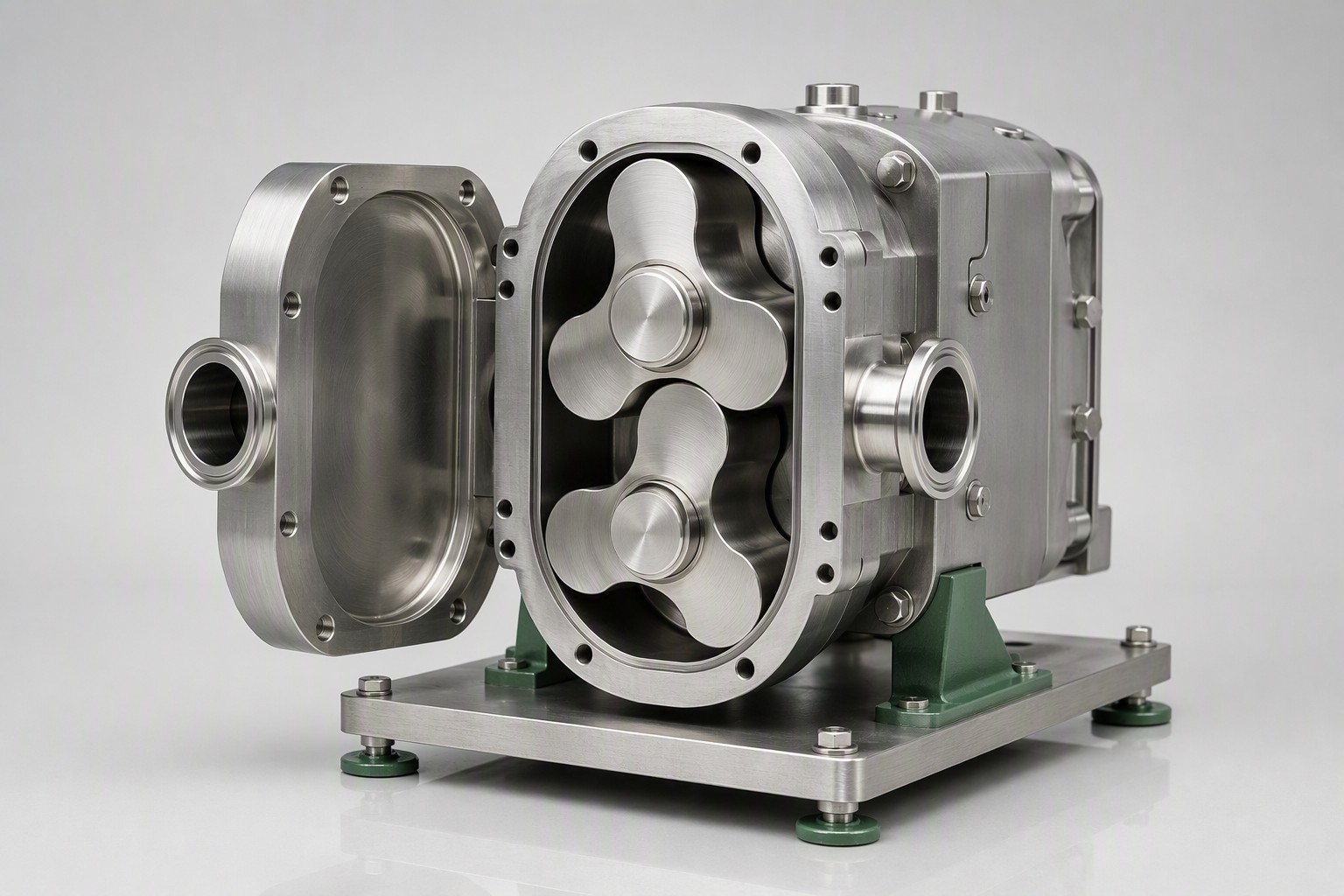
The Working Principle in Three Steps
Rotary lobe pumps belong to the positive displacement (PD) family: for each shaft revolution a fixed volume of liquid is displaced, so flow is largely proportional to speed and is less dependent on discharge pressure than a centrifugal pump.
1. Suction phase
As the lobes rotate away from each other on the inlet side, the cavity volume increases and liquid is drawn into the space between the rotor lobes and the casing.
2. Transfer phase
Each lobe carries its trapped volume around the casing towards the discharge side. Because the rotors are synchronised by timing gears and never make metal-to-metal contact, the liquid is not crushed or rubbed between moving parts.
3. Discharge phase
When the lobe tips pass the discharge port, the trapped volume is forced out against the system pressure. The result is a continuous, low-pulsation flow that can handle liquids from thin fluids to pastes above 1,000,000 cP, depending on configuration.
Why the Rotor Design Matters
The tri-lobe rotor shape (three rounded lobes per rotor) is a deliberate design choice. More lobes per rotor give smaller displacement per revolution but smoother, lower-pulsation flow; two-lobe and bi-wing rotors are alternatives when larger solids passage is required. Key characteristics of the lobe design:
- Non-contacting rotors — no metal-on-metal wear inside the pumping chamber, extending service life on clean duties.
- Gentle handling — low shear makes lobe pumps a first choice for food, dairy, cosmetic and polymer products where product integrity matters.
- Self-priming — the PD action pulls liquid up a dry suction line without external priming assist, within the pump's vacuum limit.
- Bidirectional operation — reversing the rotation reverses the flow direction, which is useful for line flushing and cleaning-in-place (CIP) circuits.
How a Lobe Pump Compares with Gear and Screw Pumps
Lobe vs Gear vs Screw Pump at a Glance
| Characteristic | Rotary lobe pump | External gear pump | Screw pump |
|---|---|---|---|
| Rotor contact | Non-contacting (timing gears) | Meshing gear teeth | Screws mesh tightly |
| Shear sensitivity | Low shear — gentle | Higher shear | Low-moderate shear |
| Solids tolerance | Moderate | Poor | Poor-moderate |
| Dry-run tolerance | Short periods (seal permitting) | Poor | Poor |
| Typical duty | Food, chemical, viscous, hygienic | Clean oils and fuels | Viscous and multiphase fluids |
For clean lubricating oils at higher pressures an external gear pump is often more compact; for very high viscosity and large capacities an industrial screw pump is a proven alternative. The lobe pump earns its place where product gentleness, hygiene or CIP is the deciding factor.
Key Selection Checks for a Lobe Pump Duty
- Flow and speed: PD flow rises with speed — select the rotor size and gear ratio for the required average and peak flow.
- Viscosity and temperature: higher viscosity increases slip losses at low speed and raises shaft power; confirm the cold-start condition.
- Pressure: confirm the maximum discharge pressure and relief-valve setting to protect the pump and line.
- Seal type: mechanical seals suit hygienic and chemical duties; packed glands suit some heavy-viscosity services.
- Materials: wetted parts must match the medium — stainless steel for food and corrosive media, cast iron or coated materials for industrial oils.
Frequently Asked Questions
What is the main difference between a lobe pump and a gear pump?
A lobe pump uses two synchronised, non-contacting tri-lobe rotors, so the rotors do not rub against each other and the pump handles shear-sensitive and slightly solids-laden fluids more gently. A gear pump uses meshing gear teeth for positive displacement, which suits clean lubricating liquids and higher pressures but is more sensitive to solids and shear.
Can a lobe pump run dry?
Many lobe pumps can tolerate short dry-running periods because the rotors do not touch each other or the casing, but the mechanical seals still need liquid lubrication. Continuous dry running will damage the seal and is not recommended.
Are 3RP lobe pumps a current Qingdao Green Power core product?
3RP lobe pumps are treated on this site as a technical-reference topic. Confirm current model availability and specifications with Qingdao Green Power before procurement.
What fluids are lobe pumps best suited for?
High-viscosity, shear-sensitive and food-grade media such as syrups, chocolate, cream, polymers, resins and hygienic products, where gentle low-pulsation transfer protects product quality.
Describe your liquid — viscosity, temperature, flow and pressure — and the engineering team will recommend the pump technology and configuration that fits your duty.
Get a Quote
Send your fluid data and duty point. Engineers reply within 24 hours.
Contact Us →💬 WhatsApp NowRelated Products
- Industrial Screw Pump
- Centrifugal Pump
Related Articles
What Is a 3RP Rotary Lobe Pump?
Technology overview
Lobe Pump vs Gear Pump
Head-to-head comparison
PD vs Centrifugal Pump
Which technology fits?