
What Is a 3RP Rotary Lobe Pump?
What a rotary lobe pump is and how it works: two synchronised tri-lobe rotors create low-pulsation, low-shear positive displacement for viscous, hygienic and shear-sensitive fluids, with self-priming behaviour and CIP-friendly construction.
A rotary lobe pump is a positive displacement pump that moves liquid with two synchronised tri-lobe rotors rotating in opposite directions inside a close-fitting casing. The lobes never touch each other or the casing wall, so each revolution traps a fixed volume of liquid and carries it from suction to discharge — giving low-shear, low-pulsation flow over a wide viscosity range, plus self-priming behaviour and easy reversing for line flushing and CIP.
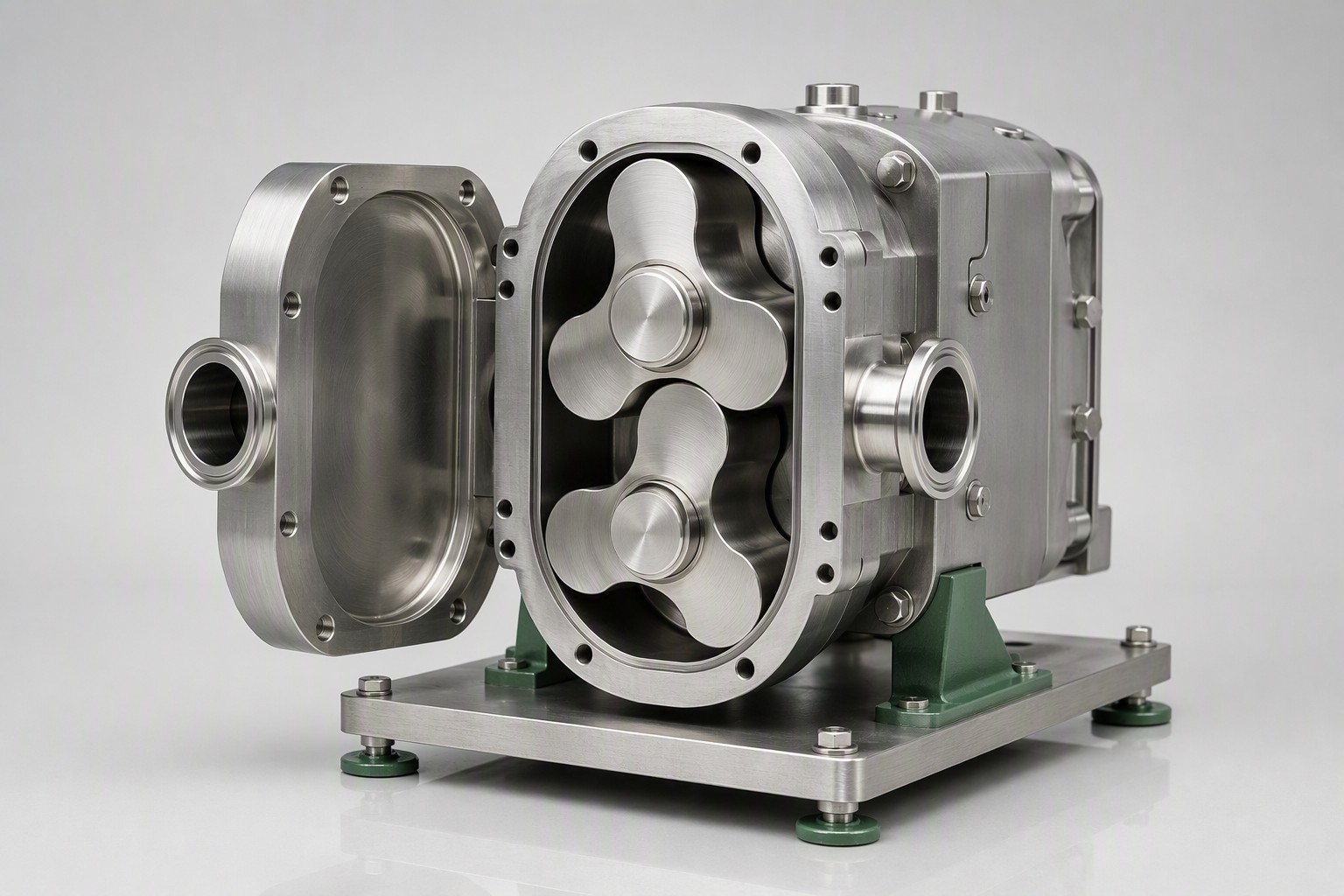
What Makes a Rotary Lobe Pump a Positive Displacement Machine
A rotary lobe pump belongs to the positive displacement (PD) family. Unlike a centrifugal pump, which relies on impeller speed and system resistance, a PD pump displaces a fixed volume of liquid for every shaft revolution. The practical consequences matter for selection:
- Flow follows speed — double the rotor speed and the delivered flow roughly doubles, which makes lobe pumps easy to meter with a variable-speed drive.
- Pressure follows the system — the pump keeps pushing until discharge pressure matches the line demand, bounded by the relief valve and driver power.
- Self-priming — the pumping action creates suction and lifts liquid up a dry line within the pump's vacuum limit, without external priming assist.
Construction of a Rotary Lobe Pump
Rotary lobe pumps are compact machines with relatively few wearing parts. The main components are the casing, two tri-lobe rotors, timing gears, shaft seals and the suction and discharge ports.
- Tri-lobe rotors — three rounded lobes per rotor. More lobes give smoother, lower-pulsation flow per revolution; two-lobe and bi-wing rotors are alternatives when larger solids passage is needed.
- Timing gears — keep the rotors synchronised in the gearbox so the lobes rotate without metal-to-metal contact inside the pumping chamber.
- Shaft seals — mechanical seals for hygienic and chemical duties, or packed glands for some heavy-viscosity services, depending on the configuration.
- Materials — stainless steel for food, hygienic and corrosive media; cast iron or coated materials for industrial oils and similar duties.
How a Rotary Lobe Pump Works
Operation happens in three repeating phases: on the suction side the lobes rotate apart, the cavity volume grows and liquid is drawn in; each lobe then carries its trapped volume around the casing towards the discharge side; finally, as the lobe tips pass the discharge port, the trapped volume is pushed out against the line pressure in a continuous, low-pulsation stream. For a full step-by-step explanation of the mechanics, read the detailed 3RP lobe pump working principle article.
What Rotary Lobe Pumps Are Used For
Typical Rotary Lobe Pump Duties
| Application area | Typical media | Why a lobe pump fits |
|---|---|---|
| Food and dairy | Cream, yogurt, syrup, chocolate, fruit pulp | Low shear preserves emulsions and product structure |
| Chemical and polymer | Resins, adhesives, pigments, latex | Viscous transfer with no crushing between tight clearances |
| Cosmetic and hygienic | Lotions, creams, toothpaste, gels | Gentle handling plus hygienic stainless build and CIP |
| Wastewater and sludge | Sludges and slurries with moderate solids | Large rotor cavities pass soft solids with low clogging |
Benefits and Limitations of the Rotary Lobe Pump
Within its design envelope the lobe pump is one of the most versatile rotary positive displacement machines. It handles thin liquids and pastes alike, keeps shear-sensitive products intact, self-primes, reverses for line flushing, and tolerates short dry-running periods better than gear or screw pumps because the rotors never touch.
The trade-offs are equally important. Clearance-based designs slip at low speed and high pressure, which limits very high-pressure duties compared with a gear pump; capacity is moderate compared with large centrifugal or screw machines; and the rotors, seals and elastomers must be matched to the medium and temperature. Where pressures are modest and product integrity is the priority, the lobe pump is hard to beat.
How a Rotary Lobe Pump Compares with Other Pump Types
Within the rotary PD family the usual question is lobe versus gear. A gear pump's meshing teeth suit clean lubricating liquids and higher pressures, while the non-contacting lobe design wins on shear-sensitive, solids-laden and hygienic media — see the head-to-head lobe pump vs gear pump comparison. For very high viscosity and large capacities, an industrial screw pump is a proven alternative; for clean water and low-viscosity liquids at high flow, a centrifugal pump is usually the economical choice. Separate application guides cover lobe pumps in food processing, chemical transfer and high-viscosity duties.
3RP lobe pumps are treated on this site as a technical-reference topic — confirm current model availability and specifications with Qingdao Green Power before procurement.
Frequently Asked Questions
What is a rotary lobe pump?
A rotary lobe pump is a positive displacement pump with two synchronised tri-lobe rotors that rotate in opposite directions inside a close-fitting casing. The rotors never touch each other or the casing, so each revolution traps and moves a fixed volume of liquid from suction to discharge with low shear and low pulsation.
What fluids can a rotary lobe pump handle?
A wide viscosity range — from thin solvents and water-like liquids up to syrups, honey, pastes and other very viscous media within the pump's design limits — including shear-sensitive foods, chemicals, resins and slurries with moderate solids. Materials, seals and elastomers must be matched to the medium and temperature.
Can a rotary lobe pump self-prime or run dry?
The positive displacement action makes it self-priming within its vacuum limit, pulling liquid up a dry suction line without external priming. Because the rotors do not contact, brief dry running is tolerated better than in gear or screw pumps, but the mechanical seals still need liquid — continuous dry running will damage them.
Are 3RP lobe pumps a current Qingdao Green Power core product?
3RP lobe pumps are treated on this site as a technical-reference topic. Confirm current model availability and specifications with Qingdao Green Power before procurement.
Tell us your liquid, viscosity, flow and pressure — the engineering team will confirm whether a rotary lobe pump configuration fits your duty.
Get a Quote
Send your fluid data and duty point. Engineers reply within 24 hours.
Contact Us →💬 WhatsApp NowRelated Products
- Industrial Screw Pump
- Centrifugal Pump
Related Articles
How Does a 3RP Lobe Pump Work?
Working principle guide
Lobe Pump vs Gear Pump
Head-to-head comparison
Lobe Pumps in Food Processing
Low-shear hygienic guide