
Rotary Lobe Pump for Food Processing: Low-Shear Hygienic Transfer
How rotary lobe pumps handle food processing duties: gentle low-shear transfer of cream, yogurt, syrup, sauces, chocolate and fruit pulp, with hygienic stainless construction, self-priming and CIP cleanability.
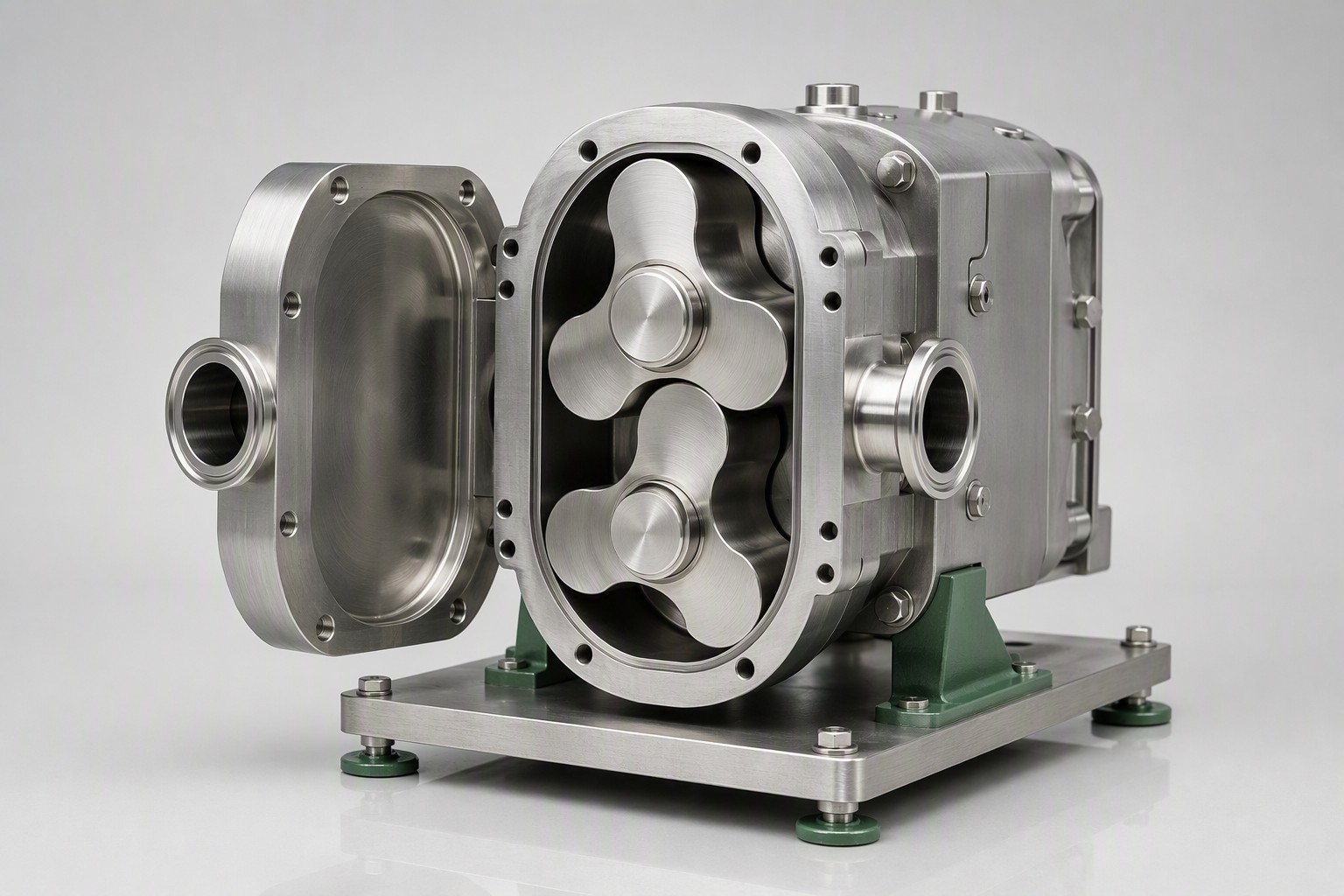
A rotary lobe pump suits food processing because two synchronised tri-lobe rotors transfer the product without metal-to-metal contact, giving low-shear, low-pulsation positive displacement that preserves shear-sensitive foods. Hygienic stainless construction, self-priming behaviour and cleaning-in-place (CIP) capability make this family a reference technology for cream, yogurt, syrup, sauces, chocolate and fruit pulp.
Why Food Processing Favours a Low-Shear Pump
Many food products are shear-sensitive. Cream and mayonnaise are emulsions that separate if beaten or rubbed too hard; yogurt loses its gel; fruit pulp loses its fibre; chocolate develops an off-texture. A pump that crushes, smears or agitates the product at high speed changes it before it reaches the filler. Rotary lobe pumps are positive-displacement machines whose rotors never touch each other or the casing wall, so the food travels in large rounded cavities instead of being worked between tight clearances.
- Emulsions and gels — cream, yogurt and dressings keep their droplet and gel structure.
- Fibrous and particulate foods — fruit pulp, compotes and fillings pass with limited damage.
- Viscous and heat-sensitive media — honey, syrup and chocolate move at controlled low speed without local overheating.
How the Tri-Lobe Rotor Transfers Food Gently
Each shaft revolution displaces a fixed volume, so flow is largely proportional to speed and can be turned down for gentle filling and dosing.
1. Suction phase
As the lobes rotate apart on the inlet side, the cavity volume grows and product is drawn into the space between the lobes and the casing.
2. Transfer phase
Timing gears keep the rotors synchronised so they never touch. Each lobe carries its trapped volume around the casing towards the discharge side without crushing or rubbing the food.
3. Discharge phase
As the lobe tips pass the discharge port, the trapped volume is pushed out against the line pressure in a continuous, low-pulsation stream that suits thin juices and viscous pastes alike within the pump's design range.
Hygiene by Design: Stainless Build and CIP
Food contact parts are typically machined in hygienic stainless steel (304 or 316L) with smooth, crevice-free surfaces that give bacteria nowhere to hide. Drainable casings and hygienic connections shorten cleaning time, and reversing the rotor direction lets a cleaning-in-place (CIP) circuit flush the suction line as well as the casing. For steam sterilisation (SIP) duties, confirm that the seal and elastomer materials are rated for the cleaning temperature and chemicals. When very high cleanability is required, review the dedicated hygienic process pump selection guidance before specifying.
Self-Priming and Low Pulsation Simplify the Line
The positive-displacement action makes the lobe pump self-priming within its vacuum limit, so it lifts product up a dry suction line and empties tanks and kettles without external priming assist. Low pulsation at the discharge protects fillers, valves and meters from pressure spikes and gives more consistent portioning — exactly what a sanitary positive displacement pump is expected to deliver on shear-sensitive products.
Food Duties at a Glance
Typical Lobe Pump Food Duties
| Product | Handling risk | Why a lobe pump fits |
|---|---|---|
| Cream, yogurt | Emulsion / gel shear | Non-contacting rotors preserve structure |
| Syrup, honey | High viscosity | Positive displacement with accurate low-speed dosing |
| Sauces, dressings | Emulsions and soft pieces | Low shear with moderate solids passage |
| Chocolate, fillings | Viscous, temperature-sensitive | Gentle movement, no local heating |
| Fruit pulp, compotes | Fibre and fruit pieces | Large cavities keep pieces intact |
Choosing the Right Food Transfer Pump
The lobe pump earns its place where product gentleness, hygiene or CIP cleanability decides the choice. A structured food-grade pump selection process weighs product type, viscosity, temperature, flow, solids and cleaning requirements together. For water-like liquids, CIP rinse water or clean low-viscosity transfers, a hygienic centrifugal pump is usually the more economical option.
3RP lobe pumps are treated on this site as a technical-reference topic — confirm current model availability and specifications with Qingdao Green Power before procurement.
Frequently Asked Questions
Why are rotary lobe pumps used in food processing?
Because they transfer shear-sensitive products gently. The synchronised tri-lobe rotors never touch each other or the casing, so emulsions such as cream and yogurt, plus fruit pulp and sauces, keep their structure instead of being crushed, whipped or heated by friction, while flow stays smooth and low-pulsation.
Can a 3RP lobe pump be cleaned in place (CIP)?
Yes. Rotary lobe pumps can be built with hygienic stainless wetted parts and smooth internal surfaces that suit cleaning-in-place circuits, and reversing the rotor direction helps flush the line. Confirm the cleaning temperature, flow and chemical compatibility of the specific configuration with Qingdao Green Power.
What food products are typically transferred with a lobe pump?
Shear-sensitive and viscous foods such as cream, yogurt, syrups, honey, sauces, chocolate, fruit pulp and pie fillings, as well as cosmetic and hygienic products where preserving product integrity matters.
Are 3RP lobe pumps a current Qingdao Green Power core product?
3RP lobe pumps are treated on this site as a technical-reference topic. Confirm current model availability and specifications with Qingdao Green Power before procurement.
Tell us your product, viscosity, temperature, flow and CIP requirements — the engineering team will recommend the right pump technology and hygienic configuration for your line.
Get a Quote
Send your product data and duty point. Engineers reply within 24 hours.
Contact Us →💬 WhatsApp NowRelated Products
- Centrifugal Pump
Related Articles
What Is a 3RP Rotary Lobe Pump?
Technology overview
3RP Lobe Pump Selection
Sizing and selection guide
Hygienic Process Pump Selection
Sanitary pump guidance