
3RP Lobe Pump for Chemical Applications: Low-Shear, Corrosion-Resistant Transfer
3RP lobe pump applications in chemical plants: low-shear, corrosion-resistant transfer of polymers, resins, pigments and dilute acids, with wetted-material, elastomer and seal selection guidance.
A rotary lobe pump is a positive-displacement machine whose two synchronised tri-lobe rotors transfer chemicals without metal-to-metal contact, making it a practical choice for viscous, shear-sensitive and slightly solids-laden media that defeat centrifugal pumps. Flow is proportional to rotor speed, giving steady, low-pulsation transfer that can be metered. Wetted materials, elastomers and seals must be matched to the chemistry, concentration and temperature, and model availability confirmed with Qingdao Green Power for the duty.
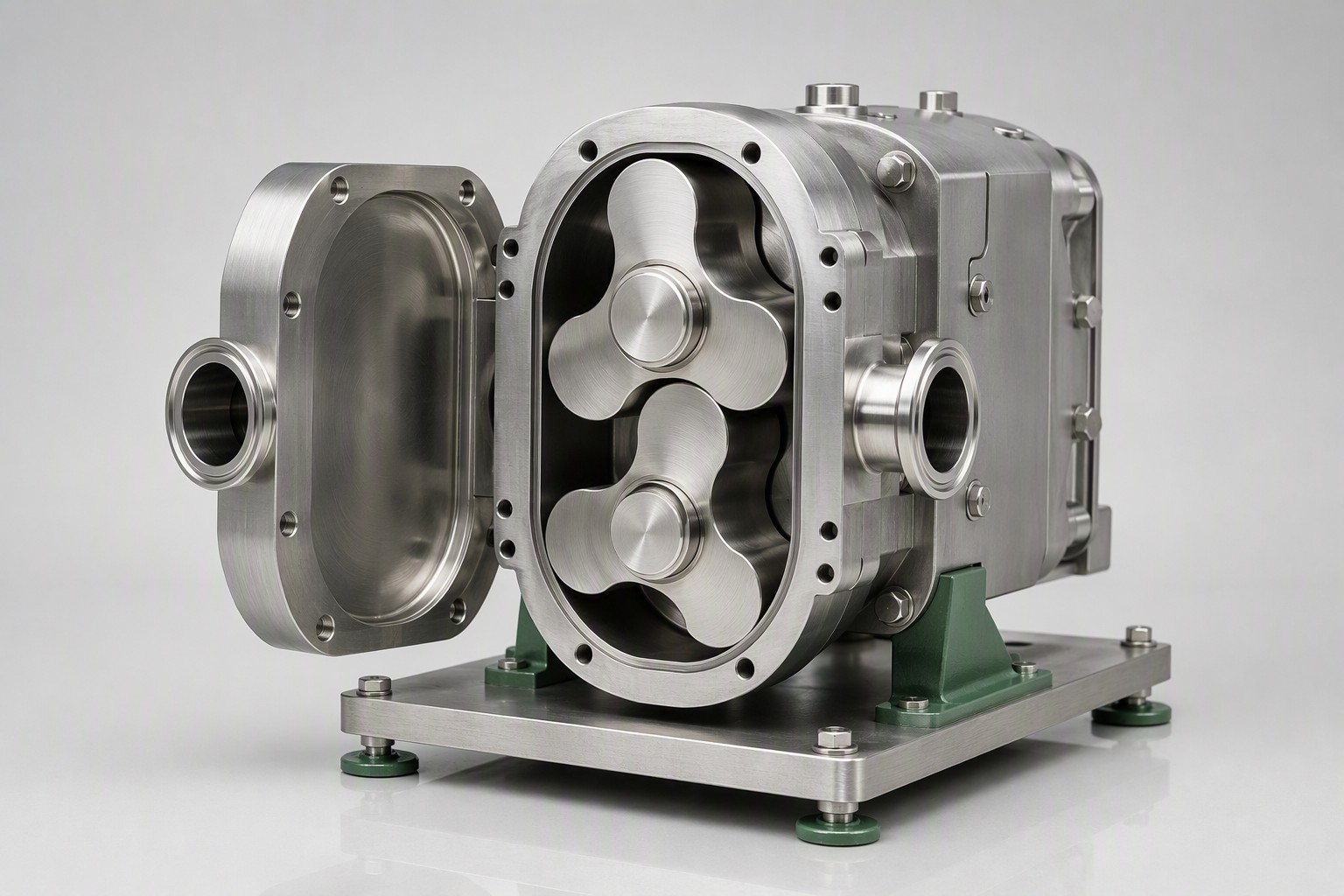
Why Chemical Transfer Favours a Positive-Displacement Pump
Many process chemicals are not water-like. Polymer solutions, resins and adhesives are viscous; emulsions and dispersions are shear-sensitive; some media carry soft solids or entrained gas. A centrifugal pump loses efficiency and head quickly as viscosity climbs. The rotary lobe pump belongs to the positive displacement family: as the 3RP lobe pump working principle explains, each shaft revolution displaces a fixed volume, so flow depends far less on discharge pressure and the pump keeps performing as the chemistry gets thicker.
- Viscous chemicals — resins and polymer solutions move at controlled speed without the steep performance loss of a centrifugal machine.
- Shear-sensitive products — emulsions, latexes and pigment dispersions keep their droplet and particle structure because the rotors never rub the product.
- Multiphase media — entrained gas, soft solids and fibres pass through the large rotor cavities within design limits.
Typical Chemical Duties for a Rotary Lobe Pump
- Polymers and resins — viscous, stringy media that need steady low-shear displacement.
- Adhesives and sealants — tacky products transferred and dosed without smearing or overheating.
- Pigments, inks and dyes — shear-sensitive dispersions where over-working changes colour strength.
- Surfactants, soaps and detergents — viscous pastes and slurries that are hard for a centrifugal pump to start.
- Dilute acids and alkalis — in a compatible stainless build, with every wetted part and elastomer verified against the specific concentration.
Chemical Duty at a Glance
| Duty | Handling risk | Why a lobe pump fits |
|---|---|---|
| Polymer solutions | Viscosity, stringing | Positive displacement at low rotor speed |
| Emulsions, latexes | Shear breaks droplets | Non-contacting rotors, low shear |
| Pigments, inks, dyes | Shear changes colour | Gentle, uniform transfer |
| Adhesives, sealants | Tacky, elastic | Steady displacement without local heating |
| Dilute acids, alkalis | Corrosion | Compatible stainless build and seals |
For heavy pastes and highly viscous masses, apply the additional checks in the 3RP lobe pump for high-viscosity fluids guide before choosing a model.
Materials, Elastomers and Seals Must Match the Chemistry
No lobe pump design is "chemically safe" on its own: safety comes from matching every wetted component to the actual medium at its operating concentration and temperature.
Wetted materials
Stainless steel (304 or 316L) covers a wide range of mild chemicals, dilute acids and alkalis, and salt solutions. Where the medium attacks stainless, or where chloride stress corrosion is a risk, higher-alloy or lined components and specialised elastomers may be required. Always check the compatibility of the rotor, casing, elastomers and static seals against a corrosion chart for the exact chemical, concentration and temperature.
Shaft sealing
Single or double mechanical seals with a compatible flush or barrier-fluid plan protect against leaks of hazardous liquids and are the normal choice for chemical duty. Seal faces need a liquid film, so avoid prolonged dry running.
Because the rotors never touch each other or the casing, there is no metal-to-metal wear and no abraded particles can contaminate the product; the timing gears run lubricated in a separate gearbox, keeping the process side clean.
Choosing the Right Chemical Transfer Pump
Specify the duty from measurable process data rather than from a pump name:
- Flow and speed — define normal, minimum and maximum capacity; flow is set by speed, so a variable-speed drive gives accurate transfer.
- Viscosity and cold start — record pumping viscosity and the far higher cold-start value that sets shaft torque.
- Temperature and vapour pressure — check available NPSH against the pump's requirement, especially on hot or volatile solvents.
- Discharge pressure and protection — confirm the maximum system pressure and the relief-valve setting so the line cannot be over-pressurised.
- Materials, elastomers and seals — verify compatibility with the specific chemistry, plus the flush or barrier-fluid arrangement.
- Duty pattern — batch, continuous, intermittent and standby operation can all lead to a different selection.
Where a clean, lubricating chemical must reach a higher discharge pressure, a gear pump can be more compact — the lobe pump versus gear pump comparison shows where each technology wins. For water-like acids and alkalis at high flow, a corrosion-resistant centrifugal pump is usually the economical answer. Rotary lobe pumps earn their place where viscosity, shear sensitivity, self-priming or product integrity decides the outcome.
3RP lobe pumps are treated on this site as a technical-reference topic — confirm current model availability and specifications with Qingdao Green Power before procurement.
Frequently Asked Questions
Which chemicals can a 3RP lobe pump transfer?
Viscous, shear-sensitive and slightly solids-laden chemicals such as polymer solutions, resins, adhesives, pigment dispersions, surfactants and dilute acids or alkalis, provided the wetted materials, elastomers and seals are compatible with the exact chemistry, concentration and temperature. Confirm current model availability and specifications with Qingdao Green Power before procurement.
What materials and seals suit a chemical lobe pump duty?
Stainless steel wetted parts cover many mild chemicals, while aggressive media may need higher-alloy or lined components and compatible elastomers. Single or double mechanical seals with a flush or barrier-fluid plan protect against leaks of hazardous liquids. Confirm the material and seal configuration for your specific chemistry with Qingdao Green Power.
Why choose a lobe pump over a centrifugal pump for chemicals?
A centrifugal pump loses efficiency and head quickly as viscosity rises, whereas a rotary lobe pump displaces a fixed volume per revolution, so viscous and shear-sensitive chemicals move slowly and gently at low pulsation. Water-like acids and alkalis at high flow are usually better served by a corrosion-resistant centrifugal pump.
Are 3RP lobe pumps a current Qingdao Green Power core product?
3RP lobe pumps are treated on this site as a technical-reference topic. Confirm current model availability and specifications with Qingdao Green Power before procurement.
Tell us the chemical, its concentration and temperature, viscosity, flow and pressure — the engineering team will recommend the pump technology, materials and seal plan for your duty.
Get a Quote
Send your fluid data and duty point. Engineers reply within 24 hours.
Contact Us →💬 WhatsApp NowRelated Products
- Industrial Screw Pump
- Centrifugal Pump
Related Articles
What Is a 3RP Rotary Lobe Pump?
Technology overview
3RP Lobe Pump Working Principle
How lobe pumps operate
Lobe Pump vs Gear Pump
Head-to-head comparison