
3RP Lobe Pump vs Gear Pump
3RP lobe pump vs gear pump compared: how non-contacting tri-lobe rotors and meshing gear teeth differ in shear, solids tolerance, pressure capability, maintenance and the duties each technology fits best.
A lobe pump and a gear pump are both rotary positive-displacement machines, but they displace liquid differently. A lobe pump uses two synchronised, non-contacting tri-lobe rotors, giving low-shear, low-pulsation flow that suits shear-sensitive, viscous and slightly solids-laden fluids; a gear pump displaces liquid with meshing gear teeth, which makes it compact, economical and well suited to high pressures on clean lubricating liquids.
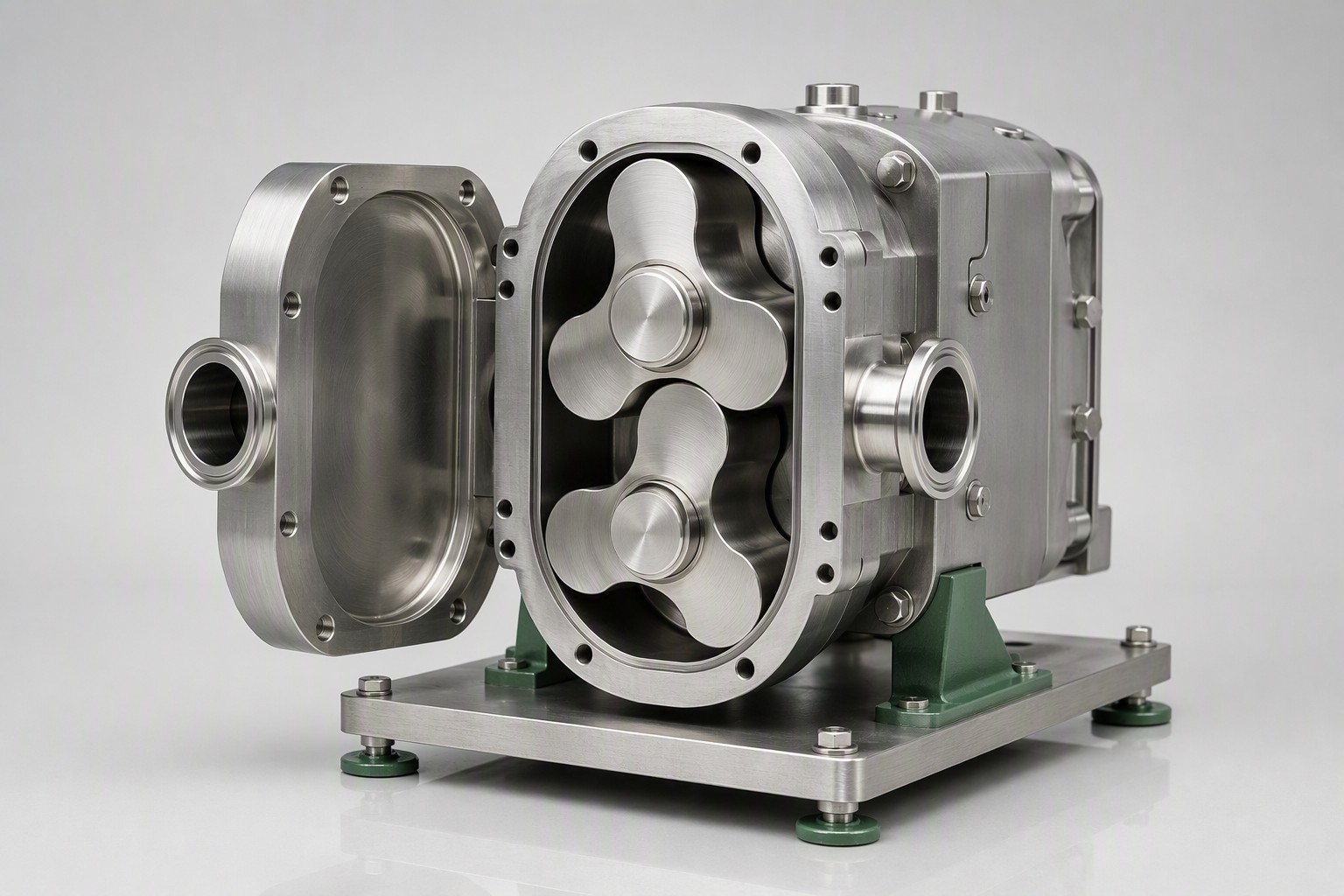
Two Positive-Displacement Designs
Both pumps belong to the rotary positive-displacement (PD) family: each shaft revolution moves a fixed volume of liquid, so flow is largely proportional to speed rather than to discharge pressure. That is where the similarity ends.
A rotary lobe pump moves liquid with two tri-lobe rotors that rotate in opposite directions inside a close-fitting casing. The rotors never touch each other or the casing wall — they are kept in phase by external timing gears — so liquid is carried through in large rounded cavities. A gear pump works on the opposite principle: liquid is trapped between meshing gear teeth and the casing, and the teeth themselves do the sealing and displacing. If the lobe pump concept is new, the 3RP lobe pump working principle article walks through the suction, transfer and discharge phases step by step.
The Key Difference: Contacting vs Non-Contacting Rotors
The single most useful comparison is rotor contact. In a lobe pump the product never passes between rubbing metal surfaces, which is why lobe pumps are famous for gentle handling. In a gear pump the fluid is squeezed between meshing teeth, creating more local shear and preventing any significant solids content.
- Lobe pump: non-contacting rotors, low shear, moderate solids passage, low pulsation, short dry-run tolerance at the seal's discretion.
- Gear pump: tight meshing clearances, higher shear, essentially clean-fluid only, compact and capable of high differential pressures on oil.
Lobe Pump vs Gear Pump at a Glance
Rotary Lobe Pump vs External Gear Pump
| Characteristic | Rotary lobe pump | External gear pump |
|---|---|---|
| Rotor contact | Non-contacting (timing gears) | Meshing gear teeth |
| Shear on the fluid | Low — gentle | Higher |
| Solids tolerance | Moderate (soft/fibrous) | Poor |
| Pressure capability | Low-moderate | High for compact size |
| Pulsation | Low | Low-moderate |
| Hygiene / CIP | Excellent option | Rarely specified |
| Typical duty | Food, chemical, viscous, hygienic | Clean oils, fuels, hydraulics |
Viscosity, Slip and Pressure Behaviour
Both technologies handle viscous liquids well, but their operating windows differ. Gear pumps use deliberately tight internal clearances to seal against slip, which lets them reach high differential pressures even with relatively thin oils; this is why hydraulic and lubrication circuits are dominated by gear pumps. The trade-off is that tight clearances mean close-fitting parts wear faster when the liquid is abrasive or slightly dirty. Lobe pumps run with larger clearances by design, so slip is higher at low viscosity and the practical pressure range is more moderate — but the open rotor profile handles thick pastes and cold-start conditions comfortably, and flow stays gentle and low-pulsation. In practice viscosity affects both: higher viscosity increases slip losses at low speed and raises shaft power, so the cold-start case should always be checked.
When to Choose a Lobe Pump
Choose a lobe pump when the fluid is shear-sensitive, hygienic, viscous or carries soft solids — the duties where gear pumps are ruled out. Typical examples include food products such as cream, yogurt, syrups and fruit pulp, and chemical or cosmetic media where product integrity and gentle transfer matter. The dedicated guides cover these applications in detail: lobe pumps in food processing, sanitary lobe pump duties and chemical lobe pump service. Where the fluid is simply very thick, review the high-viscosity lobe pump guidance as well.
When to Choose a Gear Pump
Choose a gear pump when the liquid is a clean lubricating fluid — fuel oil, lubricating oil, hydraulic oil or similar — and the duty needs a compact, economical machine that can reach higher pressures without the complexity of a larger PD pump. Gear pumps are also a natural answer for low-viscosity oils where a lobe pump's larger clearances would cause excessive slip. Qingdao Green Power's own guidance is that once viscosity exceeds roughly 150 cSt a centrifugal pump loses efficiency and a positive-displacement alternative should be used; the KCB gear pump selection article explains how to size that alternative for oil duties, and thermal oil pump selection covers the high-temperature oil case.
Cost, Maintenance and Installed Cost Realities
Gear pumps usually win on first cost and simplicity: fewer parts, no timing gear train, and a smaller footprint for a given pressure. Lobe pumps cost more up front because the timing gears, precision rotors and hygienic machining are more complex, but they pay back where product quality, CIP cleaning or solids handling would otherwise force a different, more expensive solution. Maintenance on both centres on seals and wear parts; neither should be run dry for long periods because the mechanical seals rely on the pumped liquid for lubrication and cooling.
Making the Decision
Compare the actual duty, not the pump names: write down the pressure, viscosity, cold-start condition, solids and hygiene requirements. If the fluid is clean oil at higher pressure, a gear pump is usually right. If the fluid is shear-sensitive, food-grade, viscous or slightly solids-laden, the centrifugal pump is not suitable either — a lobe pump is the reference technology. For very high viscosity or multiphase duties at large capacity, an industrial screw pump is a third option worth comparing. 3RP lobe pumps are treated on this site as a technical-reference topic — confirm current model availability and specifications with Qingdao Green Power before procurement.
Frequently Asked Questions
What is the main difference between a lobe pump and a gear pump?
A lobe pump uses two synchronised, non-contacting tri-lobe rotors driven by timing gears, so the rotors never rub against each other and the pump handles shear-sensitive and slightly solids-laden fluids gently. A gear pump displaces liquid directly with meshing gear teeth, which suits clean lubricating liquids and higher pressures but is more sensitive to shear, solids and dirt.
Which is better for high-viscosity liquids — a lobe pump or a gear pump?
Both handle viscous media well. A lobe pump is the better choice when the thick fluid is also shear-sensitive, food-grade or contains soft solids, and its larger clearances ease cold-start handling. A gear pump is a compact, economical option for clean viscous oils and fuels at higher pressure. The right answer depends on pressure, cleanliness and product sensitivity.
Can a lobe pump replace a gear pump on the same duty?
Only where the duty allows it. A lobe pump can replace a gear pump when the required pressure is moderate and the fluid is shear-sensitive, slightly solids-laden or needs hygienic/CIP handling. Where the duty demands high differential pressure on clean oil with a compact footprint, a gear pump usually remains the better fit.
Are 3RP lobe pumps a current Qingdao Green Power core product?
3RP lobe pumps are treated on this site as a technical-reference topic. Confirm current model availability and specifications with Qingdao Green Power before procurement.
Not sure whether a lobe pump or a gear pump fits your liquid? Send the viscosity, pressure, temperature and product details — the engineering team will compare both technologies against your duty.
Get a Quote
Send your fluid data and duty point. Engineers reply within 24 hours.
Contact Us →💬 WhatsApp NowRelated Products
- Industrial Screw Pump
- Centrifugal Pump
Related Articles
What Is a 3RP Rotary Lobe Pump?
Technology overview
3RP Lobe Pump Working Principle
How the pump operates
KCB Gear Pump Selection
Sizing guide for oil duties