
Thermal Oil Circulation Pump Selection Guide
RY-series thermal oil pump selection for heat transfer fluid circulation at -20°C to 350°C: flow, head, air-cooled sealing, NPSH and model data for hot-oil systems.
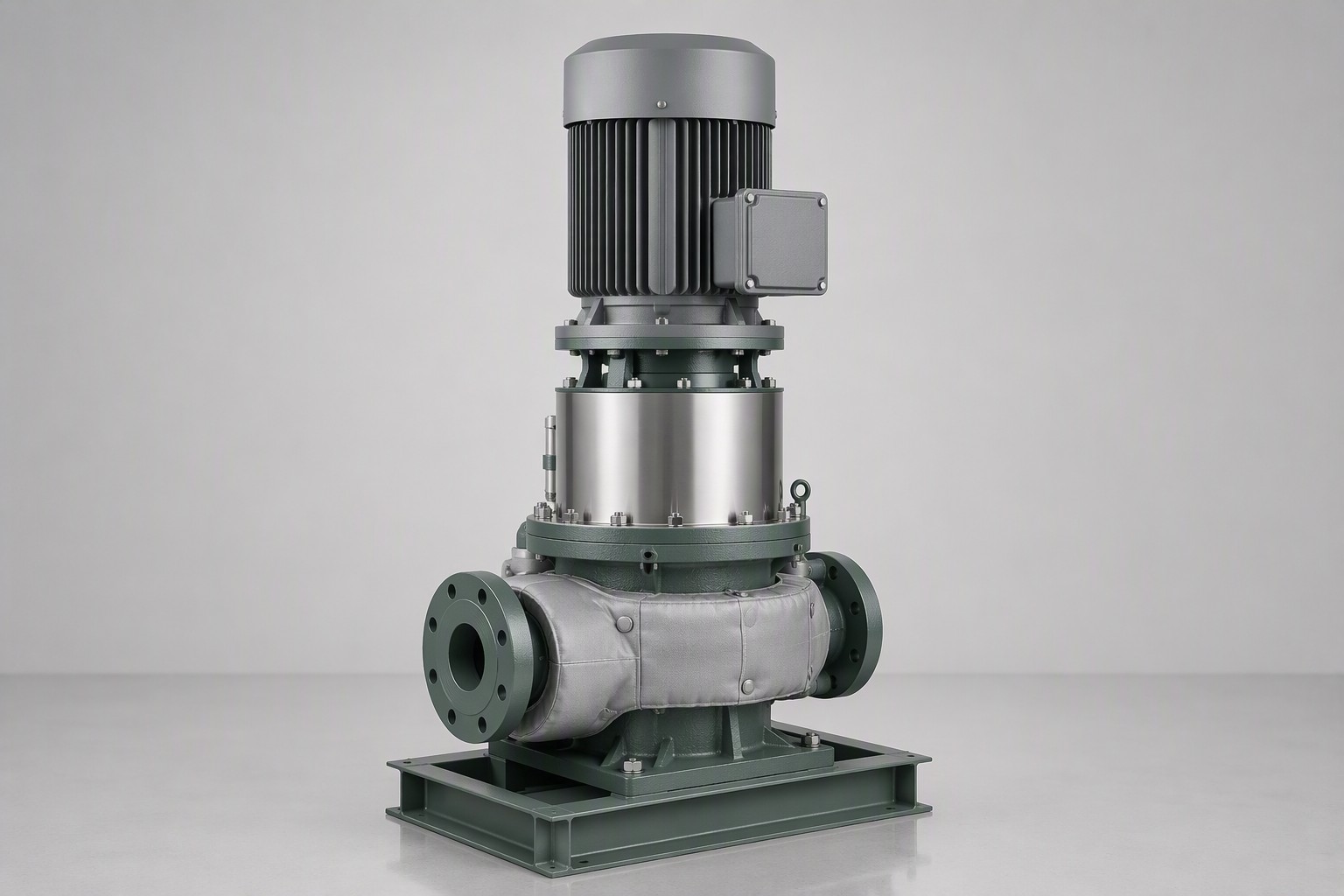
A thermal oil circulation pump moves heat-transfer fluid continuously through a closed heating loop. The RY series is a single-stage centrifugal pump rated for -20°C to 350°C service. Its natural air-cooling fin structure removes the need for an external cooling-water system, simplifying installation on hot-oil systems.
How a Thermal Oil System Works
In a liquid-phase thermal oil system, the heater raises the heat-transfer fluid (HTF) to working temperature, and the circulation pump drives it through the heater and out to the process users — reactors, presses, dryers, calenders or tanks — before returning it to the heater. Because the HTF can operate at high temperature at low pressure, hot-oil systems avoid the capital and safety cost of high-pressure steam.
The pump is the heart of the loop: it must deliver the design flow at the pressure needed to overcome heater, pipe and equipment losses, while surviving continuous service at fluid temperatures that would destroy a standard water pump seal.
RY Series Key Specifications
Published RY Series Range
| Parameter | Value |
|---|---|
| Pump type | Centrifugal, horizontal, single-stage |
| Flow rate | 1–500 m³/h |
| Temperature range | -20°C to 350°C |
| Pressure | 1–12.5 bar |
| Medium | Thermal oil / heat transfer fluid (HTF) |
| Sealing | Packing seal with heat-resistant auxiliary seal |
| Cooling | Natural air-cooling fins — no cooling water required |
Not suitable for water, chemicals or abrasive media. Confirm the final model, materials and performance against the actual system conditions before procurement.
Selection Checklist
1. Duty flow and head
Size the pump from the system heat load and the HTF properties at operating temperature. Calculate the total dynamic head from the heater, piping, valves and process equipment — never select from catalogue maximums alone. The published RY model range spans small units around 1 m³/h up to large circulation pumps of several hundred m³/h, with heads typically from about 20 m to over 120 m.
2. Temperature class and materials
Confirm the maximum fluid temperature, because it drives the casing material, the seal arrangement and the coupling design. The RY series is engineered for -20°C to 350°C service, covering most liquid-phase HTF systems in chemical, textile, food, petroleum and pharmaceutical plants.
3. Cooling and sealing
The RY design cools the bearing and seal housing with natural air-cooling fins, so no cooling-water piping is required — an advantage where cooling water is unavailable, expensive or undesirable. A combination of packing seal and mechanical seal with a heat-resistant auxiliary seal gives low-leakage operation, and an oil guide tube allows real-time observation of seal condition and HTF recovery status.
4. NPSH and suction conditions
Thermal oil systems normally operate with positive suction head from an elevated expansion tank or deaerator. Confirm the available NPSH at the highest fluid temperature, because the vapour pressure of the HTF rises steeply with temperature and can cause cavitation if the suction head is marginal.
Representative RY Model Data
RY Model Examples (published data)
| Model | Q (m³/h) | Head (m) | Motor (kW) |
|---|---|---|---|
| 20-20-100 | 1 | 20 | 0.75 |
| 32-32-160 | 6 | 28 | 1.5 |
| 50-32-200 | 12.5 | 50 | 5.5 |
| 65-40-250 | 25 | 80 | 15 |
| 80-50-250 | 50 | 80 | 22 |
| 100-65-250 | 100 | 80 | 37 |
| 100-65-315 | 100 | 125 | 75 |
Model numbers indicate approximate nozzle sizes and impeller diameter class. Exact duty point, efficiency and motor selection depend on fluid properties and system layout — verify against the performance curve for the chosen model.
Frequently Asked Questions
Why does a thermal oil pump not need cooling water?
The RY series uses a natural air-cooling fin structure on the bearing and seal housing, so heat is dissipated to ambient air instead of requiring a cooling-water jacket. This simplifies installation at hot-oil systems where cooling water is unavailable or expensive.
Can an RY thermal oil pump handle water or chemicals?
No. The RY series is designed for thermal oil, heat conduction oil and compatible heat transfer fluids. It is not suitable for water, chemicals or abrasive media.
What temperature range does the RY series cover?
The published temperature range is -20°C to 350°C, which covers most liquid-phase hot-oil systems used in chemical, textile, food, petroleum and pharmaceutical plants.
How is the RY pump sealed at high temperature?
The unit combines a packing seal with a heat-resistant auxiliary seal for low-leakage operation, and an oil guide tube lets operators observe seal condition and heat-transfer-oil recovery in real time.
Send your heat load, HTF type, required flow and temperature — the engineering team will confirm the RY model, motor and seal configuration for your hot-oil loop.
Get a Quote
Send your system data and duty point. Engineers reply within 24 hours.
Contact Us →💬 WhatsApp NowRelated Products
- RY Thermal Oil Pump
- Pipeline Circulation Pump
Related Articles
How Does a Thermal Oil Pump Work?
Technology overview
Thermal Oil Heat Transfer Pump
Application guide
Thermal Power Plant Pumps
Related duties