
How Does a Thermal Oil Pump Work?
Thermal oil pump working principle explained: how a centrifugal impeller circulates heat-transfer fluid through a closed hot-oil loop, and how the RY series copes with oil up to 350°C.
A thermal oil pump is a centrifugal pump that keeps heat-transfer fluid moving around a closed hot-oil loop. The rotating impeller adds velocity energy to the oil and the volute casing converts that velocity into pressure, pushing the oil through the heater and out to the process users. Because the fluid returns to the suction hot, the RY series is engineered for continuous service up to 350°C with air-cooled bearings and a heat-resistant seal.
The Closed Hot-Oil Loop the Pump Serves
In a liquid-phase thermal oil system, the heater raises the heat-transfer fluid (HTF) to working temperature and the circulation pump drives it around the loop: from the heater to the process users — reactors, presses, dryers or tanks — where the oil gives up its heat, and back to the heater. Because the HTF operates hot under modest pressure, hot-oil systems avoid the cost of high-pressure steam.
The pump does not generate heat and does not lift oil against a static column. It must deliver the design flow at the pressure needed to overcome the friction losses of the heater coils, piping, valves and heat exchangers — the RY series is published at 1–500 m³/h and 1–12.5 bar, covering most hot-oil circulation duties.
The expansion tank, mounted above the pump on the suction side, absorbs thermal expansion and provides static liquid head at the pump suction. The deaerator removes moisture and light fractions — water entering a 300°C loop flashes instantly, so a dry charge protects the pump as much as the process.
Working Principle: Impeller, Casing and Pressure Build
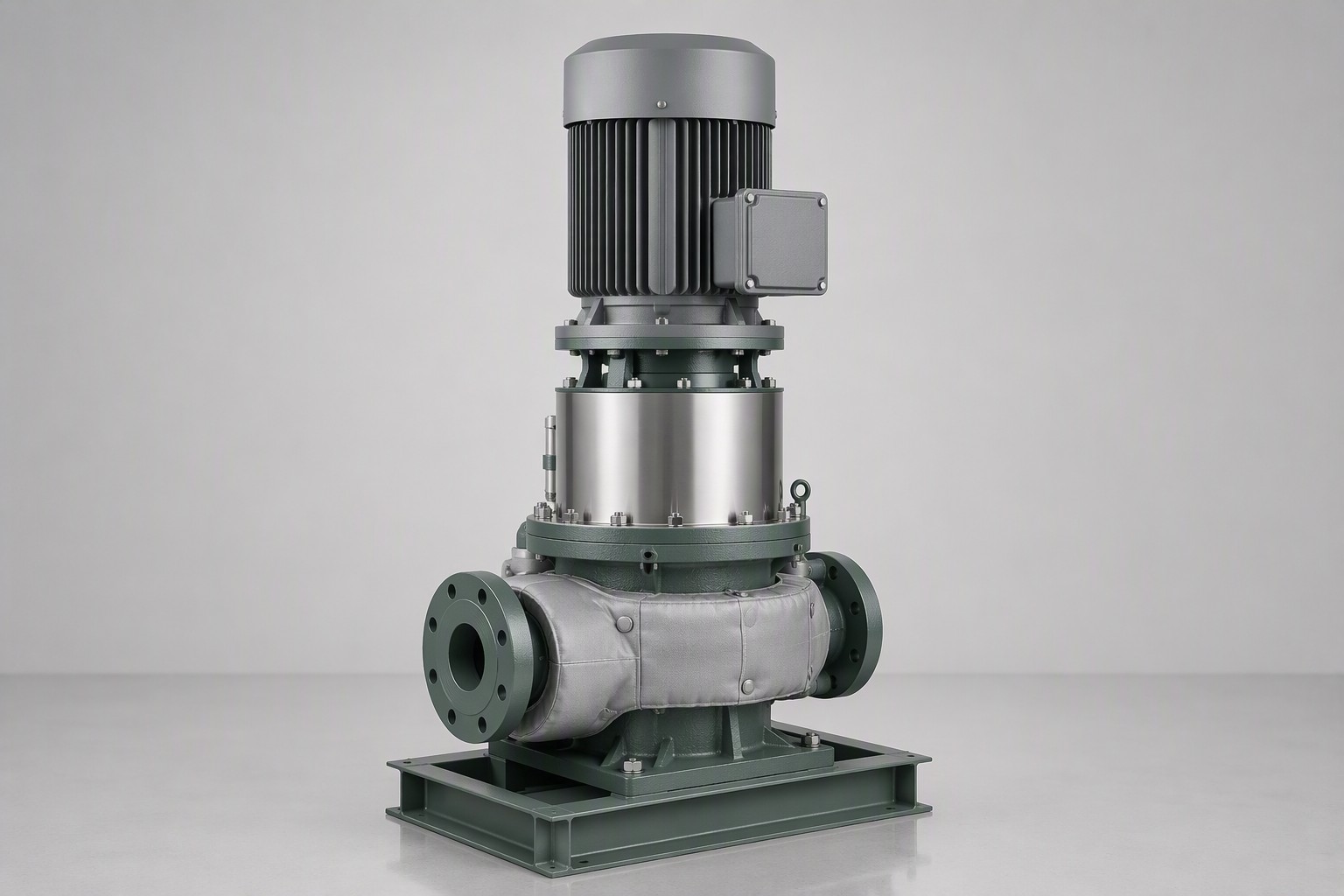
The RY thermal oil circulation pump is a horizontal, single-stage centrifugal machine. A motor drives the shaft through a flexible coupling; the impeller accelerates the oil radially outward from the suction eye, and the volute casing slows the flow, converting velocity energy into pressure at the discharge nozzle.
Because the principle is centrifugal, delivery follows system resistance and pressure rises only to what the loop requires — the pump circulates a large flow against a modest pressure difference.
Published RY Series Range
| Parameter | Value |
|---|---|
| Pump type | Centrifugal, horizontal, single-stage |
| Flow rate | 1–500 m³/h |
| Pressure | 1–12.5 bar |
| Temperature range | -20°C to 350°C |
| Medium | Thermal oil / heat transfer fluid (HTF) only |
| Sealing | Packing seal with heat-resistant auxiliary seal |
| Cooling | Natural air-cooling fins — no external cooling water |
Exact model, impeller diameter and motor follow from the duty flow, loop resistance and oil properties — the RY thermal oil pump selection guide covers that process.
Designed for 350°C: Air Cooling, Packing Seal and Oil Guide Tube
Heat travels along the shaft from the hot end toward the bearings and seal, where a standard water-pump design fails on hot-oil duty. The RY series uses a natural air-cooling fin structure on the bearing and seal housing, so no external cooling-water system is required, simplifying installation wherever cooling water is unavailable or unwanted.
The shaft is sealed by a packing gland backed by a heat-resistant auxiliary seal. An oil guide tube provides real-time observation of seal condition and heat-transfer-oil recovery: oil passing the packing is led away through the guide, so a developing leak is seen early instead of dripping onto a hot pipe.
Because the design is optimised for hot hydrocarbons, the RY series must not be used for water, chemicals or abrasive media.
Suction and NPSH: The High-Temperature Caution
The vapour pressure of heat-transfer fluid rises steeply with temperature, and near 300°C the pump suction operates close to the oil's boiling point. If local pressure at the impeller eye falls to the vapour pressure, the oil flashes, the pump cavitates and flow collapses.
Three things keep the pump safe: the expansion tank or deaerator is mounted high enough to give positive static suction head at the hottest condition; the suction line is short, direct and generously sized; and available NPSH is kept above the pump's requirement rather than throttling the suction.
Start-Up and Operating Checks
- Warm up gradually: heat the loop slowly so pump and piping expand evenly; never admit cold oil to a hot pump.
- Keep the pump full: a centrifugal oil pump must never run dry — check the expansion-tank level before starting.
- Watch the seal: use the oil guide tube to confirm packing leakage stays at a slight, steady weep.
- Monitor bearings: keep the air-cooling fins clean and check bearing temperature and vibration.
- Maintain oil quality: keep the HTF dry and free of sludge so the deaerator and pump run reliably.
Frequently Asked Questions
How does a thermal oil circulation pump work?
It is a single-stage centrifugal pump: the impeller accelerates the heat-transfer fluid and the casing converts that velocity into pressure, driving the oil around the closed loop. It does not generate heat — it overcomes the loop's friction losses.
Why does the RY thermal oil pump not need cooling water?
The RY series uses natural air-cooling fins on the bearing and seal housing, so heat is shed to the ambient air without a cooling-water jacket — an advantage where cooling water is unavailable.
Can an RY thermal oil pump handle water or chemicals?
No. The RY series is designed for thermal oil, heat-conduction oil and compatible heat-transfer fluids from -20°C to 350°C; it is not suitable for water, chemicals or abrasive media.
Why is suction head so critical on a high-temperature oil pump?
HTF vapour pressure rises steeply with temperature; if suction pressure falls to the vapour pressure the oil flashes and the pump cavitates. An elevated expansion tank and deaerator keep available NPSH above the pump requirement.
Send your heat load, HTF type, required flow and maximum temperature — the engineering team will confirm the RY model and seal configuration for your loop.
Get a Quote
Send your system data and duty point. Engineers reply within 24 hours.
Contact Us →💬 WhatsApp NowRelated Products
- RY Thermal Oil Pump
Related Articles
RY Thermal Oil Pump Selection
Selection guide
Thermal Oil Heat Transfer Pump
Application guide
Thermal Power Plant Pumps
Related duties