
Pump Solutions for Food and Pharmaceutical Industries
Pump solutions for food and pharmaceutical plants: hygienic, low-shear transfer of milk, juice, syrups, sauces, cream, chocolate and pharma liquids using centrifugal, screw and lobe pump technology.
Food and pharmaceutical plants choose pump solutions on product integrity first: the pump must move the liquid without contaminating it, overheating it or shearing its structure. Thin, low-viscosity products such as milk, juice and CIP rinse water run efficiently on hygienic centrifugal pumps; viscous pastes such as syrups, honey and chocolate move on G-type screw pumps; and shear-sensitive media such as cream, emulsions and sauces reference low-shear rotary lobe technology. Hygienic stainless wetted parts, food-safe elastomers and clean-in-place geometry are common requirements across both industries.
Why Food and Pharma Pump Solutions Are Different
Ordinary industrial pumps are judged on flow, head and efficiency. Pumps in food and pharmaceutical lines are judged on those, plus three extra requirements that can override them:
- Product safety — every product-contact surface must be food-safe or pharma-compatible stainless steel with approved elastomers, and must neither contaminate the batch nor react with it.
- Low shear — emulsions, creams and biological products lose quality when crushed, whipped or smeared between moving parts.
- Cleanability — smooth, crevice-free internals that can be cleaned in place (CIP) and, where required, steamed or chemically sanitised between batches.
These constraints push the selection towards hygienic configurations of proven pump families rather than exotic specials. The practical question is which family fits the product, and our food grade pump selection article sets out the full method.
Thin Liquids: Centrifugal Pumps for Milk, Juice and CIP
Many food and pharma lines handle liquids that are essentially water-like: milk, clarified juice, brine, CIP rinse water and low-viscosity pharmaceutical solutions. For these, a hygienically built centrifugal pump delivers large flow with continuous, non-pulsating transfer at low cost per m³. Qingdao Green Power publishes its IS/ISW centrifugal pump range at 1.5–1600 m³/h flow, 2–125 m head and liquid temperatures up to 80 °C, and the practical rule is to keep centrifugal solutions below roughly 150 cSt — above that, a positive displacement pump fits better.
Viscous Products: Screw Pumps for Syrups, Honey and Cream Bases
Syrups, honey, molasses, chocolate and concentrated fruit bases are too viscous for economical centrifugal transfer. The standard solution is a positive displacement pump, most commonly a G-type single-screw (progressive cavity) pump: a helical metal rotor turns inside an elastomeric stator, and the sealed cavities between them travel from suction to discharge with steady, low-pulsation flow and gentle product handling. Qingdao Green Power publishes the G-type range at 0.1–150 m³/h flow and 0.6–2.4 MPa, with stator grades (NBR, EPDM or FKM) matched to the product and temperature — details are on the screw pump product page. One rule dominates this family: never run it dry, because the elastomer stator is destroyed within seconds. For very thick, sticky products see our high-viscosity food pump guidance.
Shear-Sensitive Duty: Rotary Lobe Pumps as Reference Technology
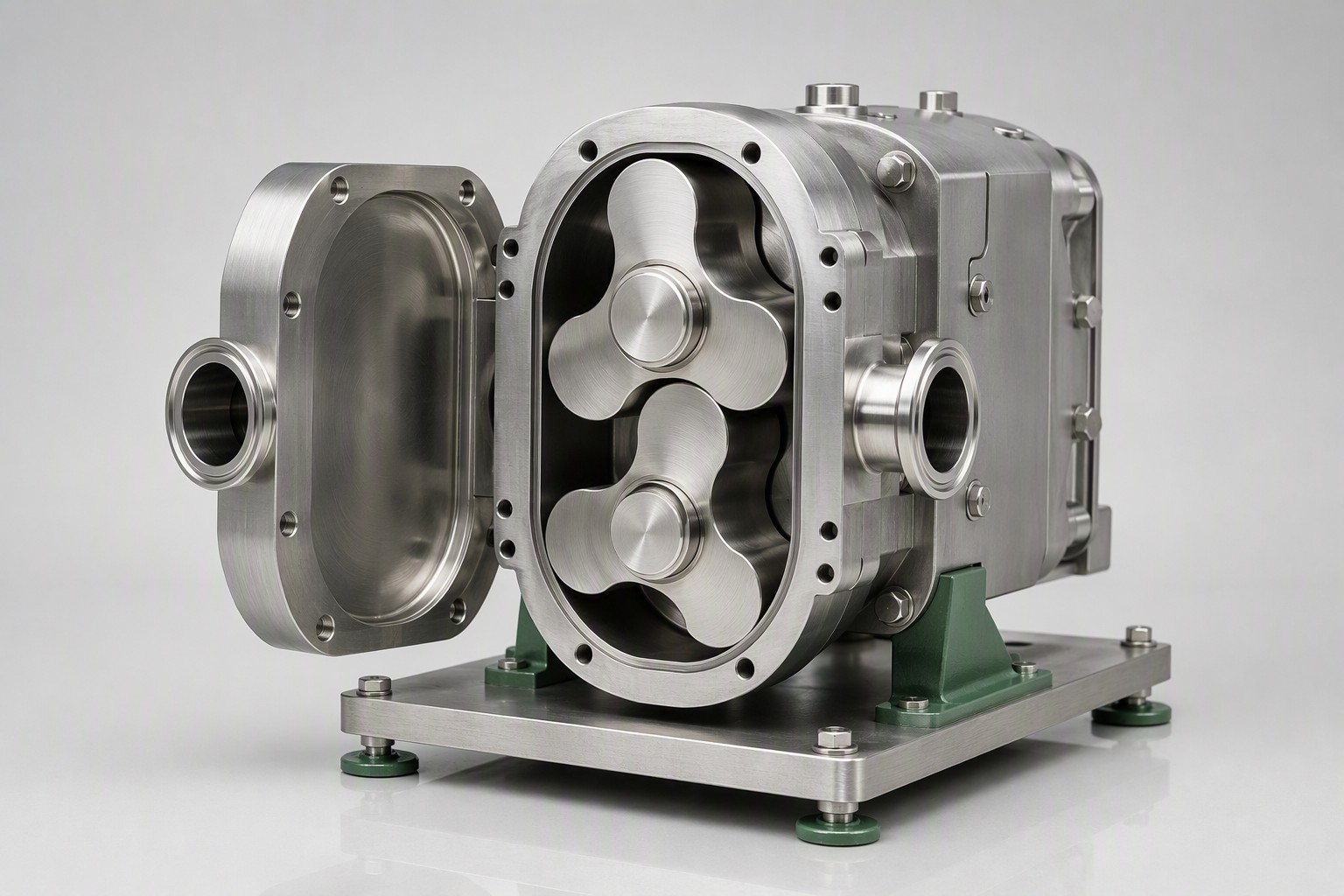
Cream, yogurt, salad dressings, fruit pulp and many pharmaceutical suspensions must not be sheared during transfer. For this duty class the reference technology is the rotary lobe pump: two synchronised, non-contacting tri-lobe rotors carry the product in large rounded cavities, so it is never crushed between metal parts and flow stays smooth and low-pulsation. Hygienic stainless builds clean easily and can flush lines by reversing rotation. Qingdao Green Power treats rotary lobe pumps as a technical-reference topic on this site; confirm current model availability and specifications with the company before procurement. Application notes for the classic duties are in our syrup and sauce transfer, cream and dairy and chocolate pumping articles.
Pump Solutions Mapped to Product Families
| Product family | Liquid profile | Pump solution | Published range (Qingdao Green Power) |
|---|---|---|---|
| Milk, juice, CIP water, pharma solutions | Thin, low viscosity, ≤80 °C | Hygienic centrifugal (IS/ISW) | 1.5–1600 m³/h, head 2–125 m |
| Syrup, honey, cream base, fruit concentrate | Viscous, above ~150 cSt | G-type single-screw pump | 0.1–150 m³/h, 0.6–2.4 MPa |
| Cream, yogurt, emulsions, sauces | Shear-sensitive | Rotary lobe (reference) | Confirm availability and specifications |
For shear-sensitive products, see also the rotary lobe pump in food processing article, which explains why non-contacting rotors preserve structure and emulsion stability.
Cleanability, Materials and CIP Design
Whatever the pump family, the food or pharma configuration adds hygienic engineering: food-safe stainless wetted parts, elastomers approved for the product and cleaning chemicals, and smooth internal surfaces without crevices where product can lodge. Cleaning-in-place circuits push rinse water, caustic and sanitiser through the pump at elevated temperature, so confirm that seals, stators and gaskets survive the cleaning cycle — not just the product — before specifying.
Data to Send for a Hygienic Pump Recommendation
A usable recommendation needs the product composition, viscosity at minimum and maximum temperature, shear sensitivity, solids content and size, required flow and discharge pressure, operating temperature and the cleaning method (CIP or manual). Send those details and the engineering team will map the duty to the right hygienic configuration with suitable wetted materials.
Frequently Asked Questions
Which pump solutions are used in food and pharmaceutical plants?
Thin, low-viscosity liquids such as milk, juice, CIP rinse water and many pharma solutions move efficiently on hygienic centrifugal pumps — Qingdao Green Power publishes its IS/ISW centrifugal range at 1.5–1600 m³/h, 2–125 m head and up to 80 °C. Viscous pastes such as syrups, honey, chocolate and cream bases point to a G-type single-screw pump (published 0.1–150 m³/h at 0.6–2.4 MPa), while shear-sensitive products such as cream, yogurt and sauces reference low-shear lobe pump technology.
Can a centrifugal pump handle food and pharmaceutical products?
Yes, when the product is thin and low-viscosity and the duty is continuous, non-pulsating transfer at moderate temperature — milk, clarified juice, CIP solutions and low-viscosity pharma liquids are typical. The published IS/ISW range is 1.5–1600 m³/h at 2–125 m head up to 80 °C; above roughly 150 cSt a positive displacement pump fits better.
What is the best pump for high-viscosity products such as syrups, chocolate and cream?
A positive displacement pump, most commonly a G-type single-screw (progressive cavity) pump, whose helical rotor and elastomeric stator move the paste in sealed cavities with low shear. The published range is 0.1–150 m³/h at 0.6–2.4 MPa, with stator grades matched to the product. Never run it dry — the elastomer stator is destroyed within seconds.
Are food and pharmaceutical pumps cleanable and hygienic?
Food and pharma duty requires hygienic design: food-safe stainless wetted parts, compatible elastomers, smooth crevice-free surfaces and cleaning-in-place (CIP) capability. Confirm the wetted materials, seals, surface finish and cleaning temperature with Qingdao Green Power against the specific product, since regulatory and process demands vary by application.
Send your product composition, viscosity and cleaning method — the engineering team will map the right hygienic pump solution for your line.
Get a Quote
Send your fluid data and duty point. Engineers reply within 24 hours.
Contact Us →💬 WhatsApp NowRelated Products
- IS/ISW Centrifugal Pump
- G-Type Screw Pump
Related Articles
Food Grade Pump Selection
Step-by-step method
High-Viscosity Food Pump
Moving thick products
Lobe Pumps in Food Processing
Low-shear transfer