
Pump for Syrup and Sauce Transfer
Syrup and sauce transfer pump guide: progressive cavity, rotary lobe and gear pump options for sticky food media, plus heating, suction, materials and CIP rules that keep the line running.
Syrups and sauces are viscous, sticky, shear-sensitive food media that are best moved by positive displacement pumps rather than by centrifugal machines. The G-type single screw (progressive cavity) pump leads for thick sugar syrups and particulate sauces — Qingdao Green Power publishes it at 0.1–150 m³/h and 0.6–2.4 MPa for high-viscosity, shear-sensitive food pastes — while hygienic rotary lobe pumps suit gentle, CIP-cleaned duties. The published guidance for the IS/ISW centrifugal range is to switch to a gear or screw pump above about 150 cSt.
Why Syrup and Sauce Are Difficult to Pump
Syrups and sauces are concentrated, often sugar-based products whose behaviour changes sharply with temperature and recipe. A warm, pourable syrup may run like light oil, while a cold or high-sugar batch turns nearly paste-like. Sauces add fruit pieces, herbs and pulp that must pass through undamaged, plus a tendency to aerate or split if beaten through tight clearances. Four behaviours drive the pump choice:
- High and variable viscosity — from warm, pourable running to thick cold start-ups.
- Shear and aeration sensitivity — rough pumping whips air into the product and can split emulsions or damage particulates.
- Crystallisation and sticking — sugar deposits form in dead zones when flow stops.
- Hygiene requirements — every wetted surface must be cleanable and free of contamination traps.
Pump Options for Syrup and Sauce at a Glance
Technology Options for a Syrup or Sauce Duty
| Technology | Where it fits | QGP reference |
|---|---|---|
| Centrifugal (IS/ISW) | Dilute, water-like sugar solutions; continuous non-pulsating flow | 1.5–1600 m³/h, up to 80°C; above ~150 cSt switch to gear or screw |
| G single screw (progressive cavity) | Thick syrups, sauces and pastes; gentle, low-pulsation flow | 0.1–150 m³/h; 0.6–2.4 MPa |
| Rotary lobe pump | Hygienic, shear-sensitive and particulate sauces needing CIP-friendly design | Confirm current model availability and specifications with Qingdao Green Power |
| Gear pump | Clean, filtered and moderately viscous syrups on well-filtered service | Confirm current model availability and specifications with Qingdao Green Power |
Centrifugal pumps accelerate liquid with an impeller and earn their place only on dilute, water-like sugar solutions; above about 150 cSt — the published guidance for the IS/ISW range — the duty belongs to a gear or screw pump, a logic set out in our high-viscosity food pump guide.
The G-Type Single Screw Pump for Thick Syrups
The G-type single screw pump is a progressive cavity machine: a helical metal rotor turns inside an elastomeric stator, forming sealed cavities that travel steadily from suction to discharge. Each revolution displaces a fixed volume, so flow stays smooth and nearly pulseless, and the large slow-moving cavities keep shear low enough for pulpy sauces. Qingdao Green Power publishes the G-type for high-viscosity, shear-sensitive food pastes at 0.1–150 m³/h and 0.6–2.4 MPa. The stator elastomer — NBR, EPDM or FKM — must match the product and temperature, and the pump must never run dry: the rubber stator is destroyed within seconds. See the G-type screw pump product range and confirm food-contact specifications with Qingdao Green Power.
Rotary Lobe Pumps for Gentle, Hygienic Transfer
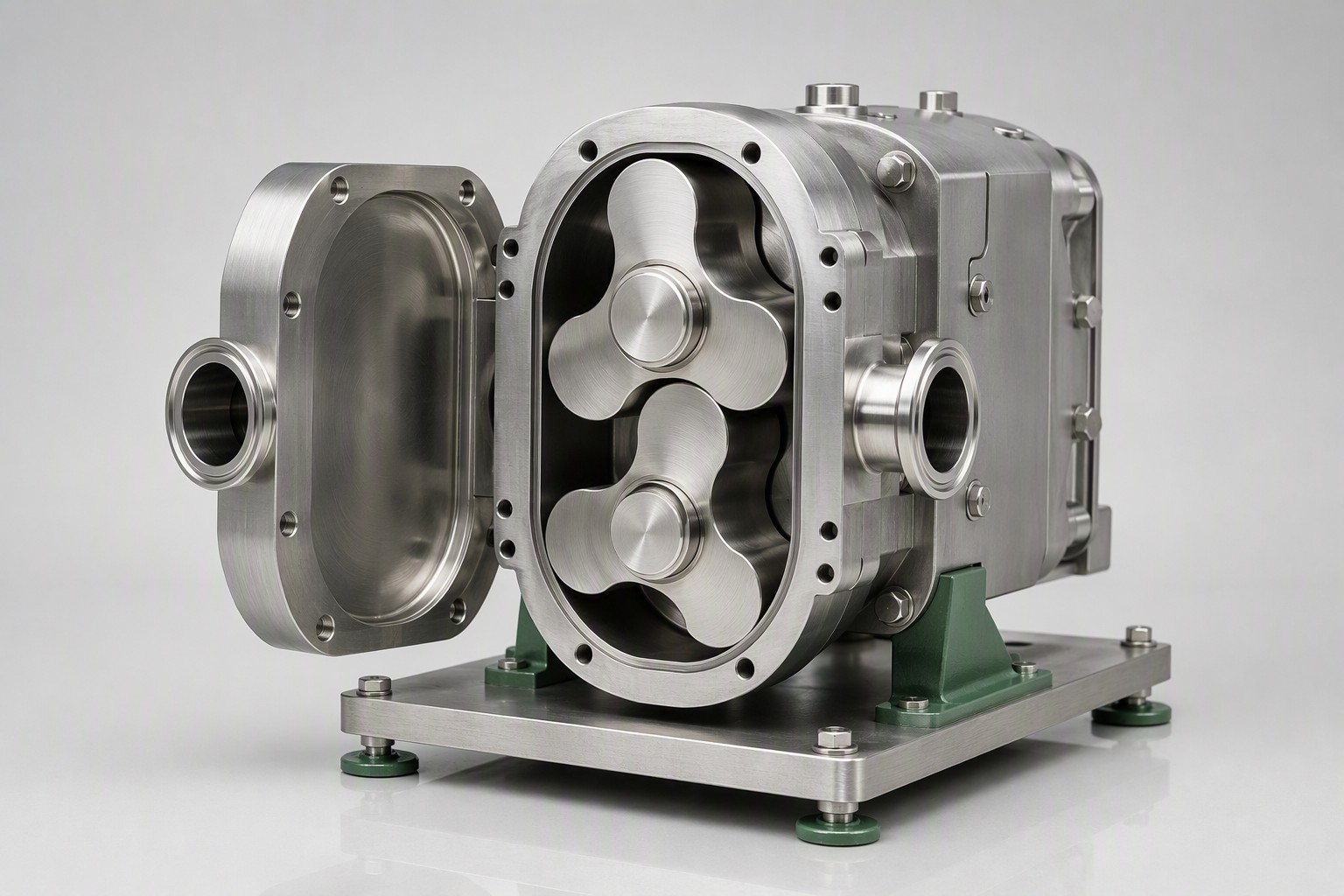
Where the product is shear-sensitive, hygienic or carries soft particulates, a rotary lobe pump is the classic alternative. Two synchronised, non-contacting tri-lobe rotors carry the product through large, rounded cavities, so there is no metal-to-metal rubbing and little local shear — ideal for pulpy or honey-based sauces. The open rotor profile and cleanable design also suit CIP-flushed lines that must not be dismantled. Lobe pumps are covered in detail in our rotary lobe pump in food processing guide, and the product-first method appears in our food grade pump selection article.
Heating, Suction and Flow-Side Rules
Viscosity falls steeply as sugar-based media warm up, so heating is often the cheapest reliability investment. Steam or hot-water jacketed casings, traced suction lines and heated tank outlets keep the product feeding the pump. Keep the suction short, direct and flooded, and fit relief protection, because a PD pump keeps displacing its full volume as pressure climbs.
Materials, Seals and Cleaning-in-Place
Syrup and sauce are food products, so the wetted end must neither contaminate them nor harbour deposits. Stainless wetted parts are the norm, with smooth, drainable flow paths and no dead pockets where sugar or bacteria can collect. Mechanical seals keep the product contained, and the stator and seal elastomers must tolerate both the warm product and the hot caustic or sanitiser used in cleaning-in-place (CIP) circuits. Where sanitary and industrial specifications are compared, our sanitary vs industrial pump article draws the line. Confirm food-grade suitability and the current product range with Qingdao Green Power.
Selection Checklist for a Syrup or Sauce Duty
- Viscosity and temperature range — define the cold start and the warm running condition.
- Particulates and shear sensitivity — confirm whether fruit pieces or pulp must pass through intact.
- Flow and pressure — fix the flow band, confirm maximum discharge pressure and fit relief protection.
- Heating provision — jacketed casing, traced suction lines and heated tank outlets keep the inlet fed.
- Materials and elastomers — stainless wetted parts, with seals and any stator matched to product and CIP chemicals.
- Anti-dry-run protection — on progressive cavity pumps, protect the stator from ever running dry.
Frequently Asked Questions
What type of pump is best for syrup and sauce transfer?
Positive displacement pumps are best for syrup and sauce because they move a fixed volume per revolution at low shear and with little pulsation. Qingdao Green Power publishes its G-type single screw (progressive cavity) pump at 0.1–150 m³/h and 0.6–2.4 MPa for high-viscosity, shear-sensitive food pastes such as syrups and sauces. Rotary lobe and gear pumps suit cleaner, moderately viscous duties — confirm current model availability and specifications with Qingdao Green Power before procurement.
Can a centrifugal pump transfer syrup or sauce?
Not efficiently once the product is thick. Friction in the impeller makes head and flow fall and efficiency drop as viscosity rises, so Qingdao Green Power's published guidance for its IS/ISW centrifugal range is to switch to a gear or screw pump above about 150 cSt. Centrifugal pumps suit dilute, water-like sugar solutions rather than finished syrups and sauces.
Should syrup or sauce be heated before it is pumped?
Sugar-based syrups are usually easier to pump warm because viscosity falls steeply as temperature rises — jacketed casings, traced suction lines and heated tank outlets keep the inlet fed and reduce torque. Heat-sensitive sauces, however, must stay within their product temperature limit. Confirm the temperature window with the product specification and process design.
Which materials are needed for a food-grade syrup and sauce pump?
Stainless steel wetted parts are the norm for food contact, with smooth, drainable flow paths that avoid sugar deposits and bacteria traps. Stator elastomers and seals — NBR, EPDM or FKM grades — must tolerate both the product and the hot caustic or sanitiser used in CIP cleaning. Confirm food-grade suitability and the current product range with Qingdao Green Power.
Tell us the product — corn syrup, glucose, tomato sauce, fruit coulis or a custom recipe — with its viscosity and temperature range, flow and pressure. The engineering team will recommend the pump technology, materials and elastomer for your line.
Get a Quote
Send your fluid data and duty point. Engineers reply within 24 hours.
Contact Us →💬 WhatsApp NowRelated Products
- Screw Pump (G / 3GB)
- Centrifugal Pump
Related Articles
Food Grade Pump Selection
Sanitary selection tips
Lobe Pumps in Food Processing
Gentle hygienic transfer
High-Viscosity Food Pumps
Thick product handling