
Best Pump for High-Viscosity Food Products
Choosing the best pump for high-viscosity food products — hygienic rotary lobe and G-type single screw pumps for syrups, pastes and purées, plus viscosity limits, materials and CIP checks.
The best pumps for high-viscosity food products are hygienic positive displacement pumps — rotary lobe pumps for gentle, low-pulsation transfer and single-screw (progressive cavity) pumps for very thick pastes. Qingdao Green Power publishes the G-type single screw pump at 0.1–150 m³/h and 0.6–2.4 MPa for high-viscosity media including food pastes, and centrifugal guidance is to switch to gear or screw pumps above roughly 150 cSt. 3RP rotary lobe pumps are a technical-reference topic on this site.
Why High-Viscosity Food Needs Positive Displacement
Many popular foods are also the hardest to pump. Honey, syrups, molten chocolate, ketchup, mayonnaise, fruit purées and processed cheese are viscous, and most are non-Newtonian: their viscosity falls when stirred.
A centrifugal impeller throws liquid outward, so in a thick product it loses head and efficiency, draws air into the mass and works it hard. Qingdao Green Power's guidance for its IS/ISW centrifugal range is to switch to gear or screw pumps above roughly 150 cSt — and food pastes sit far above that line. Positive displacement (PD) pumps answer differently: each revolution pushes a fixed volume, so flow holds steady against pressure and a thicker product seals the internal clearances better.
Rotary Lobe Pumps: Gentle, Hygienic Transfer
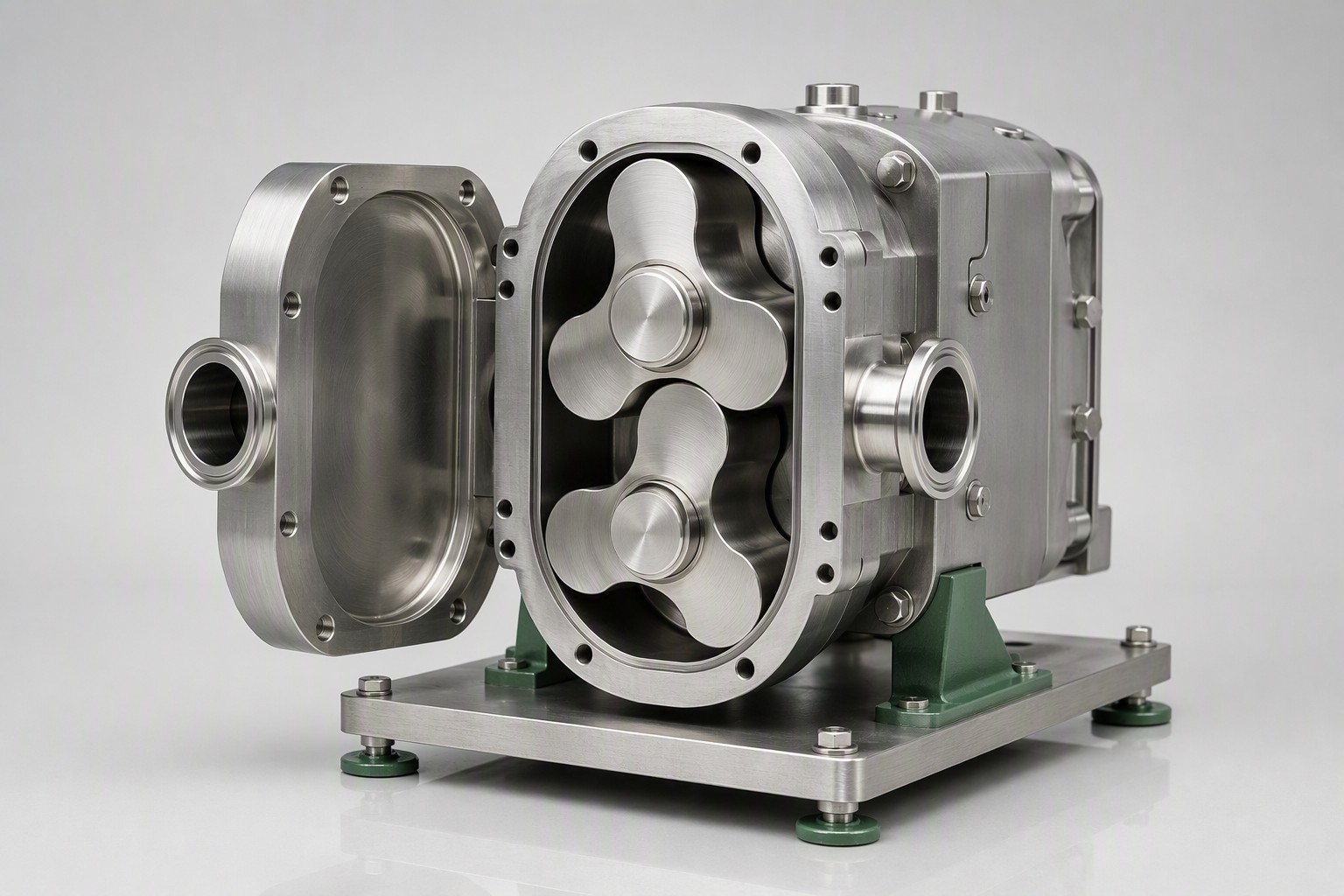
The rotary lobe pump is the classic gentle PD machine for food. Two synchronised lobe rotors rotate in opposite directions inside a close-fitting casing without touching, driven by timing gears, so the product moves in large, low-shear cavities rather than between metal parts. That suits shear-sensitive emulsions such as mayonnaise and salad dressings, and fruit pieces in syrup.
Lobe pumps are self-priming within their vacuum limit, give low-pulsation flow, and run equally well in reverse — useful for emptying lines and cleaning-in-place (CIP) circuits. On this site the 3RP lobe pump family is a technical-reference topic; its food-processing behaviour is detailed in our rotary lobe pump in food processing article.
Single-Screw Pumps for Thick and Delicate Pastes
Where a product is so thick that even a lobe pump struggles, the single-screw (progressive cavity) design takes over. A helical metal rotor turns inside an elastomeric stator, forming sealed cavities that travel steadily from suction to discharge, giving smooth, low-shear flow with accurate metering — ideal for dosing honey into jars.
Qingdao Green Power publishes the G-type single screw pump at 0.1–150 m³/h and 0.6–2.4 MPa for high-viscosity media including food pastes and biological fluids, provided any solids stay below the minimum flow passage. The food-contact stator elastomer must suit the product temperature and the CIP chemicals, and the pump must never run dry — the rubber stator is destroyed within seconds. See the G and 3GB industrial screw pump product page.
Pump Technologies Compared for High-Viscosity Food
| Technology | Where it fits | QGP reference |
|---|---|---|
| Rotary lobe pump | Shear-sensitive foods, inclusions, CIP circuits, gentle filling | 3RP technical-reference topic — confirm availability |
| G single screw | Very thick pastes, honey, purées, accurate metering | 0.1–150 m³/h; 0.6–2.4 MPa |
| Centrifugal pump | Water-like liquids only; aerates and shears thick food | Switch to gear or screw above ~150 cSt |
| External gear pump | Clean homogeneous viscous products, gentle handling not critical | Confirm current model availability and specifications with Qingdao Green Power |
Hygiene, Materials and Cleaning in Place
Food pumps carry an extra requirement beyond hydraulics: wetted parts must not contaminate the product, must survive the cleaning regime and must not harbour bacteria. That means stainless steel with a hygienic finish, food-grade elastomers, and a design that cleans in place or opens quickly for inspection.
Confirm the product-contact materials against both the food and the CIP chemicals — caustic and acid washes attack some elastomers and shorten seal life. The wider framework is covered in our food-grade pump selection guide and the hygiene trade-offs in sanitary vs industrial pumps.
Common High-Viscosity Food Duties
- Syrups and sauces — metered transfer for filling lines; see syrup and sauce transfer pumps.
- Cream and dairy mixes — low-shear handling that protects fat structure; see cream and dairy pumps.
- Molten chocolate — temperature-controlled PD transfer; see chocolate high-viscosity food pumps.
- Fruit purées and honey — single-screw pumps give steady, accurate portions.
Selection Checklist for a High-Viscosity Food Duty
- Product and temperature profile — viscosity at the worst case (cold start) sizes the drive.
- Shear sensitivity — emulsions and creams need low-shear lobe or screw designs, not gears.
- Solids and inclusions — confirm pieces stay below the minimum flow passage.
- Hygiene class — stainless finish, food-grade elastomers and CIP compatibility for the product.
- Cleaning validation — wetted materials must survive the CIP wash.
Frequently Asked Questions
What is the best pump for high-viscosity food products?
Hygienic positive displacement pumps are the best choice: rotary lobe pumps for gentle, low-pulsation transfer of shear-sensitive foods, and single-screw (progressive cavity) pumps for very thick pastes. Qingdao Green Power publishes the G-type single screw pump at 0.1–150 m³/h and 0.6–2.4 MPa for high-viscosity media including food pastes; confirm current 3RP lobe pump availability with Qingdao Green Power.
Can a centrifugal pump handle high-viscosity food?
Poorly. A centrifugal impeller loses head and efficiency as viscosity climbs and can aerate or shear the product. Qingdao Green Power's guidance for its IS/ISW centrifugal range is to switch to a gear or screw pump above roughly 150 cSt, and most viscous foods sit far above that level, so positive displacement pumps are the practical choice.
What is the difference between a rotary lobe pump and a single-screw pump for food?
A lobe pump uses two non-contacting, timing-gear-driven rotors, giving gentle low-shear handling, self-priming and easy reverse flow for CIP, with moderate solids tolerance. A single-screw (progressive cavity) pump moves product in sealed cavities through a rotor and stator, giving steady, nearly pulseless flow even at very high viscosity, though solids are limited by the minimum flow passage. Choose by product texture, solids and duty.
Which high-viscosity foods can a G-type single screw pump transfer?
Qingdao Green Power publishes the G-type single screw pump for high-viscosity media including food pastes, biological fluids and shear-sensitive products, so it is a common choice for honey, syrups, fruit purées, sauces and dessert pastes. The food-contact stator elastomer must be matched to the product temperature and CIP chemicals, and the pump must never run dry because the rubber stator is destroyed within seconds.
Describe your product — viscosity, temperature, solids, flow and hygiene class — and engineers will recommend the pump technology and food-contact materials.
Get a Quote
Send your fluid data and duty point. Engineers reply within 24 hours.
Contact Us →💬 WhatsApp NowRelated Products
- Industrial Screw Pump (G / 3GB)
- Centrifugal Pump
Related Articles
Food-Grade Pump Selection
Materials and hygiene criteria
Lobe Pumps in Food Processing
Gentle transfer practice
Chocolate High-Viscosity Food Pump
Molten chocolate transfer