
Pump for Chocolate and High-Viscosity Food Products
How to pump chocolate and high-viscosity foods: positive displacement rotary lobe and single-screw pumps, temperature control, hygienic stainless construction, and why centrifugal pumps fail above about 150 cSt.
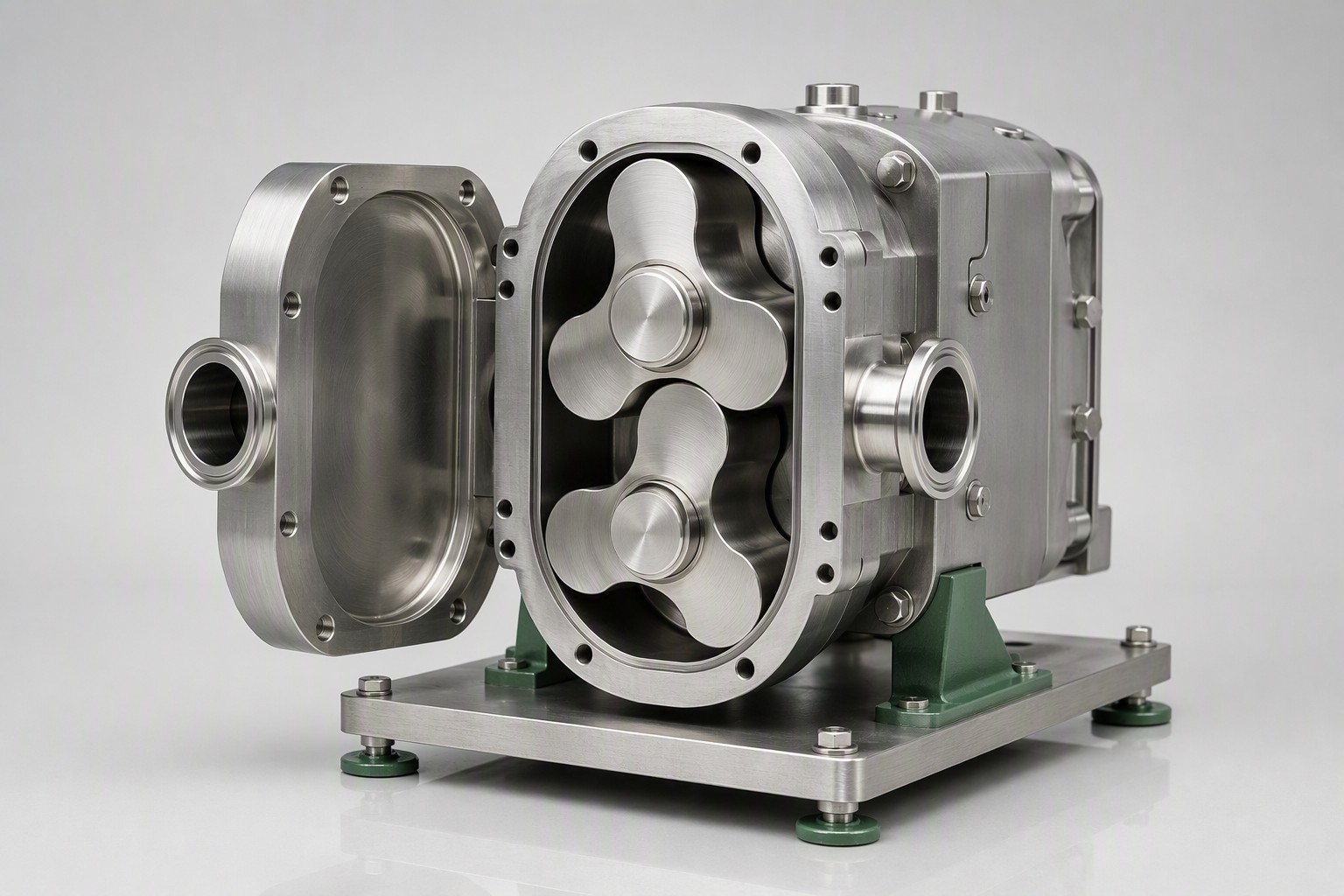
Chocolate is transferred while molten, at very high viscosity and inside a narrow temperature window, so it is moved by positive displacement pumps — rotary lobe and single-screw (progressive cavity) designs — rather than by centrifugal pumps. Rotary lobe pumps give the gentle, low-pulsation flow depositing and enrobing lines need, while single-screw pumps push the thickest pastes; both must be built for food contact, kept warm, and never asked to pump solidified product.
Why Chocolate Is Difficult to Pump
Molten chocolate is a concentrated suspension of cocoa solids and sugar crystals in cocoa butter. It is strongly non-Newtonian and shear-thinning: at rest or under low shear its apparent viscosity can reach tens of thousands of centipoise, then fall as it is worked. It is easily aerated — air bubbles do not rise out quickly — and it must stay molten (typically in the mid-40s °C for many duties) without being overheated, since excess temperature damages flavour, texture and temper. The consequences for pump selection:
- Very high viscosity — far beyond what a centrifugal impeller can move efficiently.
- Shear-thinning flow — viscosity changes with speed, so pressure and dosing are not linear.
- Aeration risk — entrained air causes poor mould filling and surface defects.
- Temperature sensitivity — too cold and the mass solidifies; too hot and quality suffers.
- Possible inclusions — nuts and crisped rice must pass without damage.
Keep the Product in Its Working Temperature Window
Temperature control is part of the pump system, not an afterthought. Jacketed or heat-traced suction lines and a heated pump casing keep chocolate molten during transfer and short stops, and many plants circulate warm water or low-pressure steam through the jackets. On shutdown, the pump and pipework should be cleared or kept heated so the chocolate does not set inside the rotors.
Positive Displacement Instead of Centrifugal
Centrifugal pumps are efficient on water-like liquids, but as viscosity climbs their performance collapses: flow and head fall, power rises, and the churning impeller can whip air into the chocolate. Qingdao Green Power's guidance for its centrifugal series is to move to a gear or screw pump above roughly 150 cSt — and molten chocolate sits far beyond that threshold. The practical choices are positive displacement (PD) machines, summarised below.
Pump Options for Chocolate and High-Viscosity Food
| Technology | Typical role in a chocolate line |
|---|---|
| Rotary lobe pump | Gentle, low-pulsation PD transfer for shear-sensitive and filling duties; hygienic stainless build, CIP-friendly |
| Single-screw / progressive cavity pump | Steady high-viscosity and paste transfer; QGP G-type single screw pump published at 0.1–150 m³/h and 0.6–2.4 MPa |
| Gear pump | Compact, accurate dosing of molten chocolate in clean closed circuits |
| Centrifugal pump | Not recommended above ~150 cSt — efficiency loss and aeration |
Two cautions apply to the PD machines. A single-screw pump must never run dry — its rubber stator is destroyed within seconds without product lubrication — and the stator elastomer must match both the food and the cleaning chemicals. 3RP lobe pumps are treated on this site as a technical-reference topic; confirm current model availability and specifications with Qingdao Green Power before procurement.
Hygiene: Food-Grade Materials, Seals and CIP
Wetted parts on a chocolate line are normally 304/316L stainless steel with smooth, crevice-free surfaces, food-grade elastomers, and seals that can be cleaned and inspected. Cleaning-in-place (CIP) circuits flush the pump and lines with the plant's cleaning sequence, so the internal geometry and elastomers must tolerate the cleaning temperature and chemicals as well as the chocolate. Where food-contact and industrial duties meet, the difference between sanitary and industrial pumps matters, and a structured food-grade pump selection process keeps product safety and cleaning requirements visible.
Low Pulsation Protects Depositors and Enrobers
On a moulding or enrobing line, flow consistency is product quality. Rotary lobe pumps deliver low-pulsation flow that keeps depositor weights even and the enrobing curtain steady, and because PD flow follows speed the pump can be turned down cleanly for dosing without pressure spikes. Screw pumps give a similarly steady discharge; see our overview of rotary lobe pumps in food processing.
The Same Pump Families Serve Other Viscous Foods
What works for chocolate works for the rest of the high-viscosity food range — caramel, syrups, sauces, honey, cream, yogurt and fruit preparations all move better with positive displacement than with centrifugal pumps. Qingdao Green Power publishes the G-type single screw pump for high-viscosity media including food pastes within the 0.1–150 m³/h, 0.6–2.4 MPa envelope. For neighbouring product groups, see syrup and sauce transfer pumps, cream and dairy pumping and the wider high-viscosity food pump topic, then confirm current model availability and specifications with Qingdao Green Power before procurement.
Frequently Asked Questions
Why is chocolate usually pumped with a positive displacement pump rather than a centrifugal pump?
Molten chocolate is a high-viscosity, non-Newtonian fluid — often tens of thousands of centipoise — and centrifugal pumps lose efficiency and can aerate the mass as viscosity climbs. Qingdao Green Power's centrifugal guidance is to move to a gear or screw pump above roughly 150 cSt, and chocolate sits far beyond that, so positive displacement pumps such as rotary lobe and single-screw designs are the practical choice.
What types of pump are used for pumping chocolate?
Rotary lobe pumps give gentle, low-pulsation transfer for filling and enrobing duties, while single-screw (progressive cavity) pumps handle very high viscosity pastes steadily; Qingdao Green Power's G-type single screw pump is published at 0.1–150 m³/h flow and 0.6–2.4 MPa pressure and suits food pastes, provided the stator elastomer matches the product and temperature. 3RP lobe pumps are treated on this site as a technical-reference topic — confirm current model availability and specifications with Qingdao Green Power before procurement.
Does chocolate need a heated or jacketed pump?
Yes, in most plants. Molten chocolate solidifies when it cools, so tanks, lines and often the pump itself are jacketed or heat-traced to hold the product inside its working temperature window; avoid overheating, which damages flavour, texture and temper. Confirm the heating arrangement and operating temperatures for the selected configuration with Qingdao Green Power.
Can a pump handle chocolate with inclusions such as nuts or crisped rice?
Chocolate with solid inclusions needs a pump whose internal passage sizes are large enough for the pieces: rotary lobe pumps tolerate moderate solids, while a screw pump is limited by its minimum flow passage dimension. Discuss inclusion size and recipe with the manufacturer, and confirm current model availability and specifications with Qingdao Green Power before procurement.
Tell us your product, viscosity, temperature and flow — the engineering team will recommend the PD technology, heating arrangement and hygienic configuration for your chocolate or food line.
Get a Quote
Send your product data and duty point. Engineers reply within 24 hours.
Contact Us →💬 WhatsApp NowRelated Products
- Single Screw (G) Pump
- Centrifugal Pump
Related Articles
Food-Grade Pump Selection
Hygienic pump guidance
Lobe Pumps in Food Processing
Low-shear food transfer
High-Viscosity Food Pumps
Thick product handling