
Sanitary Pump vs Industrial Pump
Sanitary pump vs industrial pump: what hygienic design means for food, beverage and pharmaceutical transfer, and how stainless, CIP-cleanable pumps compare with duty-first industrial machines.
A sanitary pump is a hygienic machine in which every product-contact surface is food-safe, smooth and cleanable, while an industrial pump is engineered for process duty — pressure, flow, chemical resistance and durability — with little regard to cleanability. The choice is driven by the product: anything for human consumption or pharmaceutical use demands sanitary construction, and the technology inside that class is then selected by viscosity, shear sensitivity and cleaning requirements.
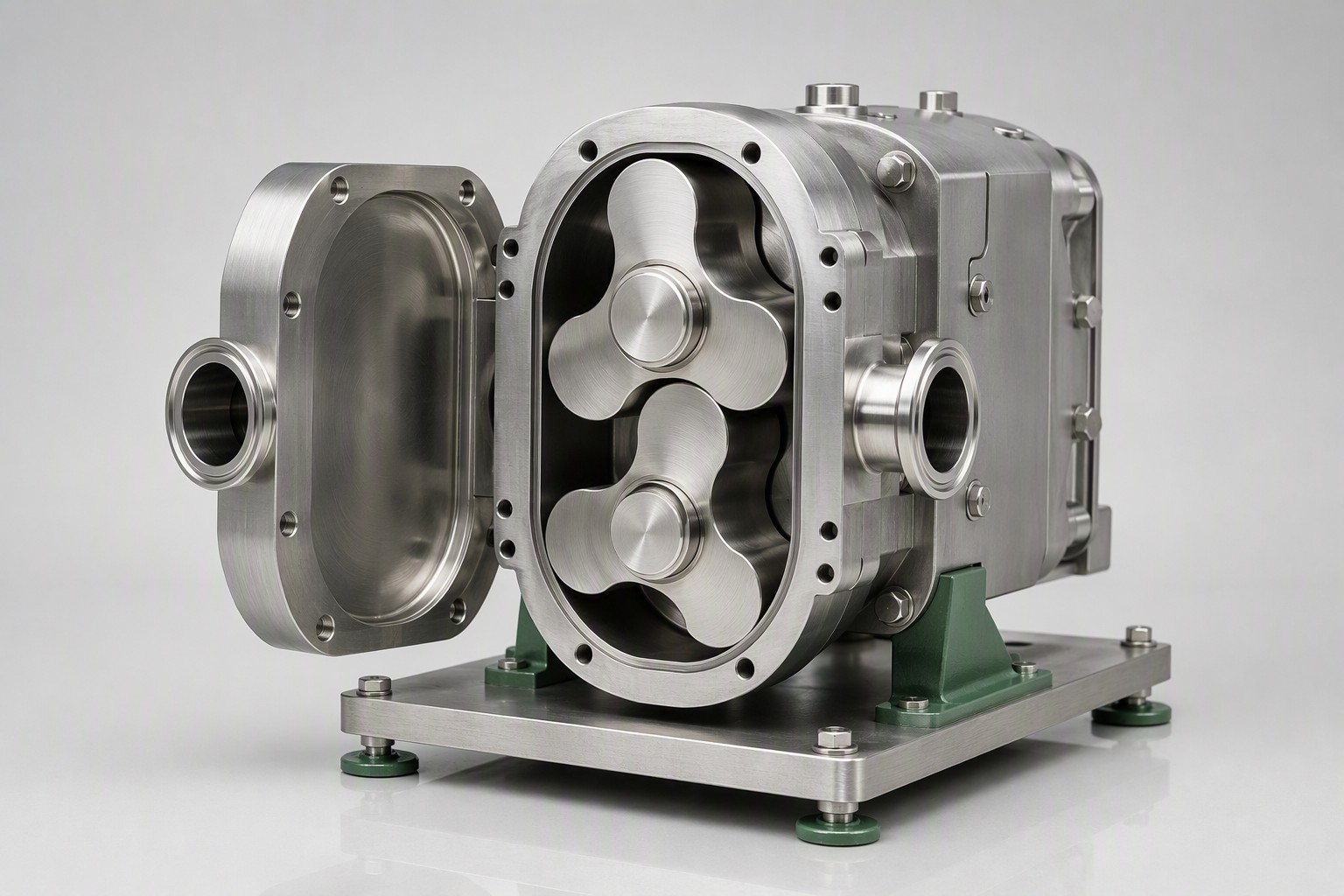
What a Sanitary Pump Actually Is
A sanitary pump — also called a hygienic pump — is built around one idea: the product it touches must never be contaminated, and the pump must be possible to clean thoroughly. That requirement drives every design decision. A food grade pump selection starts from the same principle; the defining features are:
- Food-safe wetted materials: stainless steel product-contact parts with elastomers compatible with the food or pharmaceutical recipe.
- Smooth, crevice-free surfaces: polished finishes and radiused corners give bacteria nowhere to lodge, so the pump meets hygiene audits.
- Cleanable geometry: the pump either cleans in place (CIP) with the line, or strips down quickly for manual washdown.
- Product-safe seals: shaft seals are arranged so lubricants cannot reach the product and the seal area flushes clean.
What an Industrial Pump Actually Is
An industrial pump is engineered for the process, not for the inspection. Its job is to move a liquid at the required flow and pressure, resist the medium's chemical attack, and survive years of service with straightforward maintenance. Cleanability is simply not a design target — which is what keeps an industrial machine economical. Its typical character:
- Duty-first materials: cast iron, ductile iron, coated or lined alloys chosen for strength, corrosion resistance and cost, not food contact.
- Functional internals: close clearances and compact casings maximise pressure and efficiency on clean industrial fluids.
- Industrial seals and lubrication: packed glands, standard mechanical seals and oil-lubricated gear sets that would contaminate food.
- Lower first cost: no hygienic finishing, polishing or cleanability engineering, so the same capacity costs less.
Sanitary vs Industrial Pump at a Glance
Sanitary Pump vs Industrial Pump
| Characteristic | Sanitary pump | Industrial pump |
|---|---|---|
| Primary design goal | Product safety and cleanability | Duty, pressure, durability, cost |
| Wetted materials | Stainless steel, food-safe elastomers | Cast iron, alloys, linings |
| Surface finish | Smooth and crevice-free | As-cast or machined functional |
| Lubrication | Kept away from the product | Internal oil or grease normal |
| Cleaning | CIP or full strip-down | Drain and flush only |
| Typical media | Food, beverage, dairy, pharma | Chemicals, oils, water, slurries |
| Typical industries | Food, beverage, pharmaceutical, cosmetics | Chemical, oil and gas, power, water |
The two worlds meet only when an industrial medium is also clean enough for stainless and gentle enough for hygienic geometry — which is why each family still contains several pump technologies.
The Same Technologies Serve Both Worlds
Neither label names a pump type; both describe a design standard that any pump technology can meet. A hygienic centrifugal pump moves thin liquids such as milk, juice and CIP rinse water at high flow, while a stainless rotary lobe pump handles viscous, shear-sensitive products such as yoghurt, sauces, cream and fruit pulp with low shear and low pulsation. On the industrial side the same centrifugal principle pumps water and chemicals, and screw pumps, gear pumps and other rotary designs move oils and pastes.
For pastes and shear-sensitive recipes, the rotary lobe pump in food processing is the reference configuration: non-contacting rotors never squeeze the product, so emulsions and pulps keep their structure, and the stainless build cleans in place between batches. Qingdao Green Power's verified ranges confirm the wider picture — centrifugal pumps at 1.5–1600 m³/h and 2–125 m head for thin liquids, and the G-type single screw pump at 0.1–150 m³/h and 0.6–2.4 MPa for viscous pastes — while rotary lobe pumps are treated as a technical-reference topic on this site. Confirm current model availability and specifications with Qingdao Green Power before procurement.
How to Choose: Sanitary or Industrial?
Ask what the liquid is for. If it is food, beverage, dairy, pharmaceutical or cosmetic product — or a cleaning solution that will touch them — specify a sanitary pump and select the technology by viscosity and shear sensitivity. If the liquid is a chemical, oil, utility water or waste stream, an industrial pump is correct and far more economical. The decision list:
- Thin, clean, high-flow food liquid: hygienic centrifugal pump, with materials and seals verified for food contact.
- Viscous or shear-sensitive food product: sanitary rotary lobe pump or a food-grade screw configuration for very thick pastes.
- Corrosive or aggressive industrial chemical: industrial chemical pump with wetted materials matched to the medium.
- Lubricating oil, fuel or thermal fluid: industrial rotary or centrifugal design; hygiene is irrelevant.
- When in doubt: send the full product data — composition, viscosity, temperature, solids and cleaning method — to the engineering team before choosing.
Frequently Asked Questions
What is the difference between a sanitary pump and an industrial pump?
A sanitary pump is engineered for food, beverage and pharmaceutical products: wetted parts are stainless steel with food-safe elastomers, surfaces are smooth and crevice-free so product cannot lodge or be contaminated, and the pump cleans in place or strips down easily. An industrial pump is engineered for duty — pressure, flow, chemical resistance and cost — and its materials, seals and internal geometry are usually not food-contact safe or cleanable.
Can an industrial pump be used for sanitary service?
Only if every product-contact part is food-safe and cleanable, which most industrial pumps are not: cast-iron casings, standard elastomers, oil-lubricated gear sets and internal recesses can contaminate food or harbour bacteria. Sanitary duty should always use a pump specified for hygienic service.
Which pump type is gentlest on shear-sensitive food products?
Rotary lobe pumps. Their synchronised rotors never touch each other or the casing, so emulsions, yoghurt, sauces, cream and fruit pulp move through large rounded cavities with low shear and low pulsation instead of being crushed between metal surfaces. Confirm current lobe pump model availability and specifications with Qingdao Green Power before procurement.
What data does Qingdao Green Power need to recommend a sanitary pump?
Product composition, viscosity at minimum and maximum temperature, shear sensitivity, solids content and particle size, required flow, discharge pressure, operating temperature and the cleaning method (CIP or manual). Send these to the engineering team through the contact page and they will propose a hygienic configuration; confirm current model availability and specifications before procurement.
Tell us the product you transfer — composition, viscosity, temperature, flow and cleaning method — and the engineering team will recommend a sanitary or industrial configuration that fits your process.
Get a Quote
Send your product data and duty point. Engineers reply within 24 hours.
Contact Us →💬 WhatsApp NowRelated Products
- Industrial Screw Pump
- Centrifugal Pump
Related Articles
Food Grade Pump Selection
Sanitary selection tips
Lobe Pumps in Food Processing
Gentle transfer applications
High-Viscosity Food Pump
Pastes, syrups and creams