
Cream and Dairy Pump Selection: Low-Shear Hygienic Transfer
How to choose a pump for cream and dairy products: low-shear hygienic transfer of milk, cream, yogurt and cultured dairy with stainless construction, gentle positive displacement and CIP cleanability.
A cream and dairy pump must move shear-sensitive emulsions and cultured gels without damaging them, and it must meet strict dairy hygiene standards. Low-shear positive-displacement pumps — above all sanitary rotary lobe pumps — transfer cream, yogurt and viscous dairy products gently and with low pulsation, while 316L stainless wetted parts with smooth, drainable, dead-zone-free surfaces support cleaning-in-place (CIP) between production runs.
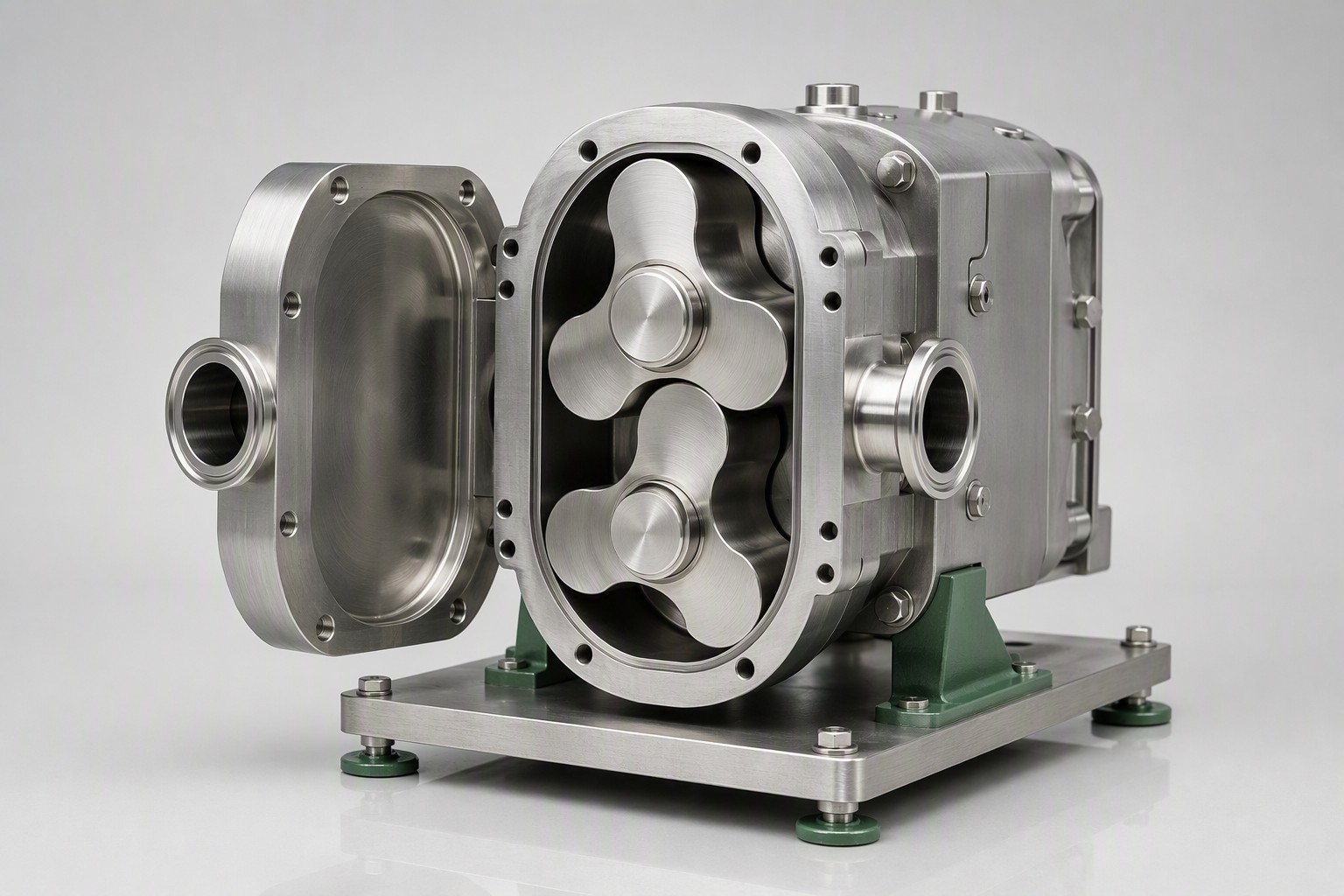
Why Cream and Dairy Products Need a Gentle Pump
Cream is an oil-in-water emulsion: microscopic fat globules are suspended in milk serum, and their structure is what gives cream its body and stability. If a pump shears the product too hard, the fat globule membranes rupture, the emulsion breaks and the cream can turn buttery or watery. Yogurt and cultured dairy are fragile gels that synerese — they leak whey — when roughly handled. Even whole milk benefits from gentle transfer: agitation damages fat globules and increases free fat that spoils flavour. Dairy products are also perishable and strictly regulated, so the pump must never become a contamination or cleaning weak point.
Core Requirements for a Dairy Transfer Pump
Dairy pumping duties combine hydraulics with food-safety engineering. Four requirements dominate: low shear, hygienic materials, complete drainability and cleaning-in-place capability.
Low shear for emulsions and cultured gels
Rotary lobe pumps are positive-displacement machines whose synchronised rotors never touch each other or the casing wall. The product travels in large rounded cavities instead of being crushed or rubbed, which keeps the fat globules and the yogurt gel intact. Because flow is proportional to speed, the pump can run slowly for gentle filling, recirculation and dosing of fruit or cultures.
Hygienic stainless construction
Wetted parts are machined in 316L stainless steel with smooth, crevice-free surfaces, polished welds and hygienic connections. There is no product-zone lubrication: the timing gearbox is separated from the pumping chamber, so oil can never contaminate the dairy product. Seals and elastomers are selected for contact with milk fat as well as hot caustic and acid cleaning solutions.
No dead zones and CIP cleanability
Dairy lines are cleaned daily, often with hot caustic, acid and sanitising steps at 70–95°C. A pump for cream and dairy duty must be self-draining with no pockets where milk solids can build up, and every internal surface must be reachable by the cleaning flow. Reversing the rotor direction of a lobe pump lets a CIP circuit flush the suction line as well as the casing; where steam sterilisation (SIP) is required, confirm that seals and elastomers are rated for the sterilising temperature.
Choosing the Pump Technology for Each Dairy Product
No single pump family serves the whole dairy plant. The table below maps common dairy products to their handling risk and the usual pump approach.
Dairy Products and Typical Pump Approach
| Product | Handling risk | Pump approach |
|---|---|---|
| Whole and skim milk | Low viscosity, fat damage | Stainless centrifugal or lobe pump at low speed |
| Cream | Emulsion shear | Low-shear rotary lobe pump |
| Yogurt, cultured dairy | Fragile gel, fruit pieces | Lobe pump with large cavities and slow speed |
| Butter, ice-cream mix | High viscosity, temperature-sensitive | Lobe or single-screw pump with controlled speed |
| Whey, rinse water, CIP | Low viscosity, hot | Stainless centrifugal pump |
For thin, low-viscosity streams such as skim milk, whey and CIP return, a stainless centrifugal pump is efficient and economical. Qingdao Green Power's centrifugal ranges deliver flows from 1.5 to 1600 m³/h with heads from 2 to 125 m and handle temperatures up to 80°C. For very viscous dairy pastes and recombined mixes, the G-type single screw pump covers 0.1–150 m³/h at pressures of 0.6–2.4 MPa and tolerates the gentle, pulseless movement these products need. Where the low-shear rotary lobe pump is specified for cream and cultured dairy, confirm current model availability and specifications with Qingdao Green Power before procurement.
Practical Checks When Sizing a Dairy Pump
Work through the product and line data before choosing a size, using the structured food-grade pump selection method as the framework.
- Suction conditions — keep suction lines short and flooded; a self-priming lobe pump empties pasteurisers and balance tanks within its vacuum limit.
- Temperature and viscosity — cold cream and butter are far more viscous than warm product; size the motor for the worst cold-start case, not the running average.
- Speed control — variable-speed drives protect emulsions during start-up, give accurate dosing of fruit or cultures, and allow slow CIP flushing.
- Seals and elastomers — verify chemical and temperature resistance against hot caustic, nitric or peracetic cleaning cycles.
- Standards and traceability — choose designs with hygienic connections, drainable casing and documented materials for audit and validation.
Two further references help confirm the technology choice. The rotary lobe pump food processing article explains how hygienic positive displacement behaves on real dairy and food lines, and the sanitary vs industrial pump comparison clarifies when a full hygienic build is mandatory and when an industrial-grade pump is acceptable. For high-viscosity or shear-sensitive semi-liquids beyond dairy — syrups, sauces, chocolate and fruit preparations — review the high-viscosity food pump guidance as well.
Frequently Asked Questions
Why is low shear important in a cream and dairy pump?
Cream is an oil-in-water emulsion and yogurt is a fragile gel. High shear ruptures the fat globule membranes or the protein gel network, causing separation, free fat, whey leakage and poor texture. Low-shear positive-displacement pumps move the product in large cavities at controlled speed, preserving the structure.
Which pump types are used for cream and dairy products?
Sanitary rotary lobe pumps are the reference for cream, yogurt and cultured dairy because their non-contacting rotors transfer gently with low pulsation. Single-screw pumps suit very viscous dairy pastes and mixes, while stainless centrifugal pumps handle low-viscosity milk, whey, rinse water and CIP flows.
Can a dairy transfer pump be cleaned in place (CIP)?
Yes. Dairy pumps are built with 316L stainless wetted parts and smooth, crevice-free, fully drainable surfaces, and reversing the rotor direction on a lobe pump helps flush the suction line. Confirm that seals and elastomers survive the cleaning temperature, chemicals and cycle time with Qingdao Green Power.
Does Qingdao Green Power supply pumps for cream and dairy duties?
For low-viscosity dairy streams Qingdao Green Power offers stainless centrifugal pumps (1.5–1600 m³/h, heads of 2–125 m, up to 80°C), and the G-type single screw pump covers viscous pastes at 0.1–150 m³/h and 0.6–2.4 MPa. For hygienic rotary lobe-style dairy duties, confirm current model availability and specifications with Qingdao Green Power before procurement.
Tell us your dairy product, viscosity, temperature, flow and CIP requirements — the engineering team will recommend the pump technology and hygienic configuration that fits your line.
Get a Quote
Send your product data and duty point. Engineers reply within 24 hours.
Contact Us →💬 WhatsApp NowRelated Products
- Centrifugal Pump
- Screw Pump
Related Articles
Food-Grade Pump Selection
Selection framework
Lobe Pumps in Food Processing
Low-shear hygienic transfer
Sanitary vs Industrial Pump
When is a hygienic build required?