
3RP Lobe Pump for Sanitary Applications: Low-Shear Hygienic Transfer
How 3RP lobe pumps serve sanitary applications: hygienic stainless construction, low-shear non-contacting rotors, self-priming behaviour and CIP cleanability for food, dairy, beverage, pharma and cosmetics lines.
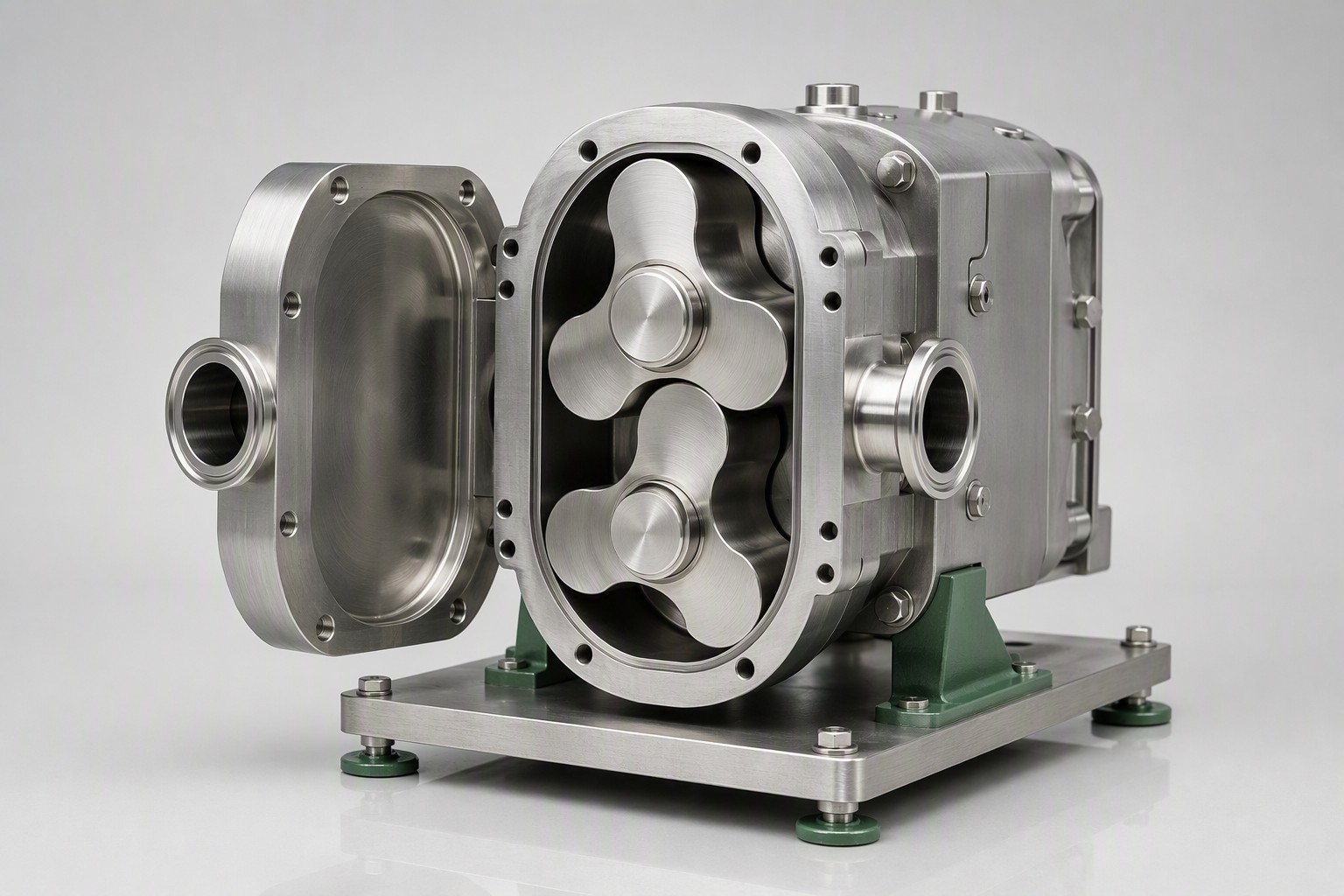
A 3RP lobe pump suits sanitary applications because its synchronised tri-lobe rotors never touch each other or the casing, so shear-sensitive products move in large, low-pulsation volumes while hygienic stainless wetted parts keep the pump cleanable. Smooth, crevice-free and drainable surfaces, hygienic mechanical seals and a separately lubricated timing gearbox support cleaning-in-place (CIP), and reversing the rotor direction flushes the suction side of the line.
What Makes an Application "Sanitary" for a Pump
A sanitary pumping duty exists wherever the liquid comes into contact with people — food, dairy, beverage, pharmaceutical and cosmetics or personal-care products. On those lines the pump has to do more than move liquid: it must protect the product from contamination, preserve its texture and composition, and prove cleanable so that residues cannot harbour micro-organisms between batches.
That is why a sanitary pump is judged on hygienic design as much as on hydraulics. Wetted parts are made from corrosion-resistant stainless steel, surfaces are smooth and free of crevices, the casing drains completely, connections avoid dead zones, and no lubricant from the drive reaches the product zone. The pump also has to be gentle, because many of these products — emulsions, gels, soft solids — are easily damaged by shear.
Hygienic Design Features and Why They Matter
Sanitary Lobe Pump Design at a Glance
| Design feature | Why it matters on sanitary duty |
|---|---|
| Hygienic stainless wetted parts | Corrosion-resistant and compatible with food, pharma and cosmetics media and cleaning chemicals |
| Smooth, crevice-free surfaces | No hiding places for residues or bacteria; faster, more reliable cleaning |
| Drainable casing and hygienic ports | Full drainage and no dead legs between batches |
| Separately lubricated timing gearbox | Gear oil never contacts the product zone |
| Hygienic mechanical seals | Single flushed or double seals protect the product and survive hot CIP cycles |
| Non-contacting tri-lobe rotors | Low shear, low pulsation and no metal-on-metal wear debris |
These features follow the same design logic used across the hygienic processing industry: easy cleaning, full drainage, no product-zone lubrication and materials that survive both the product and the cleaning regime. None of them replaces validation — the line operator still confirms cleaning effectiveness — but the pump must be designed so that cleaning can succeed.
Why Sanitary Lines Choose a Lobe Pump
Lobe pumps are positive-displacement machines, which gives them several behaviours that sanitary processes value:
- Low-shear product handling — cream, yogurt, lotions and emulsions keep their structure because the rotors never crush or rub the product.
- Self-priming within limits — the pump lifts product up a dry suction line and empties tanks, kettles and totes without external priming assist.
- Low-pulsation flow — steady discharge protects fillers, valves and in-line instruments and gives consistent dosing and portioning.
- Reverse flushing — reversing rotation back-flushes the suction line during wash-down and CIP.
- Moderate solids passage — soft pieces such as fruit pulp and particulates pass through the large rotor cavities with limited damage.
The way the twin tri-lobe rotors trap and carry the liquid — and why that protects shear-sensitive media — is explained step by step in the 3RP lobe pump working-principle guide.
Materials, Surface Finish and Seals
Product-contact parts on sanitary lobe pumps are typically machined in 304 or 316L stainless steel, selected for corrosion resistance, cleanability and compatibility with the product and the cleaning chemicals. Surface finish is part of the specification: smoother finishes on product-contact surfaces are easier to clean and are specified where the process demands it. Confirm the required finish, material grade and certificates for your duty with the supplier before ordering.
Sealing is where many sanitary duties are won or lost. A flushed single mechanical seal suits many food and beverage products, while double seals or barrier-fluid arrangements protect against difficult media, high cleaning temperatures and the risk of product contamination. Elastomer choice matters just as much: the O-rings and static seals must survive both the product and the hot caustic and acid cycles used for cleaning-in-place, so verify chemical and temperature compatibility with the manufacturer.
Cleaning-in-Place (CIP) and the Pump's Role
Sanitary lines are cleaned in place rather than stripped down: the line is flushed, washed with cleaning solution, rinsed and often sanitised without dismantling. The pump must survive those cycles with its seals and elastomers intact and must not trap product that the cleaning flow cannot reach. Reverse rotation helps flush the suction side, and a fully drainable casing lets the line empty between stages.
Cleaning temperature, flow velocity and chemical strength are set by the process, not by the pump — but the pump has to be compatible with them. Confirm the maximum cleaning temperature and the chemical resistance of the seal and elastomer materials with Qingdao Green Power for the specific configuration. For dairy, chocolate and fruit-based products, the lobe pump food-processing guide looks at the same CIP question from the food side.
Where Sanitary Lobe Pumps Are Used
- Dairy — cream, yogurt, cultured products and desserts, where emulsion and gel structure must survive pumping.
- Beverages and liquid food — syrups, honey, pulpy juices, sauces and dressings, from thin liquids to viscous pastes.
- Cosmetics and personal care — lotions, creams, gels, shampoos and ointments where appearance and texture are the product.
- Pharmaceutical and biotech intermediates — emulsions, suspensions and viscous bases handled with hygienic, validated equipment.
Where the choice is between a lobe pump and other rotary designs, gentleness and cleanability are usually decisive: a gear pump's meshing teeth shear emulsions and give less room for cleaning access, as the 3RP lobe pump vs gear pump comparison shows in detail.
3RP lobe pumps are treated on this site as a technical-reference topic — confirm current model availability and specifications with Qingdao Green Power before procurement.
Frequently Asked Questions
What makes a pump suitable for sanitary applications?
A sanitary pump uses corrosion-resistant stainless wetted parts with smooth, crevice-free, fully drainable surfaces, hygienic connections and seals, and no product-zone lubrication, so it can be cleaned in place and cannot contaminate the product. Lobe pumps add low-shear, low-pulsation transfer, which protects emulsions, gels and soft particulates.
Can a 3RP lobe pump be cleaned in place (CIP)?
Yes. Rotary lobe pumps can be built with hygienic stainless wetted parts and smooth internal surfaces that suit cleaning-in-place circuits, and reversing the rotor direction helps flush the suction line. Confirm the cleaning temperature, chemicals and cycle time against the seal and elastomer materials with Qingdao Green Power.
Which sanitary products can a lobe pump handle?
Cream, yogurt and cultured dairy, syrups, honey, pulpy juices, sauces, dressings, lotions, creams, gels, shampoos and pharmaceutical emulsions or viscous bases — shear-sensitive, viscous or particulate media where gentle low-pulsation transfer protects product quality.
Are 3RP lobe pumps a current Qingdao Green Power core product?
3RP lobe pumps are treated on this site as a technical-reference topic. Confirm current model availability and specifications with Qingdao Green Power before procurement.
Tell us your product, viscosity, temperature, flow and CIP cycle — the engineering team will advise the right sanitary pump configuration for your line.
Get a Quote
Send your product data and duty point. Engineers reply within 24 hours.
Contact Us →💬 WhatsApp NowRelated Products
- Centrifugal Pump
- Industrial Screw Pump
Related Articles
What Is a 3RP Rotary Lobe Pump?
Technology overview
3RP Lobe Pump for High-Viscosity Fluids
Viscous hygienic transfer
3RP Lobe Pump for Chemical Applications
Compatibility guidance