
3RP Lobe Pump vs Centrifugal Pump
A practical lobe pump vs centrifugal pump comparison: how positive displacement and kinetic designs differ in flow behaviour, discharge pressure, viscosity range, pulsation, shear and solids handling — and how to choose the right technology.
A 3RP lobe pump is a positive displacement machine whose two synchronised tri-lobe rotors trap a fixed volume of liquid per revolution, while a centrifugal pump is a kinetic machine whose impeller adds velocity that the casing converts into pressure. Choose the lobe pump for viscous, shear-sensitive, self-priming or hygienic duties at moderate flow; choose the centrifugal pump for high-volume, low-viscosity water-like liquids.
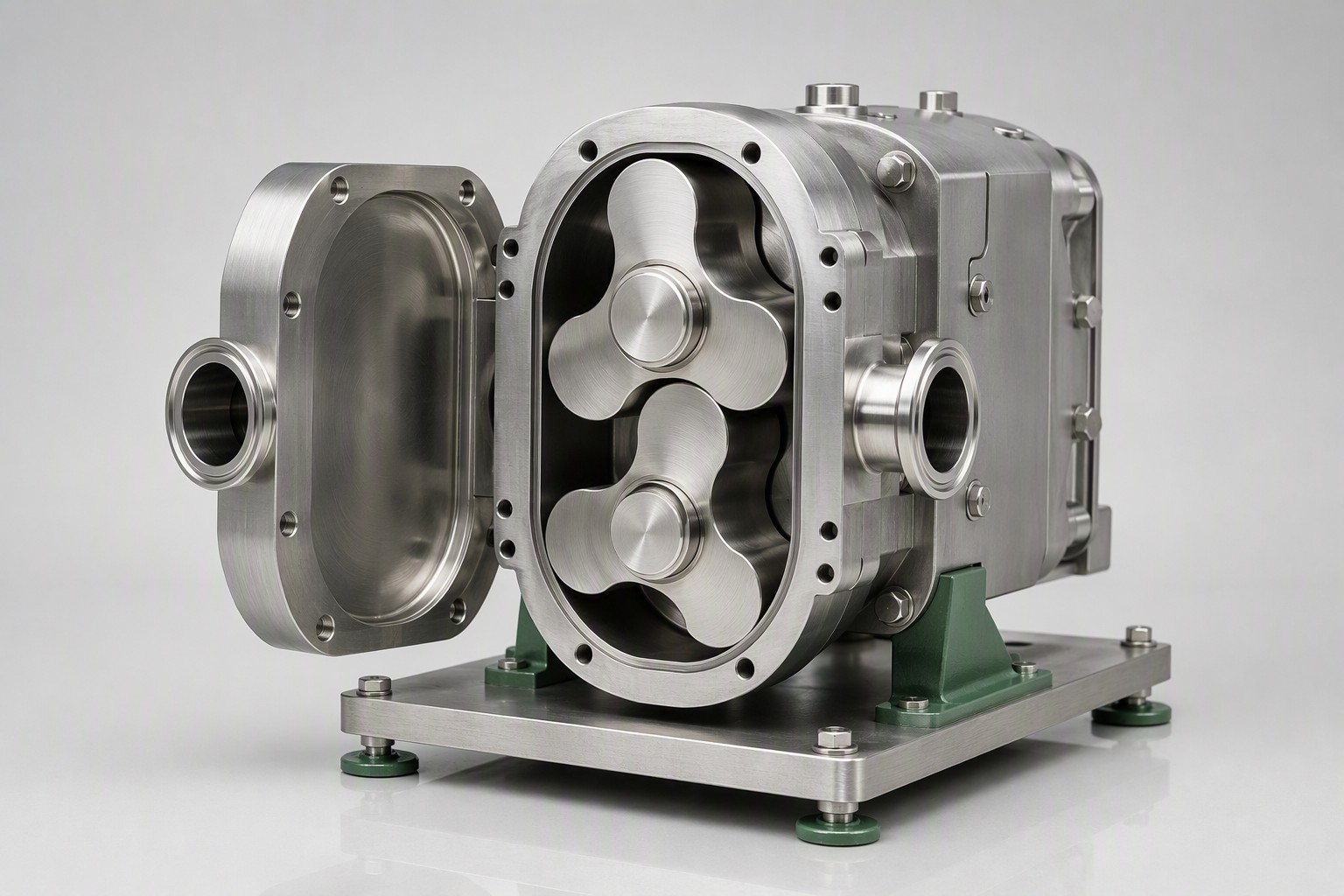
Positive Displacement vs Kinetic: Two Ways to Move Liquid
The rotary lobe pump belongs to the positive displacement (PD) family. Each shaft revolution displaces a fixed volume of liquid, so flow is largely proportional to rotor speed, and discharge pressure rises until it matches the system demand. Because the tri-lobe rotors are synchronised by timing gears and never touch each other or the casing, liquid is carried in large rounded cavities — gently, with low pulsation and no metal-to-metal wear.
The centrifugal pump belongs to the kinetic (rotodynamic) family. An impeller spins at high speed and throws liquid outward by centrifugal force; the volute or diffuser then converts that velocity energy into pressure. At a fixed speed the pump follows its performance curve, so the flow delivered is governed by the system resistance rather than by the machine alone.
Lobe Pump vs Centrifugal Pump: Key Differences
Rotary Lobe Pump vs Centrifugal Pump at a Glance
| Characteristic | Rotary lobe pump (PD) | Centrifugal pump (kinetic) |
|---|---|---|
| Flow behaviour | Fixed volume per revolution — flow follows speed | Flow follows system resistance at fixed speed |
| Pressure | Rises to meet system demand, bounded by relief valve | Limited by impeller head; falls as flow rises |
| Viscosity handling | Strong — thin liquids to thick pastes | Weak above moderate viscosity — efficiency drops |
| Shear on product | Low — non-contacting rotors | Higher shear at impeller tips |
| Self-priming | Yes, within its vacuum limit | No — flooded suction or a priming device needed |
| Pulsation | Low pulsation at rotor frequency | Smooth, continuous flow at a stable duty point |
| Typical duty | Viscous, hygienic, shear-sensitive media | Large volumes of clean, low-viscosity liquid |
Viscosity: The Crossover That Often Decides
Viscosity is usually the first filter in the choice. Centrifugal performance erodes as viscosity rises because friction losses in the impeller and casing grow quickly. Positive displacement pumps behave in the opposite way — internal slip falls as viscosity rises, so volumetric efficiency actually improves.
That crossover is why Qingdao Green Power's published guidance for its centrifugal pump range states: best for water and low-viscosity process liquids, with a switch to a gear or screw pump above about 150 cSt. The IS/ISW centrifugal series covers 1.5–1600 m³/h, head 2–125 m, power 0.18–250 kW and temperatures up to 80 °C. A rotary lobe pump sits in the same positive displacement family and is the preferred choice when the duty also demands low shear, hygiene, solids passage or self-priming — see the guidance on lobe pumps for high-viscosity fluids.
Where the Rotary Lobe Pump Wins
- Shear-sensitive products — food, dairy, cosmetic and polymer media keep their structure because nothing rubs or crushes them.
- Viscous and sticky fluids — syrups, honey, resins and pastes move reliably with positive displacement force.
- Self-priming and line stripping — the PD action lifts liquid up a dry suction line and empties tanks and vessels.
- Reversibility — reversing rotor direction flushes the line and supports CIP circuits in hygienic plants.
Where the Centrifugal Pump Wins
- High flow at low head — moving large volumes of water-like liquid per hour is centrifugal territory.
- Compactness and cost per m³ — simple construction, low first cost and low maintenance on clean liquids.
- Constant, non-pulsating flow — ideal where a smooth continuous stream matters.
- Solids-laden water duties — special impeller designs pass rags, fibres and grit where a lobe pump would not be appropriate.
How to Choose: A Practical Selection Path
Start from the duty, not the pump name. If your liquid is viscous, shear-sensitive or must be lifted up a dry suction line, begin with the 3RP rotary lobe pump overview and the lobe pump working principle to confirm the technology fits. If your service is clean water or a low-viscosity process liquid at high flow and continuous duty, a centrifugal pump is usually the more economical answer, matched to your flow and head rather than a catalogue maximum.
Define the complete operating envelope before specifying: normal, minimum and maximum flow; discharge pressure or head; liquid viscosity, temperature and solids content; available NPSH; and the shear sensitivity of the product. Any technology can be misapplied when a single parameter drives the decision.
3RP lobe pumps are treated on this site as a technical-reference topic — confirm current model availability and specifications with Qingdao Green Power before procurement.
Frequently Asked Questions
What is the main difference between a lobe pump and a centrifugal pump?
A lobe pump is a positive displacement machine: two synchronised tri-lobe rotors trap a fixed volume per revolution, so flow follows speed and pressure rises to match the system. A centrifugal pump is a kinetic machine: an impeller adds velocity that the casing turns into pressure, so at fixed speed flow follows the system resistance and pressure is limited by the impeller head.
At what viscosity should I switch from a centrifugal pump to a lobe pump?
Centrifugal pump performance erodes as viscosity rises because friction losses grow in the impeller and casing. Qingdao Green Power guidance is to switch to a gear or screw pump above about 150 cSt; a rotary lobe pump is the positive displacement choice when the duty also needs low shear, hygiene, solids passage or self-priming. Confirm current specifications with Qingdao Green Power.
Can a lobe pump handle the same high flow as a centrifugal pump?
Not usually in the same size class. Centrifugal pumps are built for high-volume, low-viscosity transfer — Qingdao Green Power's IS/ISW centrifugal series covers roughly 1.5–1600 m³/h for water and low-viscosity liquids up to 80 °C. Rotary lobe pumps are selected for viscous, shear-sensitive or self-priming duties at moderate flow rather than for moving very large volumes of clean water.
Are 3RP lobe pumps a current Qingdao Green Power core product?
3RP lobe pumps are treated on this site as a technical-reference topic. Confirm current model availability and specifications with Qingdao Green Power before procurement.
Send your duty point — liquid, viscosity, temperature, flow and pressure — and the engineering team will tell you whether a lobe pump or a centrifugal pump fits best.
Get a Quote
Send your fluid data and duty point. Engineers reply within 24 hours.
Contact Us →💬 WhatsApp NowRelated Products
- Centrifugal Pump
- Industrial Screw Pump
Related Articles
What Is a 3RP Rotary Lobe Pump?
Technology overview
3RP Lobe Pump Working Principle
How the rotors move liquid
Lobe Pumps for High-Viscosity Fluids
Thick-media handling guide