
3RP Lobe Pump for High-Viscosity Fluids: Moving Thick Media Gently
How 3RP lobe pumps move high-viscosity fluids: positive-displacement transfer of polymers, resins, syrups, heavy oils and pastes, with low-speed torque, sealing and sizing guidance for thick media.
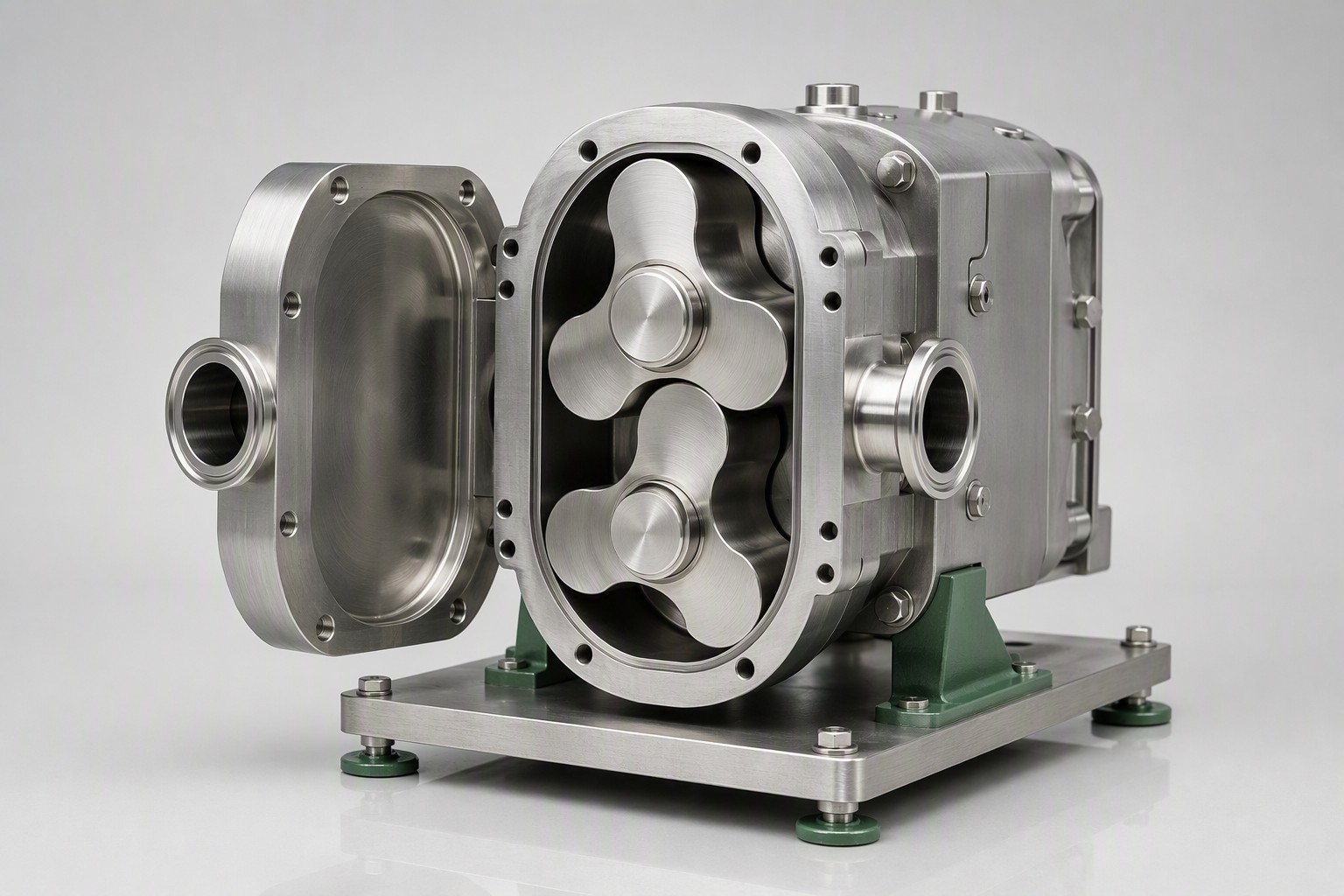
A rotary lobe pump handles high-viscosity fluids by positive displacement: two synchronised tri-lobe rotors trap a fixed volume of liquid each revolution and carry it from suction to discharge, so flow holds up as viscosity rises instead of collapsing as in a centrifugal pump. The rotors never touch each other or the casing, keeping shear low even on thick media, and higher viscosity actually reduces internal slip. Model availability and specifications must be confirmed with Qingdao Green Power for the specific duty.
Why High-Viscosity Media Break the Centrifugal Rule
A centrifugal pump accelerates liquid with an impeller and converts velocity into pressure. That mechanism relies on the liquid being thin enough to move easily between the vanes. As viscosity rises, friction inside the pump and piping grows quickly: head and efficiency fall, the pump may fail to deliver its rated flow, and thick pastes can simply stall the impeller. Positive displacement machines follow a different rule. As the 3RP lobe pump working principle shows, the pump pushes a fixed volume per revolution regardless of the fluid's resistance, which is why lobe, gear and screw pumps take over once viscosity climbs beyond centrifugal limits.
How the Lobe Pump Behaves on Thick Fluids
- Low speed, high torque — viscous duty needs slow rotor speed with a speed reducer or larger drive, not impeller velocity.
- Slip falls as viscosity rises — leakage back through internal clearances falls in thick media, so volumetric efficiency improves exactly where centrifugal pumps struggle.
- Large, open cavities — the space between lobes and casing carries the product without forcing it through narrow gaps.
- Non-contacting rotors — timing gears keep the lobes apart, so stringy polymers and shear-sensitive pastes are not crushed or smeared.
- Steady, low-pulsation flow — speed sets the flow rate, so the pump can meter viscous additives and fillers.
Typical High-Viscosity Duties
- Polymers and resins — viscous, stringy and often shear-sensitive media moved slowly without degrading molecular structure.
- Adhesives and sealants — tacky, elastic products transferred from drums, totes and reactors and metered to the line.
- Syrups, molasses, honey and glucose — heavy food-grade liquids transferred at low speed; food-safe builds are covered separately.
- Paints, inks and pigment pastes — thick dispersions where gentle, uniform pumping preserves colour strength and filler distribution.
- Heavy oils, greases and waxes — products whose cold-start viscosity is far above the running value.
When a viscous product is also chemically aggressive, review the material and seal guidance in the 3RP lobe pump for chemical applications guide before specifying the build.
Viscous Duty Considerations at a Glance
| Medium | Main challenge | Why a lobe pump fits |
|---|---|---|
| Polymer, resin | Stringing, shear | Low-speed, large-cavity displacement |
| Adhesive, sealant | Tack, elasticity | Gentle positive displacement |
| Syrup, molasses, honey | Heavy food liquid | Low-shear, food-safe build options |
| Paint, ink, pigment paste | Shear-sensitive fillers | Uniform low-pulsation transfer |
| Heavy oil, grease, wax | Cold-start torque | Timing-gear drive with torque reserve |
Sizing Checks for a High-Viscosity Duty
- Cold-start viscosity — a product that flows at operating temperature can be extremely thick at start-up; this value, not the running viscosity, sets the required shaft torque.
- Speed and gear ratio — select rotor speed for the viscosity class; very thick media need a speed reducer between motor and pump.
- Shaft power — power consumption rises with viscosity and pressure, so confirm the drive margin, especially for batch processes that start against a full line.
- Inlet conditions — high viscosity raises friction loss in the suction line and slows refill of the rotor cavities; keep suction piping short, use a flooded inlet where possible and verify available NPSH.
- Relief protection — a positive displacement pump must never discharge against a closed valve; confirm the relief-valve setting protects the pump and piping.
- Heating and jacketing — jackets on the casing or heat-traced lines lower cold-start viscosity and are often the cheapest fix for a stiff product.
- Seals and elastomers — confirm seal and elastomer compatibility with the fluid and its temperature; some viscous products lubricate seal faces poorly at start-up.
Lobe, Gear or Screw: Matching the Technology to the Fluid
All three are positive displacement machines; the choice follows the product. A rotary lobe pump wins where the fluid is shear-sensitive, contains soft solids, or needs gentle, metered transfer with self-priming behaviour. For clean, lubricating heavy oils at higher discharge pressure, a gear pump is compact and efficient, while an industrial screw pump is a proven choice for very high viscosity and large capacities. Define viscosity at running and start-up temperature, then let the engineering team match rotor size, speed and drive to the duty.
3RP lobe pumps are treated on this site as a technical-reference topic — confirm current model availability and specifications with Qingdao Green Power before procurement.
Frequently Asked Questions
How viscous can the fluid be for a 3RP lobe pump?
Rotary lobe pumps move everything from water-thin liquids to heavy pastes, with suitable configurations handling media well above 1,000,000 cP. The practical limit for a given duty depends on rotor size, speed, drive power and inlet conditions. Confirm current model availability and specifications with Qingdao Green Power before procurement.
Does a lobe pump need a gearbox for high-viscosity service?
Usually yes. Viscous fluids call for low rotor speed and high torque, so a speed reducer with a suitably sized motor is typical. Confirm the drive configuration and torque requirement with Qingdao Green Power for your viscosity and flow.
Why does a lobe pump outperform a centrifugal pump on thick fluids?
A centrifugal pump's head and efficiency fall sharply as viscosity rises, but a positive displacement lobe pump transfers a fixed volume per revolution, and higher viscosity actually reduces internal slip. Thick pastes and polymers therefore move reliably at controlled speed with low shear.
Are 3RP lobe pumps a current Qingdao Green Power core product?
3RP lobe pumps are treated on this site as a technical-reference topic. Confirm current model availability and specifications with Qingdao Green Power before procurement.
Tell us your product and its viscosity at running and start-up temperature, plus flow and pressure — the engineering team will recommend the rotor size, speed and drive for your duty.
Get a Quote
Send your fluid data and duty point. Engineers reply within 24 hours.
Contact Us →💬 WhatsApp NowRelated Products
- Industrial Screw Pump
- Centrifugal Pump
Related Articles
What Is a 3RP Rotary Lobe Pump?
Technology overview
3RP Lobe Pump Working Principle
How lobe pumps operate
Lobe Pump vs Gear Pump
Head-to-head comparison