
Complete Industrial Pump Buying Guide
How to buy an industrial pump the right way: translate flow, head, viscosity, temperature, solids and NPSH into the correct pump family, then match each service to a verified Qingdao Green Power series.
Buy an industrial pump by matching the machine to the liquid's behaviour, not by picking a catalogue number. Start with the duty point — flow, head, viscosity, temperature, solids and NPSH — and the correct family emerges: centrifugal pumps for thin liquids, screw or gear pumps above roughly 150 cSt, chemical-lined pumps for corrosives, and dedicated series for thermal oil, wastewater and vacuum. Qingdao Green Power publishes verified ranges for each of these services, which makes the shortlist step straightforward.
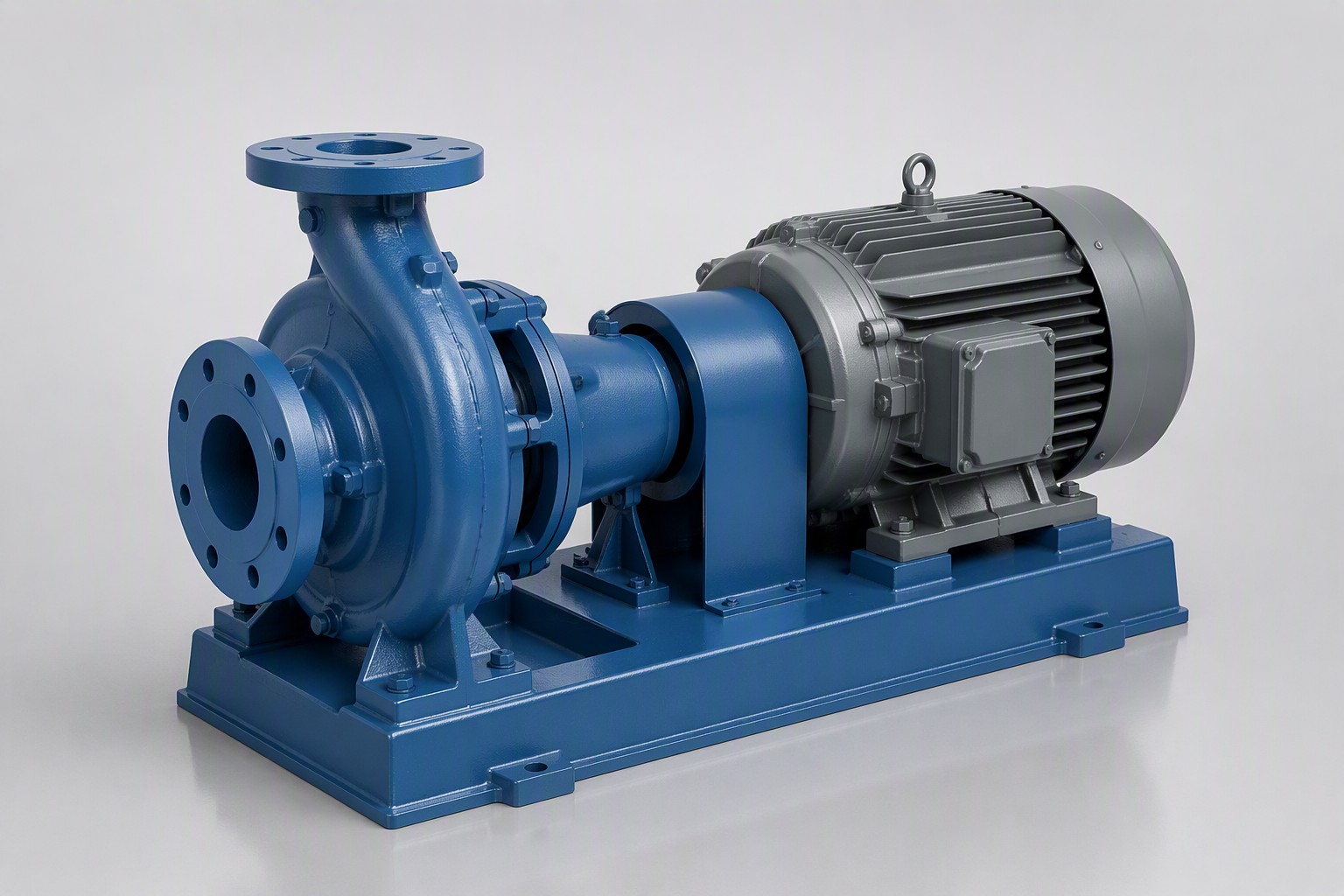
Step 1: Fix the Duty Point with Fluid Data
Every reliable industrial pump purchase starts from the same data set: flow rate in m³/h, total head or discharge pressure, the liquid and its operating temperature, specific gravity, viscosity and available NPSH, plus solids content and whether the duty is continuous or intermittent. Record the fluid properties at the coldest and hottest operating conditions — the article on pump selection and fluid properties explains which numbers matter most. An incomplete duty point is the most common reason a new pump underperforms.
Step 2: Choose the Pump Family That Fits the Liquid
With the duty point fixed, the first branch of the decision is centrifugal versus positive displacement. Centrifugal pumps suit water and thin, low-viscosity process liquids that need continuous, non-pulsating flow: Qingdao Green Power publishes its IS/ISW industrial centrifugal pump range at 1.5–1600 m³/h flow, 2–125 m head and liquid temperatures up to 80 °C. Above roughly 150 cSt, centrifugal efficiency falls sharply and a gear or screw pump becomes the correct answer — see our high-viscosity pump application guide for the crossover rules.
Quick Map: Duty to Qingdao Green Power Series
| Service | Liquid profile | Series | Published range |
|---|---|---|---|
| Water & low-viscosity process | Thin, clean liquids, ≤80 °C | IS / ISW centrifugal | 1.5–1600 m³/h, head 2–125 m |
| Corrosive chemicals | Dilute to strong acids & alkalis | IH stainless / IHF fluoroplastic-lined | 3.5–400 m³/h, head 4.5–125 m |
| High-viscosity, shear-sensitive media | Above ~150 cSt | G-type single screw | 0.1–150 m³/h, 0.6–2.4 MPa |
| High-temperature oil | Thermal oil / HTF to 350 °C | RY circulation; 3GB triple screw | RY 1–500 m³/h, 1–12.5 bar; 3GB 2.4–241.7 m³/h |
| Wastewater & solids | Sewage, sludge, slurries | ZW solids-handling; ZJL/LZ submerged | ZW 5–800 m³/h; ZJL/LZ 2–600 m³/h |
| Space-saving boosting | Clean water, HVAC, boosting | ISG vertical inline / GDL multistage | 1.6–1200 m³/h, head 5–150 m |
If the application is vacuum rather than liquid transfer, treat it separately — the 2BV liquid ring pump handles wet gas streams down to 0.097 MPa absolute and is reviewed on the vacuum pump product page. The table is a starting map, not a substitute for a quoted duty point.
Step 3: Check NPSH, Suction and Installation
Available NPSH at the pump suction must exceed the pump's required NPSH with a safety margin, or the pump will cavitate; long suction lines, strainers, hot liquid and low tank levels all reduce the available value, so calculate at the worst case. Then fix the installation geometry: horizontal end-suction pumps suit conventional baseplates and typically show lower required NPSH, while vertical inline pumps such as ISG mount directly in the pipeline to save floor space. For liquid in a below-grade tank or pit, a submerged vertical pump avoids poor suction conditions altogether.
Step 4: Select Materials, Seals and Drive
Corrosiveness decides the wetted materials. Qingdao Green Power's IH series in SS304 or SS316L covers mild chemicals and dilute acids and alkalis up to 80 °C, while the IHF fluoroplastic-lined series handles strong acids, strong alkalis and oxidising agents up to 100 °C — compatibility should always be verified against the specific concentration. For aggressive duties consider a double mechanical seal; for clean water a single seal usually suffices. The motor choice needs voltage, frequency, IP rating and enclosure to match the site, and high-temperature services such as the RY thermal oil series add their own sealing and cooling rules — natural air-cooling fins mean no external cooling water is required. The chemical industry pump guide covers material selection in more depth.
Step 5: Budget the Whole-Life Cost
The cheapest quotation is rarely the cheapest pump: compare efficiency at the actual duty point, seal and wear-part life, dry-run protection and ease of maintenance, then add the energy cost over the expected service life. Retrofits on existing installations often pay back faster than a new purchase — see our pump efficiency improvement article for the options worth evaluating first.
Application Shortcuts for Common Industries
Industry-specific media narrow the choice quickly. For guidance by sector, start with these four paths through the knowledge base:
- Chemical processing — industrial pumps for the chemical industry and the IH/IHF chemical pump range.
- Oil and fuel transfer — industrial oil transfer pump guidance for lubricants, fuels and thermal oil.
- High-viscosity and slurry media — high-viscosity pump application guide and the screw pump product range.
- Wastewater and sewage — wastewater pump selection guide for solids-handling and submerged duty.
Confirm current model availability and specifications with Qingdao Green Power before procurement — published ranges change as models are upgraded.
Frequently Asked Questions
What data do I need before buying an industrial pump?
The essential set is flow rate (m³/h), total head or discharge pressure, the liquid and its temperature, specific gravity and viscosity, available NPSH, and the installation layout. Corrosive or abrasive media also require a material and seal decision. Send these with the duty point to Qingdao Green Power and the engineering team will shortlist the matching pump family.
How do I choose between a centrifugal and a positive displacement pump?
Centrifugal pumps fit thin, low-viscosity liquids needing continuous, non-pulsating flow — Qingdao Green Power's IS/ISW range is published at 1.5–1600 m³/h, 2–125 m head and up to 80 °C. Above roughly 150 cSt, efficiency drops sharply and a positive displacement pump such as a gear or screw pump is the better choice, especially when flow must stay steady against changing pressure.
Which pump series suits water, chemicals, oils, wastewater or vacuum duty?
As a starting map: IS/ISW centrifugal pumps for water and process liquids; IH stainless and IHF fluoroplastic-lined pumps for corrosive chemicals; RY pumps for thermal oil and the 3GB triple-screw series for high-temperature oil; ZW and ZJL/LZ pumps for wastewater and solids; and the 2BV liquid ring pump for wet vacuum service. Confirm current model availability and specifications with Qingdao Green Power before procurement.
Why is viscosity the most important fluid property in a buying decision?
Viscosity changes both the pump technology and the power required. Below about 150 cSt a centrifugal pump performs economically — Qingdao Green Power's IS/ISW series covers 1.5–1600 m³/h at 2–125 m head up to 80 °C. As viscosity climbs above roughly 150 cSt, centrifugal performance falls and positive displacement machines such as gear or screw pumps hold flow steady; the G-type single-screw pump is published at 0.1–150 m³/h and 0.6–2.4 MPa for high-viscosity media.
Send your duty data — flow, head, liquid, temperature and viscosity — and the engineering team will shortlist the right pump family and configuration.
Get a Quote
Send your fluid data and duty point. Engineers reply within 24 hours.
Contact Us →💬 WhatsApp NowRelated Products
- IS/ISW Centrifugal Pump
- G-Type Screw Pump
Related Articles
Industrial Pumps for Chemicals
Materials and seal selection
High-Viscosity Pump Guide
When to go positive displacement
Pump Efficiency Improvement
Cut operating cost