
3RP Lobe Pump Maintenance Guide: Preventive Care and Troubleshooting
Practical 3RP lobe pump maintenance guidance: daily and weekly operator checks, gearbox oil care, mechanical seal protection, rotor clearances and troubleshooting common faults to keep uptime high.
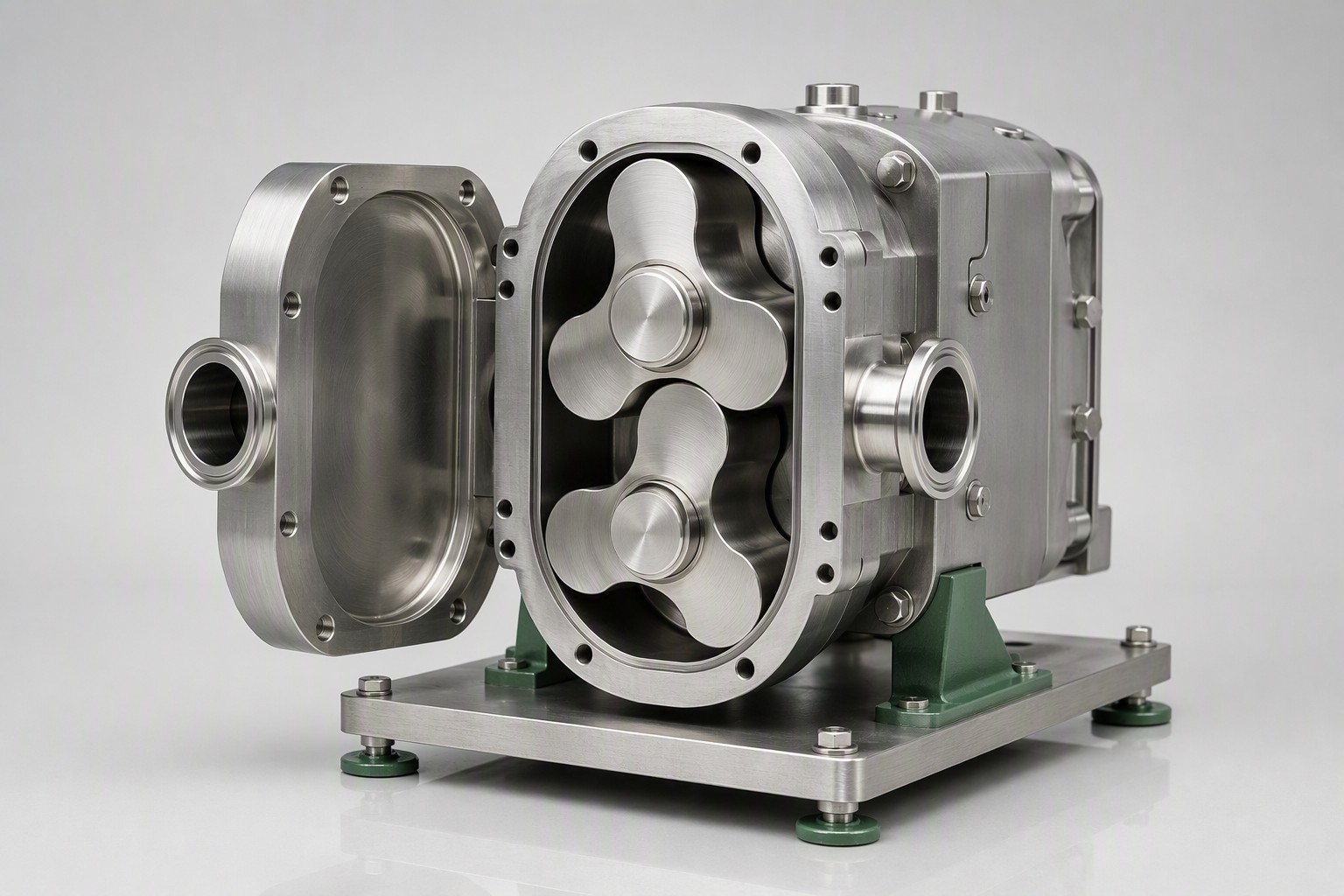
Keep the timing-gear oil clean, protect the mechanical seal from dry running, guard the suction against starvation and check rotor clearances on a planned schedule — that covers most 3RP lobe pump maintenance. Because the tri-lobe rotors never touch each other or the casing, wear concentrates in the seals, bearings and timing gears rather than in the pumping chamber, so a preventive programme built around those components gives the longest service life and the lowest unplanned downtime.
Why a Lobe Pump Needs Its Own Maintenance Routine
A rotary lobe pump is a positive-displacement machine whose two synchronised tri-lobe rotors are driven through an oil-lubricated timing gearbox. Because the rotors never touch each other or the casing, the fine running clearances, the mechanical seal and the timing gears do the real work and need regular attention.
Unlike a centrifugal pump, a lobe pump is not maintained by simply watching the motor current and the stuffing box. Its performance depends on internal clearances that change slowly with wear, on seal condition and on oil condition. If you are new to this pump family, the 3RP lobe pump working-principle guide explains how the lobes, timing gears, seal and clearances share the duty before you start servicing the machine.
Daily and Weekly Operator Checks
The fastest way to catch a developing fault is a short, consistent walk-around — most lobe pump failures announce themselves through noise, heat, leaking or a change in flow first.
- Listen for noise and vibration — a steady hum is normal; rattling or whining signals cavitation, air ingress or a bearing problem.
- Watch discharge pressure and flow — a gradual drop usually means internal slip or a blocked suction; a sudden change points to the relief valve, coupling or drive.
- Check the mechanical seal area — a small weep can be normal on some designs, but an increasing leak or spray needs immediate attention.
- Verify the gearbox oil level at the sight glass or dipstick, and look for water droplets or a milky colour that indicate contamination.
- Feel the gearbox and casing temperature — a casing far hotter than the pumped liquid suggests excessive slip or a dead-headed line.
- Confirm the suction strainer is clean — on viscous or solids-laden media it is the most common cause of starvation.
Gearbox Oil and Lubrication Care
The timing gearbox has its own oil charge that must stay clean and at the correct level. Water wash-down, condensation and gear wear debris all degrade the oil over time, and contaminated oil is a leading cause of premature timing-gear and bearing failure.
As a general practice, change the oil after the initial break-in period and then at the interval stated in the OEM manual — typically every few thousand operating hours. Keep the breather clean and investigate sudden oil consumption or metal particles rather than simply topping up. Confirm the recommended oil type and change interval for the specific configuration with Qingdao Green Power before procurement.
Mechanical Seal Care
The mechanical seal is the most common wear item on a lobe pump because it is the only wetted component with sliding faces. It must always see liquid at the faces: continuous dry running overheats the faces and destroys the seal in a short time, even though the non-contacting rotors themselves tolerate brief dry periods.
- Never dead-head the pump against a closed discharge valve — test the relief valve setting periodically.
- Keep any flush or quench supply running when the pump is in service; flushed single and double seals protect the faces on hot or abrasive media.
- Match elastomers to the liquid — an incompatible O-ring swells, hardens or leaks long before the metal parts show damage.
Rotor Clearances and Slip
Flow loss on a lobe pump is usually slip — liquid leaking backwards past the rotor tips when the pump is under pressure. As the rotors, liner and casing faces wear, slip grows and the pump delivers less flow at the same speed, especially with low-viscosity liquids.
Measure and record the rotor tip and end clearances at each scheduled service, because a trend is more useful than a single reading. Clearances are restored with replaceable wear parts, so keep a rotor kit and liner in store for critical duties and set clearances with the OEM procedure.
Preventive Maintenance Schedule at a Glance
| Interval | What to check | Typical action |
|---|---|---|
| Daily | Noise, vibration, leaks, pressure, flow, oil level | Record readings; investigate any change |
| Weekly | Strainer, seal weep rate, coupling alignment, casing temperature | Clean strainer; adjust or report |
| Every 2,000–3,000 hours | Oil condition, seal faces, rotor clearances, relief valve | Change oil; test relief valve; measure clearances |
| Annually / major service | Rotors, liner, bearings, timing gears, elastomers | Overhaul with OEM wear kits; replace elastomers |
Intervals above are general preventive-maintenance practice — always follow the OEM manual for the specific pump, duty and operating hours.
Troubleshooting Common Lobe Pump Faults
When a lobe pump misbehaves, work from the outside in: check the system first, then the pump, and only then strip the machine. The 3RP lobe pump guide for high-viscosity fluids covers the suction and speed strategy where cold-start viscosity is the root cause.
Low flow or low discharge pressure
Blocked suction strainer, starved suction, air ingress on the inlet, drive speed set too low, relief valve bypassing, or internal slip from worn rotors, liner or timing gears. Confirm the discharge valve is open before suspecting the pump.
Noise, vibration or cavitation
Insufficient NPSH, viscous liquid at cold start, a partially blocked suction line, air entrainment, coupling misalignment, or worn bearings and timing gears. Reduce speed and improve suction conditions before major disassembly.
Seal leakage or overheating
Dry running, a failed flush supply, wrong elastomer for the chemical or temperature, or recirculation against a closed valve. Stop the pump, confirm the flush circuit and inspect the seal at the next planned shutdown.
Cleaning, Flushing and Hygienic Service
On food, dairy and hygienic lines the cleaning routine is part of maintenance: flushing between products, hot washing and cleaning-in-place (CIP) cycles all stress the seal and elastomers. Reversing the rotor direction back-flushes the suction line, but confirm the cleaning temperature, chemicals and cycle time against the seal specification. The 3RP lobe pump sanitary applications guide explains what the cleaning regime demands from the pump.
3RP lobe pumps are treated on this site as a technical-reference topic — confirm current model availability and specifications with Qingdao Green Power before procurement.
Frequently Asked Questions
What does routine maintenance on a 3RP lobe pump include?
Routine lobe pump maintenance covers daily operator checks for noise, vibration, leaks, flow and discharge pressure; regular timing-gear oil level and condition checks; mechanical seal inspection and flush verification; planned rotor tip-clearance measurement; and periodic relief-valve testing. Follow the documented schedule and the OEM manual for the specific configuration.
Why has my lobe pump lost flow or discharge pressure?
The usual causes are a blocked suction strainer or starved suction, air ingress on the inlet side, running speed set too low, a relief valve bypassing, or growing internal slip from worn rotors, liner or timing gears. Work through the suction conditions first, then measure internal clearances during a scheduled service.
Can a 3RP lobe pump run dry during cleaning or start-up?
The non-contacting rotors tolerate short dry-running periods better than gear pumps, but the mechanical seal needs liquid at its faces and continuous dry running will overheat and destroy it. Keep the casing primed or use a flush during cleaning and start-up, and confirm the dry-run capability of the specific configuration with Qingdao Green Power.
Are 3RP lobe pumps a current Qingdao Green Power core product?
3RP lobe pumps are treated on this site as a technical-reference topic. Confirm current model availability and specifications with Qingdao Green Power before procurement.
Send us your pump duty, operating hours and the fault symptoms you see — the engineering team will advise the right service plan and spare parts for your lobe pump.
Get a Quote
Send your fluid data and duty point. Engineers reply within 24 hours.
Contact Us →💬 WhatsApp NowRelated Products
- Industrial Screw Pump
- Centrifugal Pump
Related Articles
What Is a 3RP Rotary Lobe Pump?
Technology overview
3RP Lobe Pump for Food Processing
Low-shear and CIP practice
3RP Lobe Pump for Chemical Applications
Aggressive media care