
What Is a KCB Gear Pump?
KCB gear pump definition, construction and operating principle: how a compact external gear pump transfers clean oils and fuels, and where it fits among other positive displacement pump types.
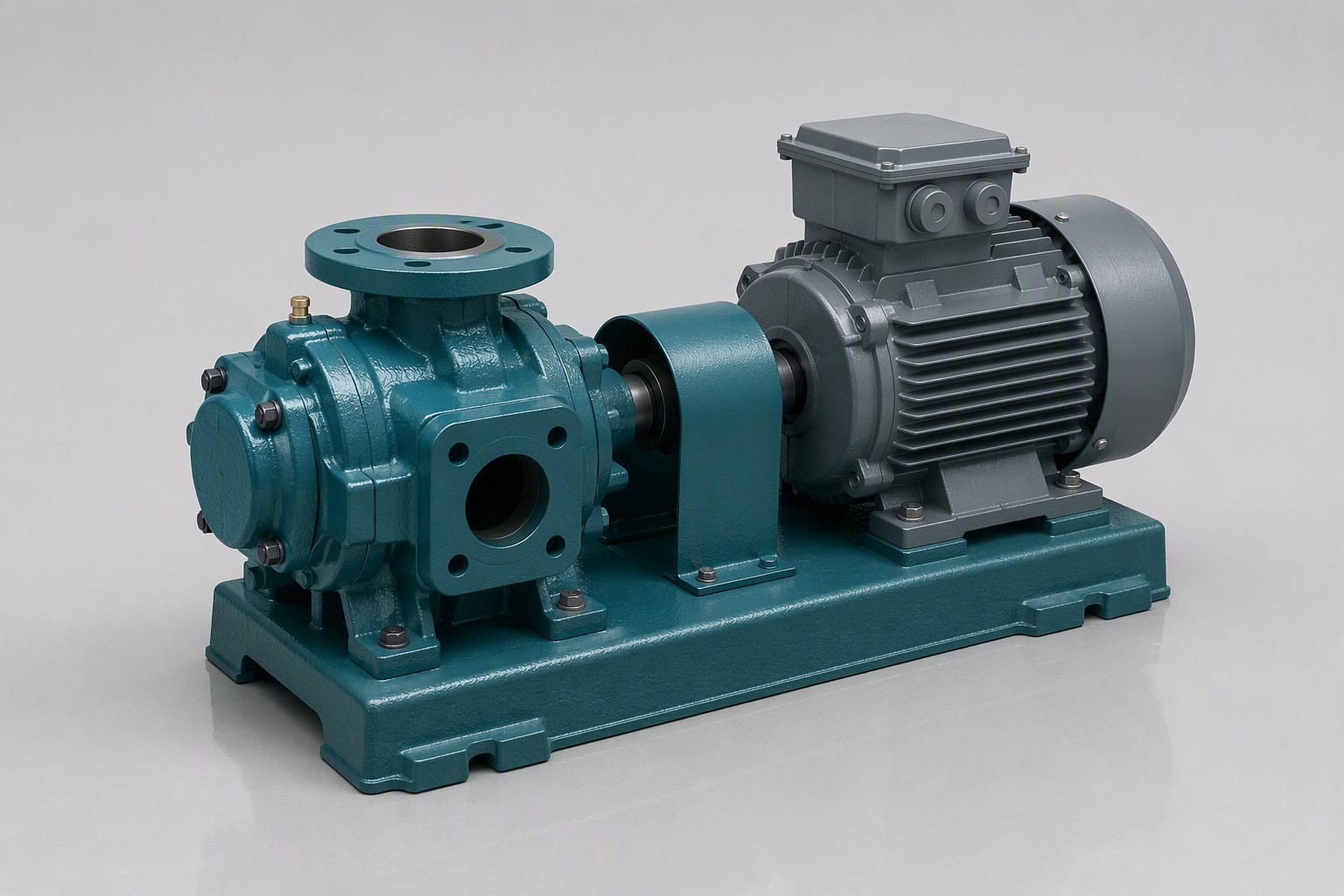
A KCB gear pump is a classic external gear pump design: two externally meshing gears — one driven and one idler — rotate inside a close-clearance casing, and liquid trapped between the gear teeth and the casing wall is carried from the suction port to the discharge port. Because each revolution displaces a nearly fixed volume, it is a positive displacement machine whose flow stays steady against changing discharge pressure, which makes the KCB type a compact, low-cost workhorse for clean lubricating oils, fuels and hydraulic oil transfer duties.
What the KCB Design Consists Of
KCB is a classic designation for external gear pumps used widely in oil transfer, covering a family of similar machines rather than one manufacturer's model. The standard construction:
- The casing — a close-fitting housing, usually cast iron for clean oil service, carrying the suction and discharge ports.
- Two external gears — a driven gear coupled to the shaft and a matching idler, running with small controlled clearances.
- Bearings and shafts — the driven shaft transmits motor power while the idler shaft rotates freely.
- Shaft seals — mechanical seals or packed glands keep oil inside the pump.
- An integral relief valve — fitted on many KCB-type pumps to protect the pump and piping if the discharge line is closed while running.
How a KCB Gear Pump Works
The operating principle is positive displacement. As the gears rotate out of mesh on the suction side, the tooth spaces open and oil is drawn in, then carried around the gears in the tooth pockets — trapped between the teeth and the casing wall — and squeezed out through the discharge port as the teeth mesh again at the centre. Flow is proportional to speed and almost independent of discharge pressure, and the pumped oil itself does the internal sealing, which is why gear pumps suit naturally lubricating liquids. The KCB gear pump working principle article covers these phases in more detail.
Where KCB Gear Pumps Are Used
KCB-style external gear pumps appear wherever clean, lubricating liquids must be moved at moderate pressure with a compact, simple machine:
- Lubricating oil systems — circulating lube oil to bearings, gearboxes and machine tools.
- Fuel oil supply — feeding burners and boilers and transferring diesel and light fuel oils.
- Heavy and viscous oil transfer — moving heated fuel oil and heavy oils that must stay fluid at the suction.
- Hydraulic and process oil duties — oil transfer and circulation where the liquid is clean and solids-free.
Duty-specific guidance sits in the fuel oil, lubricating oil and heavy-oil articles, and the step-by-step KCB gear pump selection procedure ties them together.
Strengths and Limits of the KCB Type
The KCB gear pump earns its place through simplicity, compactness and cost: few moving parts, high pressure in a small package, self-priming within its vacuum limit, and steady flow as discharge pressure rises.
The limits matter just as much. Gear pumps need clean liquid — abrasive solids wear the gears and casing, and free water destroys internal sealing and corrodes parts. They shear the product more than lobe or screw rotors, and the meshing gears should not run dry. For gentle or solids-laden duties a rotary lobe pump fits better; for very high viscosity and large flows an industrial screw pump competes; for thin, non-lubricating liquids a centrifugal pump is the wrong family entirely.
Model Availability: Confirm the Current Range
KCB-type pumps are covered on this site as a technical-reference topic rather than a listed product series, so specific flow, pressure and motor figures are not published here. Where a number would be needed — required flow, discharge pressure, viscosity at pumping temperature — confirm current model availability and specifications with Qingdao Green Power before procurement, and request the performance curve for the exact duty point.
Frequently Asked Questions
What is a KCB gear pump?
A KCB gear pump is a classic external gear pump design in which two externally meshing gears — one driven and one idler — trap liquid between their teeth and the casing and carry it from suction to discharge. It is a compact positive displacement machine for clean lubricating liquids such as fuel oil, lubricating oil and hydraulic oil.
What liquids can a KCB gear pump handle?
KCB-style gear pumps suit clean, lubricating liquids over a wide viscosity window, from light fuels to heated heavy oils, because the pumped liquid itself seals the internal clearances. Abrasive solids, free water and corrosive chemicals must be avoided or confirmed against the wetted materials.
What is the difference between a KCB gear pump and a lobe or screw pump?
A KCB gear pump uses meshing gear teeth, which makes it compact and efficient on clean oils but sensitive to solids and shear. Lobe pumps use non-contacting rotors for gentle, hygienic duties, and screw pumps excel on very viscous or multiphase fluids — the right choice follows the liquid and the duty.
Are KCB gear pumps a current Qingdao Green Power product line?
KCB gear pumps are treated on this site as a technical-reference topic. Confirm current model availability and specifications with Qingdao Green Power before procurement.
Tell us the oil type, viscosity at pumping temperature, flow and discharge pressure — the engineering team will confirm the right gear pump configuration and current availability.
Get a Quote
Send your oil data and duty point. Engineers reply within 24 hours.
Contact Us →💬 WhatsApp NowRelated Products
- Industrial Screw Pump
- Centrifugal Pump
Related Articles
KCB Gear Pump Working Principle
How gear pumps operate
KCB Gear Pump Selection
Selection guide
3RP Lobe Pump Working Principle
Alternative technology