
KCB Gear Pump for Fuel Oil Transfer: A Practical Guide
KCB-style external gear pumps for fuel oil transfer: why gear pumps suit burner supply and day-tank duties, how fuel grade and temperature set the operating window, and when screw pumps fit better.
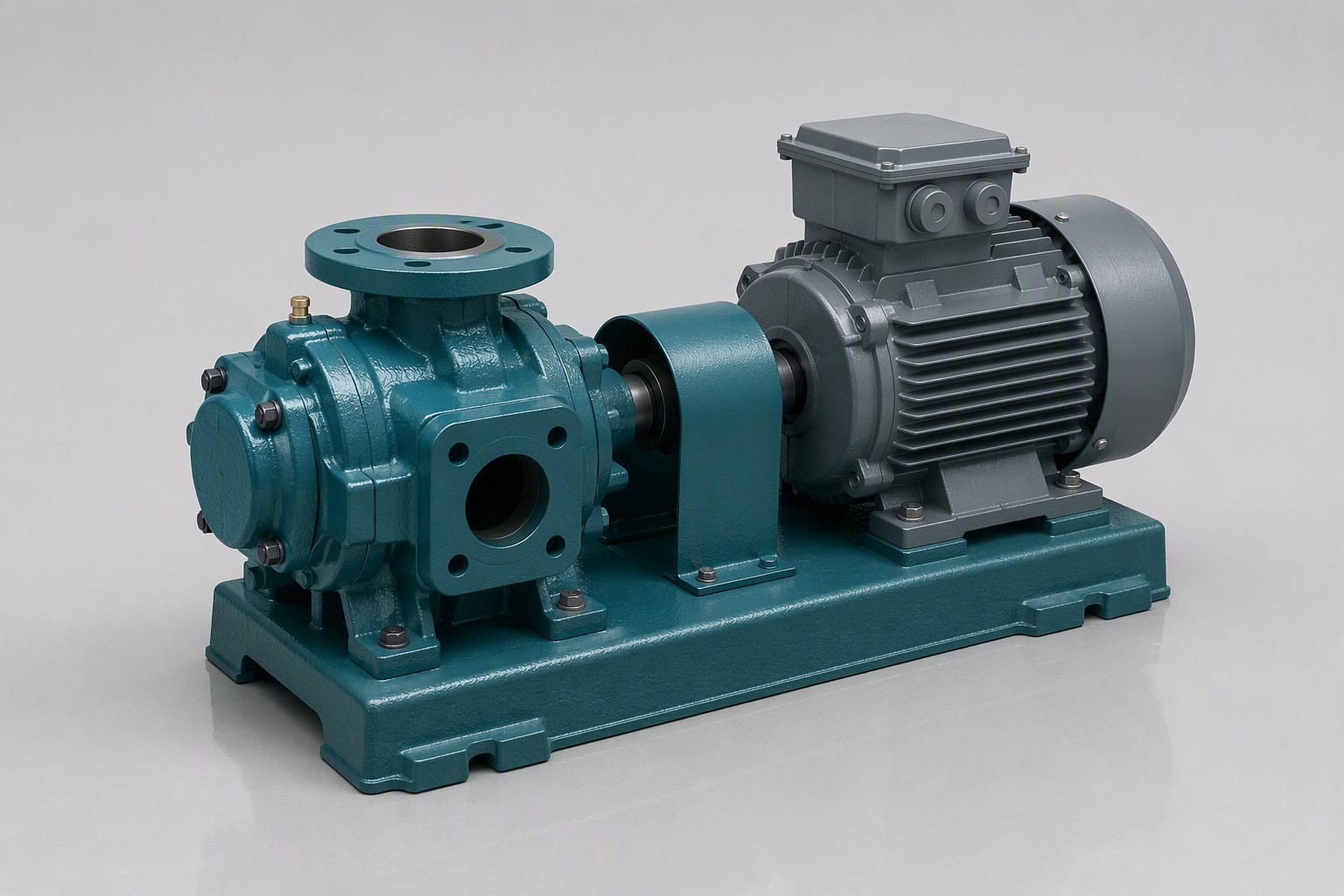
KCB-style external gear pumps are positive-displacement machines widely used to transfer fuel oil, from distillate diesel to heavy fuel oil heated to a workable viscosity. Two meshing gears trap fuel in the tooth spaces and deliver a nearly fixed volume per revolution, so flow stays steady as the burner or downstream system changes pressure demand. Fuel grade, temperature and cleanliness set the operating window — heavy grades must be heated, and the fuel itself lubricates the close-running parts.
Why Gear Pumps Are a Standard Choice for Fuel Oil
Fuel-oil systems — boiler burner trains, marine engine rooms, power-plant day tanks — need a pump that delivers a steady, metered flow at the pressure the system demands, that can lift fuel from a tank below the pump, and that survives the viscosity swing between a cold start and a hot running condition. The KCB line of external gear pumps answers that profile: positive displacement gives flow proportional to speed, self-priming pulls fuel up a dry suction line, and an integral relief valve protects the pump if the discharge is closed.
Because the pumped fuel itself seals the clearance between the gears and the casing, gear pumps run efficiently on oils that behave like lubricants. That same feature explains the operating rules: keep the fuel clean, dry and within the pump's viscosity window, and never let the pump run dry.
Fuel Grade Sets the Operating Window
“Fuel oil” spans a wide viscosity range, and the grade determines how the pump must be operated. See the gear pump working principle to understand why viscosity matters so much.
Distillate fuels — diesel and light fuel oil
Diesel and kerosene are thin at ambient temperature. They fill the gear spaces easily, but their low viscosity increases internal slip, so the same pump delivers less flow at higher discharge pressure. Duty calls for models with tighter clearances and moderate speeds, and for care with modern ultra-low-sulfur fuels whose reduced lubricity can stress close-running parts. Water or wax in the fuel must be filtered out before the pump.
Heavy fuel oil — heated to be pumpable
Heavy fuel oil and residual grades are viscous at ambient temperature and are handled hot. Viscosity falls sharply as temperature rises, so the tank outlet, suction line and often the pump casing are heated and insulated to bring the fuel into the pump's comfortable band. On heavy-oil duty the suction heating arrangement is as important as the pump selection itself.
Heating, Cleanliness and Protection
Whatever the grade, three support systems decide whether a fuel-oil gear pump has a long life. First, heating and insulation on heavy-oil duty keep the fuel fluid so the gear cavities fill completely; if the fuel is too thick, the pump starves, suction vacuum climbs and delivery falls. Second, filtration and water separation protect the close clearances — abrasive dirt and free water erode and corrode the gears, casing and seals. Third, the relief valve, set below the maximum allowable pressure of the pump and piping, returns fuel to the suction side rather than allowing a closed discharge to overpressure the system.
Cold start deserves its own check: breakaway torque at the lowest expected temperature can far exceed running torque, so the drive must be sized for the worst case or the fuel must be pre-heated before start-up.
Gear Pump vs Screw Pump for Fuel Oil
External Gear Pump vs Screw Pump for Fuel Oil
| Characteristic | External gear pump (KCB type) | Triple screw pump (3GB type) | Single screw pump (G type) |
|---|---|---|---|
| Flow characteristic | Fixed volume per revolution | Smooth continuous axial flow | Cavity-by-cavity displacement |
| Best fuel band | Diesel to heated heavy fuel oil | Low-viscosity fuel oil at high temperature | Very viscous, contaminated fuel residue |
| Pulsation | Low-moderate | Very low | Low |
| Solids / water tolerance | Poor — clean fuel required | Poor-moderate | Moderate, stator dependent |
| Typical duty | Burner supply, day-tank transfer, diesel transfer | Hot-oil circulation, large fuel-oil transfer | Sludge, tarry residue, abrasive-laden fuel |
Gear pumps dominate clean distillate and heated-fuel duties because they are compact, self-priming and inexpensive to maintain. Where a fuel system runs large capacities of hot, low-viscosity oil, a triple screw pump is quieter and smoother; where the “fuel” is really sludge, tarry residue or fuel contaminated with solids, a single screw pump handles what a gear pump cannot. For such alternatives Qingdao Green Power publishes G/3GB industrial screw-pump configurations covering 2.4–241.7 m³/h for the 3GB triple-screw range at temperatures up to 350°C, and 0.1–150 m³/h at 0.6–2.4 MPa for the G-type single-screw range.
Key Checks for a Fuel-Oil Gear Pump Duty
- Fuel grade and viscosity: record viscosity at pumping temperature and the worst cold-start value.
- Heating and insulation: confirm suction heating keeps the fuel fluid up to the pump inlet on heavy-oil duty.
- Cleanliness: fit strainers and water separators sized for the fuel and flow.
- Flow, pressure and relief: define normal and maximum flow, discharge pressure and relief-valve setting.
- Model confirmation: KCB-type pumps are a technical-reference topic here — confirm current model availability and specifications with Qingdao Green Power before procurement.
Frequently Asked Questions
What fuel oils can a KCB gear pump handle?
KCB-style external gear pumps are used for distillate fuels such as diesel and for heavy fuel oils heated to a workable viscosity. The practical range depends on the model, speed, temperature and internal clearances — confirm current model availability and specifications with Qingdao Green Power before procurement.
Why are gear pumps common in fuel-oil burner supply systems?
A gear pump is positive displacement and self-priming, so it delivers a steady flow of fuel at the pressure the burner demands, and the fuel itself lubricates the close-running parts. An integral relief valve protects the pump if the discharge is blocked.
Can a gear pump handle thin fuels like diesel at ambient temperature?
Yes, but low-viscosity fuel increases internal slip, so the same pump delivers less flow at higher discharge pressure. Models with tighter clearances and moderate speeds are selected for such duty, and filtration keeps water and dirt away from the gears.
Are KCB gear pumps a current Qingdao Green Power product?
KCB-type pumps are treated on this site as a technical-reference topic. Confirm current model availability and specifications with Qingdao Green Power before procurement.
Send your fuel grade, viscosity at pumping temperature, flow and pressure — the engineering team will confirm the pump type and heating arrangement for your fuel-oil duty.
Get a Quote
Send your fuel data and duty point. Engineers reply within 24 hours.
Contact Us →💬 WhatsApp NowRelated Products
- Industrial Screw Pump
- Centrifugal Pump
Related Articles
What Is a KCB Gear Pump?
Technology overview
KCB Gear Pump for Chemical Transfer
Application guide
KCB Gear Pump Selection
How to specify a gear pump