
How Does a KCB Gear Pump Work?
KCB gear pump working principle explained: how two meshing external gears trap oil in the tooth spaces and move a fixed volume per revolution — plus the viscosity, relief-protection and duty checks that keep these pumps running reliably.
A KCB gear pump is an external gear pump: two meshing spur gears rotate inside a close-fitting casing, and liquid trapped between the gear teeth and the casing is carried from suction to discharge. Each revolution displaces a nearly fixed volume, so a KCB-type pump is a positive displacement machine whose flow is set mainly by running speed rather than by discharge pressure.
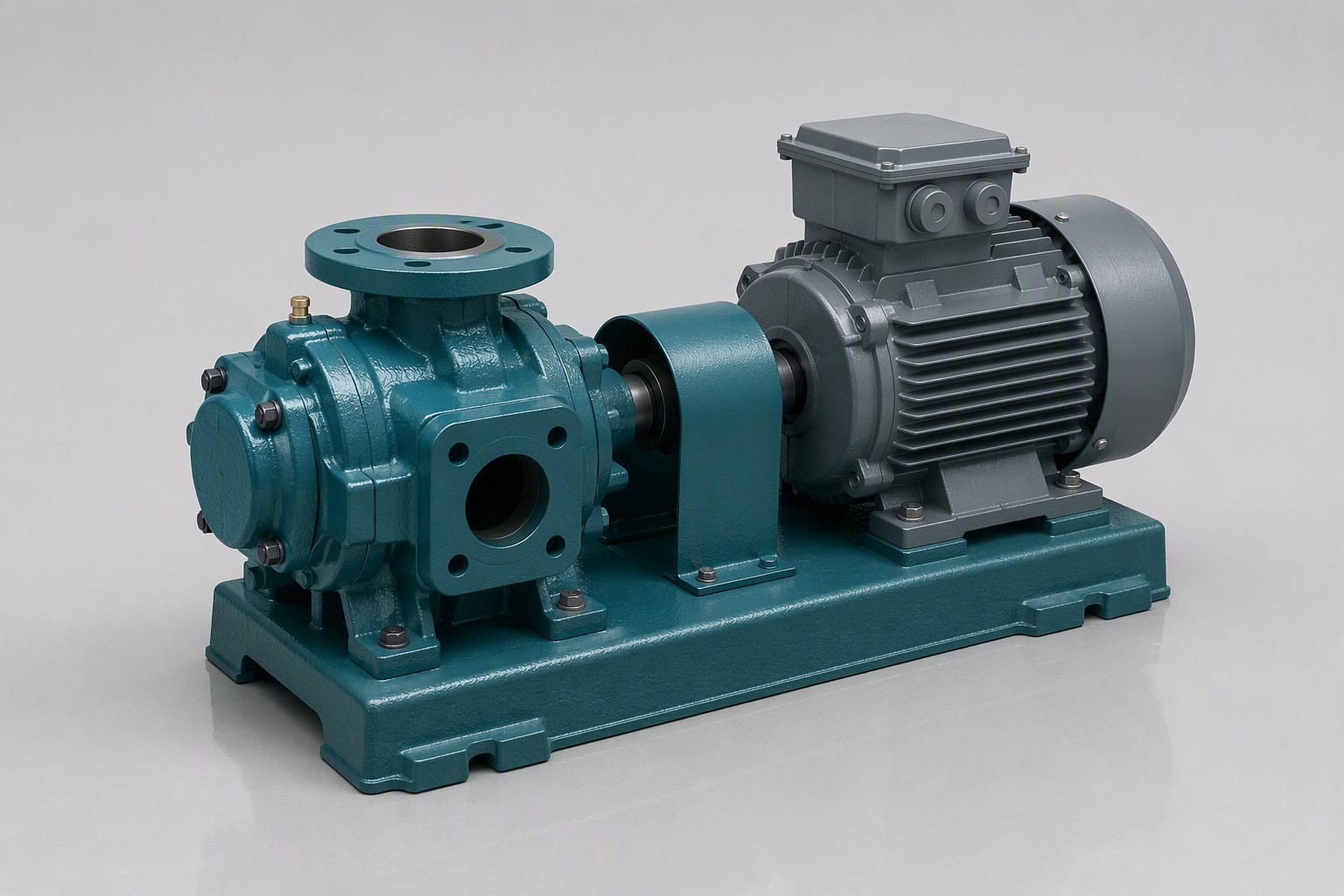
The Working Principle in Three Steps
KCB-type gear pumps are external gear pumps, a member of the positive displacement (PD) family. One gear is keyed to the drive shaft; the second, identical gear is turned by the mesh, so the rotors stay in tight, synchronised contact and the pumped oil itself seals the clearances.
1. Suction phase
On the inlet side the teeth separate as they rotate out of mesh. Each tooth space opens into a larger cavity, pressure falls slightly below line pressure, and liquid flows in to fill the space between the tooth flank and the casing.
2. Transport phase
Each filled tooth space is then carried around the casing periphery as a sealed pocket. The liquid is not compressed or heavily sheared here; it simply travels with the gears, separated from the discharge side by the tooth mesh.
3. Discharge phase
When the teeth re-enter mesh at the outlet, the pocket collapses and the trapped liquid is forced out against the discharge pressure. Delivery is continuous, with only the small pulsation of each tooth pass; theoretical flow is displacement per revolution times speed, minus internal slip.
Viscosity and Slip Set the Practical Limits
A gear pump relies on the pumped liquid to seal its clearances, so the medium decides performance: a clean, lubricating oil of moderate to high viscosity keeps internal slip small and volumetric efficiency high, while shaft power rises with viscosity, especially at cold start.
Thin, low-viscosity fluids leak back from discharge to suction through the clearances, so delivered flow falls at low speed and high pressure. That is why external gear pumps suit oils and fuels rather than water-like liquids — and why the centrifugal-side guidance is to consider a gear or screw pump above roughly 150 cSt.
Fixed Displacement Means a Relief Valve
Because displacement is fixed regardless of discharge pressure, closing the discharge line while a gear pump runs makes pressure climb until a component fails. KCB-type pumps therefore carry an integral relief valve that bypasses liquid to the suction side, set below the maximum allowable pressure of the pump and piping.
Typical KCB-Type Gear Pump Duties
The KCB designation refers to a widely used external gear pump layout for clean petroleum products, covered here as a technical-reference topic with dedicated application guides. The best-suited duties are steady transfers of clean, lubricating oils at low to moderate pressure:
- Fuel-oil transfer and burner supply — day tanks and boiler houses.
- Lubricating-oil circulation and change-over — clean oil at steady duty points.
- Heated heavy-oil transfer — oil kept fluid by heating.
- Clean, non-corrosive chemical transfer — compatible lubricating liquids.
When Another Pump Technology Fits Better
Not every oil duty is a gear-pump duty: centrifugal pumps move large flows of thin liquids economically, screw pumps take over for very viscous, high-pressure or tarry services, and lobe pumps suit products that must be handled gently. Qingdao Green Power's G/3GB industrial screw-pump range covers 0.1–241.7 m³/h at 0.6–2.4 MPa for such heavy services.
External Gear Pump vs Screw Pump vs Centrifugal Pump
| Characteristic | External gear pump (KCB type) | Industrial screw pump | Centrifugal pump |
|---|---|---|---|
| Displacement | Fixed volume per revolution | PD — smooth axial flow | Dynamic — velocity head |
| Flow vs pressure | Nearly constant at fixed speed | Nearly constant at fixed speed | Falls as discharge head rises |
| Viscosity band | Clean oils, light to heated heavy fuels | Very wide — thin hot oils to tars | Thin liquids; above ~150 cSt switch |
| Self-priming | Yes, within suction limits | Yes, within suction limits | Usually no — flooded suction required |
| Typical oil duty | Fuel, lube and heated heavy-oil transfer | High-pressure viscous oil duties | Water and light process liquids |
Key Checks for a KCB-Type Gear Pump Duty
- Flow and speed: PD output rises with speed — match the drive and gear size to normal and maximum flow.
- Viscosity: specify the oil at pumping temperature and at cold start; the motor is often set by the cold start.
- Pressure and relief: confirm the maximum discharge pressure and set the relief valve below the system limit.
- Seal and materials: match the mechanical seal or gland and the wetted materials to the oil and its temperature.
- Cleanliness: fit a suction strainer sized for the coldest oil and keep water and abrasives out.
- Model confirmation: KCB-type gear pumps are a technical-reference topic here — confirm current model availability and specifications with Qingdao Green Power before procurement.
Frequently Asked Questions
How does a KCB gear pump create flow and pressure?
Two meshing external gears rotate inside the casing. On the suction side the teeth separate, the pocket volume grows and liquid fills the tooth spaces; the liquid is carried around the casing and forced out on the discharge side as the teeth re-mesh. Each revolution displaces a nearly fixed volume, and discharge pressure develops from the resistance of the downstream system.
Why does a KCB gear pump need a relief valve?
A gear pump is a positive displacement machine, so if the discharge line is closed while the pump runs, pressure climbs until a casing, seal or pipe fails. An integral relief valve set below the maximum allowable pressure returns liquid to the suction side and protects the pump and the piping.
Which liquids can a KCB gear pump handle?
KCB-type gear pumps suit clean, lubricating liquids such as fuel oils, lubricating oils and heated heavy oils. Thin, non-lubricating or abrasive media increase slip and wear; the practical viscosity window is model-specific, so confirm current model availability and specifications with Qingdao Green Power.
Are KCB gear pumps a current Qingdao Green Power core product?
KCB gear pumps are treated on this site as a technical-reference topic. Confirm current model availability and specifications with Qingdao Green Power before procurement.
Send the liquid, viscosity at pumping temperature, flow and pressure — the engineering team will confirm the right gear pump configuration and model availability.
Get a Quote
Send your fluid data and duty point. Engineers reply within 24 hours.
Contact Us →💬 WhatsApp NowRelated Products
- Industrial Screw Pump
- Centrifugal Pump
Related Articles
What Is a KCB Gear Pump?
Technology overview
How to Select a KCB Gear Pump for Oil Transfer
Selection guide
KCB Gear Pump for Fuel Oil Transfer
Application guide