
KCB Gear Pump for High-Viscosity Oil: What Limits the Duty
KCB-style external gear pumps for high-viscosity oil: why viscosity helps seal internal clearances, how speed, power and suction conditions set the limit, and when screw pumps fit better.
A KCB-style external gear pump moves high-viscosity oil by trapping a fixed volume between the teeth of two meshing gears and the pump casing. Every shaft revolution displaces the same volume, so flow is set by speed rather than by discharge pressure. The oil itself seals the running clearances, which is why a moderately viscous, clean oil is not a problem for a gear pump — the real limits are shaft power, suction filling and the model's rated speed.
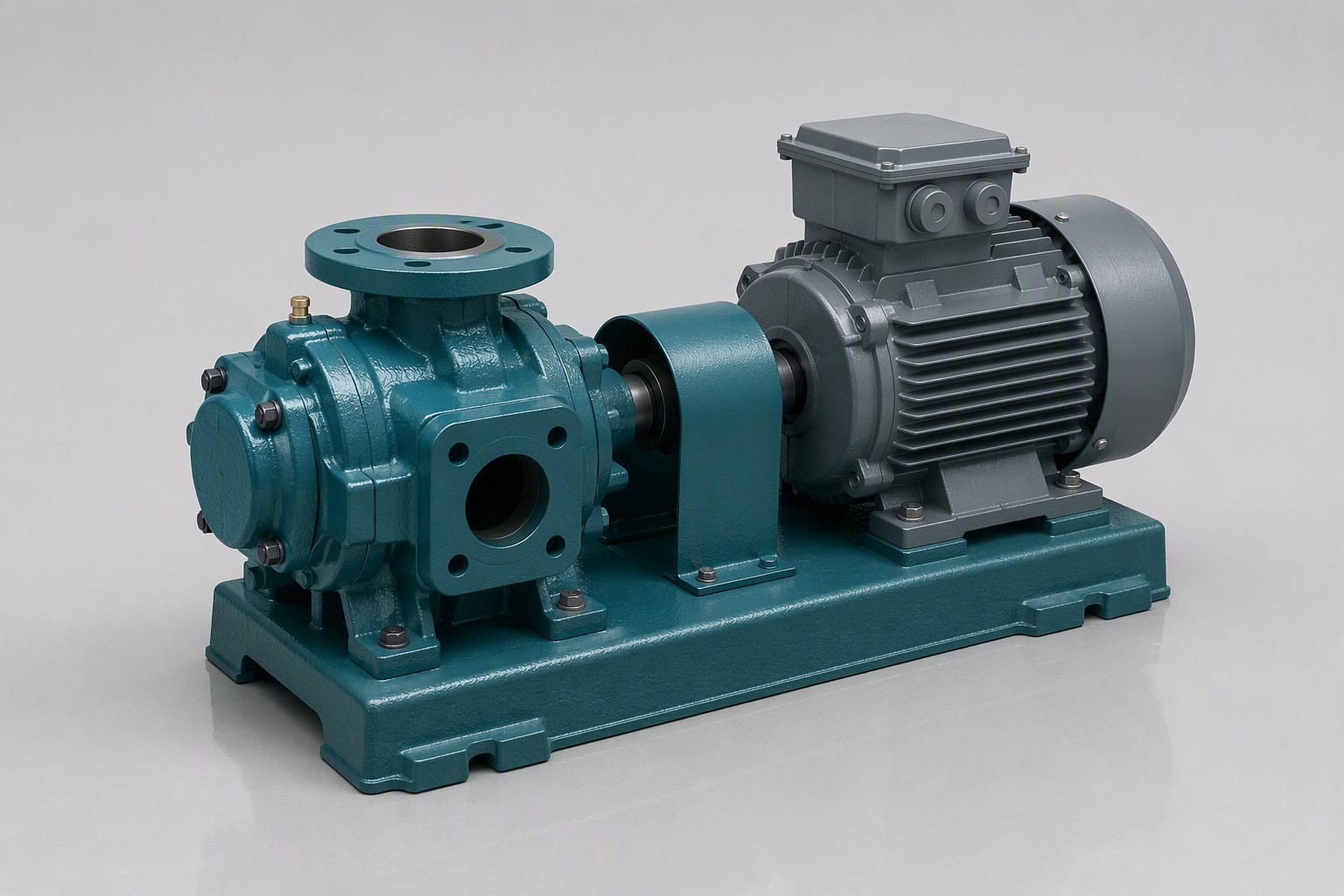
Why Viscosity Is Not the Enemy of a Gear Pump
Positive-displacement pumps behave the opposite way from centrifugal pumps as viscosity rises. In a KCB-style gear pump, thicker oil leaks less across the gear tips and side faces, so internal slip falls and volumetric efficiency improves; in a centrifugal pump, friction in the impeller and casing makes head, flow and efficiency collapse.
That is why the IS/ISW centrifugal pumps offered by Qingdao Green Power are specified for water and low-viscosity process liquids — above about 150 cSt the guidance is to move to a gear or screw pump, which is exactly the territory of the KCB line.
Flow follows speed
An external gear pump displaces a nearly constant volume per revolution, so discharge flow rises and falls with shaft speed. Discharge pressure, by contrast, is set by the system; the pump simply keeps pushing until the relief valve or the line resistance stops it. The full sequence is explained in the gear pump working principle guide.
The Real Limits: Power, Speed and Suction
Viscosity raises shaft power because every tooth engagement has to shear a film of oil, and the thicker the oil the more torque the drive must deliver. Three limits decide whether a high-viscosity duty is practical at all.
Cold start sets the drive
Oil viscosity can be many times higher at the lowest expected start-up temperature than at running temperature. Breakaway torque on cold, thick oil often exceeds the running torque, so the practical answer is either to heat the oil before start-up or to size the motor for the cold condition.
Suction filling and speed
Thick oil cannot rush into the gear spaces as they open on the suction side. If the pump runs too fast, or the suction pipe is long and unheated, the cavities starve, suction pressure drops and the pump loses flow or cavitates. The standard remedies are a flooded or heated suction, a short direct suction line and a lower pump speed — the classic reason high-viscosity gear pumps run slowly.
Heating Keeps Viscous Oil Pumpable
The most powerful lever on a viscous-oil duty is temperature. Because viscosity falls sharply as oil warms, steam or electric trace heating on the suction line and a tank suction heater usually let an ordinary gear pump handle oil that would be impossible to move cold.
On heavy and high-viscosity fuel-oil services the same rules apply; the heavy-oil guidance covers suction heating, insulation and relief protection in detail.
Gear, Screw or Centrifugal for the Same Oil
The duty, not the pump label, should pick the technology. The practical comparison for high-viscosity oil transfer looks like this:
External Gear vs Screw vs Centrifugal Pump for Viscous Oil
| Characteristic | External gear pump (KCB type) | Industrial screw pump | Centrifugal pump (IS/ISW) |
|---|---|---|---|
| Viscosity band | Clean oils, thin to moderately viscous | Very wide — thin hot oils to tarry media | Low-viscosity liquids only |
| Flow behaviour | Fixed volume per revolution | Smooth, continuous axial flow | Falls as viscosity rises |
| Pressure capability | Moderate; needs relief protection | Higher pressures, low pulsation | Limited by the head curve |
| Solids and water tolerance | Poor — clean, dry oil required | Better, type dependent | Moderate |
| Typical duty | Viscous-oil transfer, fuel and lube service | Heavy, viscous, high-pressure oil | Water and thin process liquids |
Qingdao Green Power publishes envelopes for the alternatives: G single-screw pumps cover 0.1–150 m³/h at 0.6–2.4 MPa for high-viscosity media, 3GB triple-screw pumps cover 2.4–241.7 m³/h for thin hot oils, and IS/ISW centrifugal pumps reach 1.5–1600 m³/h at 2–125 m head for low-viscosity liquids. See the industrial screw pump and centrifugal pump ranges for those machines; for KCB-type gear pump flow, pressure and speed ratings, confirm current model availability and specifications with Qingdao Green Power before procurement.
Key Checks for a High-Viscosity Oil Duty
- Working viscosity: specify viscosity at pumping temperature and the cold-start worst case; both decide speed and motor size.
- Heating: confirm the suction line and tank outlet keep the oil fluid right up to the pump inlet.
- Duty point: state normal and maximum flow and discharge pressure, plus the relief-valve setting.
- Cleanliness: keep water and abrasive solids out — they erode close-clearance parts and raise slip.
- Model confirmation: KCB-type gear pumps are a technical-reference topic on this site — confirm current model availability and specifications with Qingdao Green Power before procurement.
Frequently Asked Questions
How viscous an oil can a KCB gear pump handle?
External gear pumps use the pumped oil as their internal seal, so a moderately thick oil actually improves volumetric efficiency by reducing slip. The practical ceiling depends on shaft power, suction filling and the model speed rating — confirm current model availability and specifications with Qingdao Green Power for the viscosity range of a specific model.
Why should a gear pump run slower on high-viscosity oil?
Viscous oil cannot fill the gear tooth spaces instantly as the cavities open on the suction side. Reducing pump speed gives the oil time to fill the cavities, which lowers cavitation risk and keeps shaft power inside the motor rating; flow rises with speed, so a larger, slower pump often beats a small fast one on thick oil.
When is a screw pump better than a KCB gear pump for viscous oil?
When the oil is tarry, solids-laden or extremely viscous, or the duty needs higher pressure with low pulsation, an industrial screw pump usually fits better. Qingdao Green Power's G single-screw range covers 0.1–150 m³/h at 0.6–2.4 MPa for high-viscosity media, and the 3GB triple-screw range covers 2.4–241.7 m³/h for thin hot oils.
Can a centrifugal pump handle high-viscosity oil instead of a gear pump?
Centrifugal pumps lose head, flow and efficiency quickly as viscosity climbs. Qingdao Green Power recommends switching from its IS/ISW centrifugal pumps to a gear or screw pump above about 150 cSt, so a KCB-type gear pump is usually the right starting point for viscous-oil transfer.
Send your oil grade, viscosity at pumping temperature, flow and pressure — the engineering team will recommend the pump technology, speed and heating arrangement for your duty.
Get a Quote
Send your oil data and duty point. Engineers reply within 24 hours.
Contact Us →💬 WhatsApp NowRelated Products
- Industrial Screw Pump
- Centrifugal Pump
Related Articles
What Is a KCB Gear Pump?
Technology overview
KCB Gear Pump for Lubricating Oil
Application guide
KCB Gear Pump Selection
How to specify a duty