
KCB Gear Pump for Lubricating Oil: Transfer and Circulation
External KCB-type gear pumps for lubricating oil: steady-flow transfer and circulation, why clean dry oil is a red line, and the relief, filtration and suction basics.
A KCB-style external gear pump moves lubricating oil by trapping it between the teeth of two meshing gears and the casing, delivering a nearly fixed volume per revolution. That fixed-displacement behaviour makes gear pumps a natural fit for lube-oil transfer and circulation, where flow must stay steady while system pressure varies. Because the pumped oil itself seals the running clearances, lubricating oil is close to an ideal medium — provided it stays clean, dry and within the pump's viscosity range.
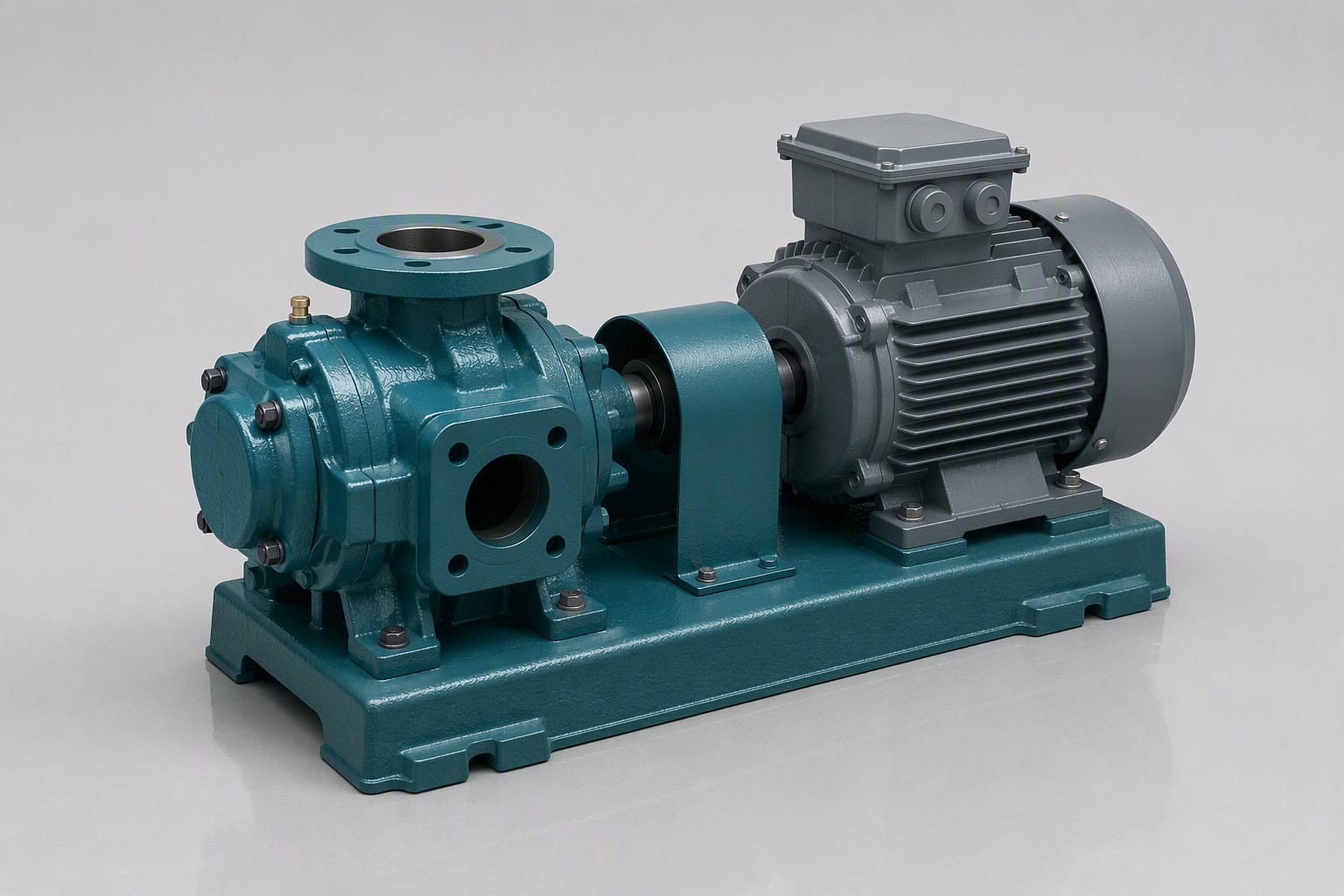
What a Lubricating-Oil Duty Looks Like
Lubricating-oil service usually means one of three jobs: transferring oil from storage tanks or drums to day tanks, circulating oil around a machine's bearing or gearbox lubrication system, and feeding oil to engines, compressors and other rotating equipment at a controlled pressure and flow.
Oil grades in this service span thin turbine and hydraulic oils up to heavier gear oils, and the same KCB line of external gear pumps is routinely applied across that range, with model selection depending on flow, pressure, viscosity and temperature. The heaviest gear-oil duties sit at the top of the band and are covered separately in the high-viscosity-oil guide.
Why a Gear Pump Suits Lube-Oil Circuits
Lubrication circuits want a steady, predictable flow regardless of the pressure the system builds. A gear pump's fixed volume per revolution delivers exactly that, and the oil it pumps provides the seal between gears and casing and lubricates the close-running parts — which is why the gear pump working principle is built around a clean lubricating liquid.
Gear pumps are also self-priming within limits and compact, so they fit neatly on skids and inside machinery. On thin oils internal slip is higher, so a larger pump or a higher speed may be needed to reach the same flow; specifying the oil's actual viscosity at pumping temperature avoids a pump that cannot meet its rated flow.
Clean, Dry Oil Is a Red Line
An external gear pump keeps only small, controlled clearances between the gear teeth and the casing, and the oil film is what keeps those surfaces apart. Abrasive solids such as scale, grit or wear debris lap the surfaces and open up the clearances, which shows up as falling flow and pressure. Water is the second enemy: it breaks down the oil film, promotes corrosion and increases internal slip.
Practical protection is a suction strainer or filter sized for the oil's cold viscosity, water drains and clean storage, and regular oil-condition checks on circulation duties.
Pressure, Relief and Suction Arrangement
Because flow is fixed per revolution, closing a discharge valve makes the pressure climb until a casing, seal or pipe fails. An integral relief valve set below the pump's maximum allowable pressure returns oil to the suction side, and the setting should be reviewed against the whole circuit, including cold starts.
The suction side matters just as much: a flooded or slightly positive suction head, a short direct suction pipe and a strainer that does not plug on cold oil keep the gear cavities full and the pump running quietly.
How Gear Pumps Compare with the Alternatives
For most lube-oil duties the real choice is between gear, screw and centrifugal machines:
External Gear vs Screw vs Centrifugal Pump for Lubricating Oil
| Characteristic | External gear pump (KCB type) | Triple-screw pump | Centrifugal pump (IS/ISW) |
|---|---|---|---|
| Flow behaviour | Fixed volume per revolution | Smooth, low-pulsation axial flow | Falls as discharge pressure rises |
| Typical lube-oil use | Transfer, circulation, feed | Large or high-temperature oil systems | Bulk low-viscosity oil transfer |
| Pressure capability | Moderate; needs relief protection | Higher pressures, low pulsation | Limited by the head curve |
| Oil condition needed | Clean, dry oil essential | Clean oil | Moderate tolerance |
| Viscosity range | Thin to moderately viscous oils | Wide, including thin hot oils | Low-viscosity liquids only |
Qingdao Green Power publishes envelopes for the alternatives: IS/ISW centrifugal pumps cover 1.5–1600 m³/h at 2–125 m head for low-viscosity liquids, and the 3GB triple-screw range covers 2.4–241.7 m³/h for low-viscosity oils at temperatures up to 350°C. See the centrifugal pump and screw pump ranges for those machines; for KCB-type gear pump flow, pressure and speed ratings, confirm current model availability and specifications with Qingdao Green Power before procurement.
Key Checks for a Lube-Oil Gear Pump Duty
- Oil condition: keep the oil clean, dry and inside the specified viscosity band — it is both the seal and the lubricant.
- Duty point: confirm flow, discharge pressure and whether the run is continuous, batch or standby service.
- Relief setting: set the integral relief valve below the maximum allowable pressure of the pump and pipework.
- Suction: provide a flooded or positive suction head and a strainer sized for the coldest start.
- Model confirmation: KCB-type gear pumps are a technical-reference topic on this site — confirm current model availability and specifications with Qingdao Green Power before procurement.
Frequently Asked Questions
Why must lubricating oil fed to a KCB gear pump be clean and dry?
In an external gear pump the pumped oil seals the clearances between gears and casing and lubricates the close-running parts. Abrasive solids erode those surfaces and raise internal slip, while water breaks down the oil film and promotes corrosion — so filtration and water separation protect pump performance.
Does a KCB gear pump deliver constant flow on a lube-oil circuit?
As a positive-displacement pump it moves a nearly fixed volume per revolution, so flow is set mainly by speed, not by discharge pressure. Internal slip rises slightly at higher pressure or lower viscosity, and an integral relief valve set below the maximum allowable pressure protects the pump and circuit.
What is the difference between a gear pump and a screw pump for lubricating oil?
An external gear pump is compact, economical and standard for lube-oil transfer and circulation at moderate pressure. A triple-screw pump gives smoother, lower-pulsation flow for large or high-temperature oil duties — Qingdao Green Power's 3GB range covers 2.4–241.7 m³/h with oil temperatures up to 350°C.
How is a KCB gear pump protected on a lubricating-oil system?
With a suction strainer or filter to keep the oil clean, a relief valve to limit discharge pressure, and correct suction conditions so the pump primes and fills reliably. For model-specific flow, pressure and speed ratings, confirm current model availability and specifications with Qingdao Green Power.
Tell us your oil grade, viscosity, flow and system pressure — the engineering team will confirm the right pump configuration for your lube-oil circuit.
Get a Quote
Send your oil data and duty point. Engineers reply within 24 hours.
Contact Us →💬 WhatsApp NowRelated Products
- Industrial Screw Pump
- Centrifugal Pump
Related Articles
What Is a KCB Gear Pump?
Technology overview
KCB Gear Pump for Heavy Oil
Application guide
KCB Gear Pump for High-Viscosity Oil
Application guide