
KCB Gear Pump for Chemical Transfer: A Practical Guide
KCB-style external gear pumps for chemical transfer: which clean, viscous chemicals suit gear pump technology, how materials and seals decide compatibility, and when centrifugal or screw pumps fit the duty better.
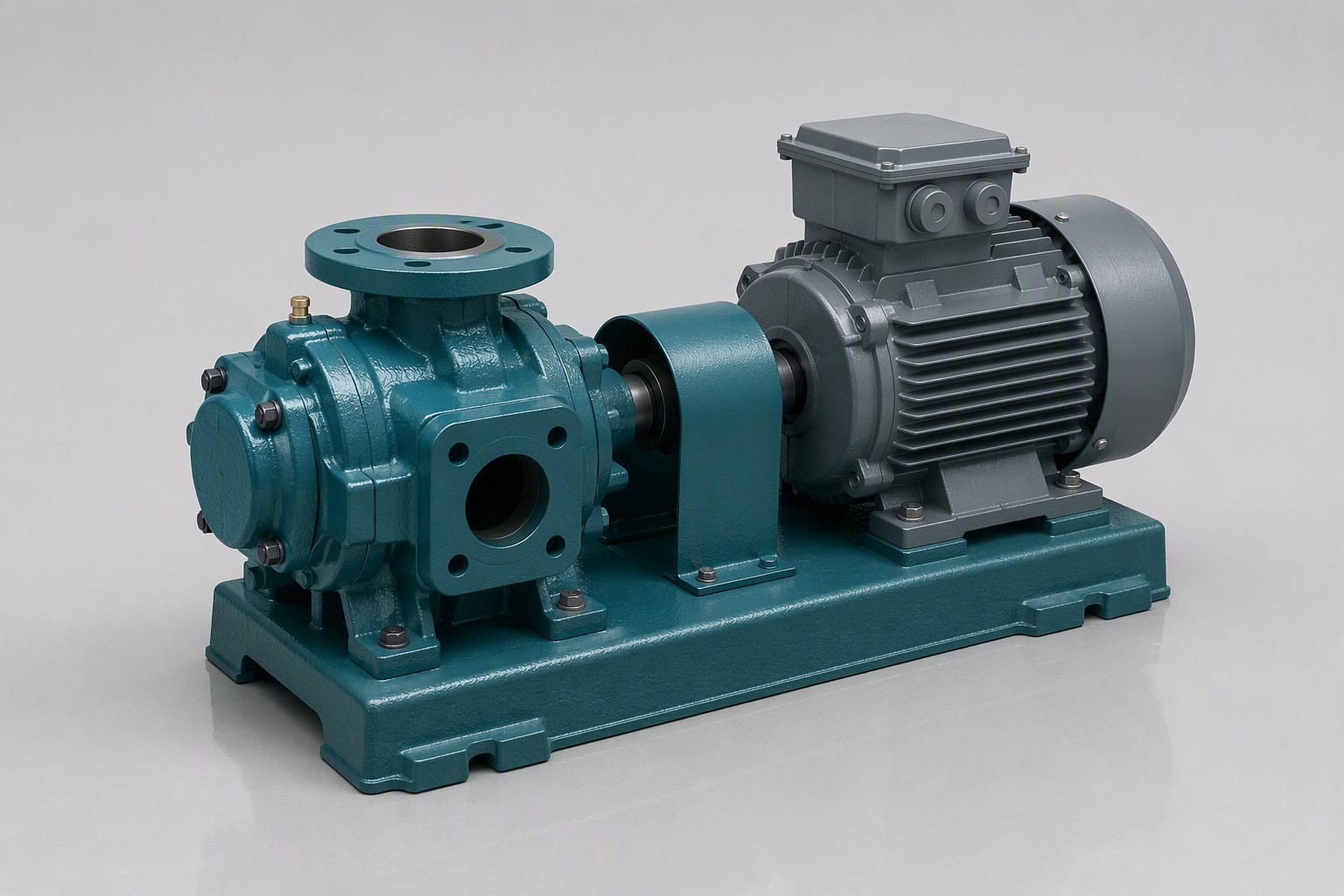
KCB-style external gear pumps are positive-displacement machines suited to a narrow but important family of chemicals: clean, viscous liquids that are chemically compatible with the wetted materials and give the gears some lubricity. Two meshing gears trap liquid in the tooth spaces and carry it from suction to discharge, so each revolution delivers a nearly fixed volume with steady flow as pressure changes. They are not general-purpose corrosive-chemical pumps — strong acids, caustic alkalis and abrasive slurries are better served by corrosion-resistant centrifugal pumps or screw pumps.
When an External Gear Pump Fits a Chemical Duty
In a chemical plant the pump is specified from the process liquid, not the other way round. The KCB line of external gear pumps earns its place when three conditions are met together: the chemical is clean (no abrasive solids), it is viscous enough to fill and seal the gear spaces, and it is compatible with the wetted materials.
The liquid itself is the seal between the gear tips, the casing and the side plates. That is why a gear pump meters additives, catalysts, resins and polymer melts so predictably — flow is close to proportional to shaft speed, which makes the gear pump working principle attractive for dosing and batch transfer. It is also why the same pump fails fast on the wrong chemical: a medium that attacks the casing, dissolves the elastomers or leaves a crust on the gears quickly destroys volumetric performance.
Which Chemical Families Suit Gear Pumps — and Which Do Not
Experience divides chemical duties into gear-pump-friendly and gear-pump-hostile groups: viscous, oily and resinous products on one side; corrosive, abrasive or solids-forming media on the other.
- Suitable: resins, varnishes, polymer systems and reactive components that stay liquid and clean; adhesives and sealants; plasticizers, process additives and lubricating-oil packages; fatty acids, oleochemicals and similar viscous organics; compatible heat-transfer fluids and hot oils.
- Not suitable: strong mineral acids and concentrated caustic alkalis unless the wetted alloy is verified against the exact concentration and temperature; abrasive slurries and suspensions; media that crystallize, settle or polymerize during shutdown; very thin, water-like solvents that slip through the clearances and attack standard elastomers.
When the real duty is acids, alkalis or oxidizers, a corrosion-resistant chemical centrifugal pump is the workhorse — do not stretch a gear pump into that service.
Materials and Seals Decide Chemical Compatibility
Wetted materials
Compatibility starts with the pump construction. Cast iron and ductile-iron casings with hardened steel gears suit neutral, lubricating products such as fuel oils and mineral-oil additives. Corrosion-resistant builds — stainless-steel casings and shafts, bronze or coated gear sets — extend the range to mildly aggressive organics. Seals and elastomers must be matched as carefully as the metal — an incompatible O-ring or seal face fails first.
Sealing the shaft
Mechanical seals dominate chemical gear-pump service because they leak far less than packed glands. Single seals handle most clean, viscous chemicals; double seals with a barrier fluid are specified for hazardous, toxic or fugitive-emission-sensitive media. The seal must see liquid at start-up — a gear pump must never run dry.
Viscosity, Temperature and Suction Conditions
Viscosity sets the operating window. Thicker chemicals seal the internal clearances and raise volumetric efficiency, but they also raise shaft power, so the motor must be sized for the worst cold-start condition, not the running condition. Thinner chemicals slip more, so the same pump delivers less flow at higher discharge pressure.
Temperature limits come from the seals, elastomers and materials rather than from the pumping principle. Keep the suction line short, fit a strainer, and set the integral relief valve below the maximum allowable pressure so a closed discharge cannot overpressure the casing or seals.
Gear Pump vs Centrifugal vs Screw Pump for Chemicals
External Gear Pump vs Centrifugal vs Screw Pump for Chemical Transfer
| Characteristic | External gear pump (KCB type) | Chemical centrifugal pump | G-type screw pump |
|---|---|---|---|
| Flow characteristic | Fixed volume per revolution | Variable with head | Smooth axial displacement |
| Best viscosity band | Thin fuels to medium-viscosity chemicals | Thin, water-like liquids | Very high viscosity media |
| Corrosive service | Limited by materials | Broad — stainless to lined | Limited by stator elastomer |
| Solids tolerance | Poor — clean liquid only | Poor | Moderate, type dependent |
| Typical duty | Resins, additives, dosing, transfer | Acids, alkalis, solvents, bulk transfer | Sludge, slurry, paste, abrasive media |
For thin, low-viscosity process liquids, Qingdao Green Power's IS/ISW centrifugal range covers 1.5–1600 m³/h at heads of 2–125 m and temperatures up to 80°C; above roughly 150 cSt a gear or screw pump usually fits better. Corrosive duties are served by its IH stainless and IHF fluoroplastic-lined chemical pumps (3.5–400 m³/h, 4.5–125 m head). When a chemical is too viscous or abrasive for a gear pump, an industrial G-type screw pump (0.1–150 m³/h, 0.6–2.4 MPa) is a proven alternative — never run it dry.
Key Checks for a Chemical Gear Pump Duty
- Chemical compatibility: verify casing, gears, shaft seals and elastomers against the exact product, concentration and temperature.
- Cleanliness: exclude abrasive solids and anything that crystallizes or settles in the pump.
- Viscosity and temperature: record values at pumping temperature plus the worst cold-start case for motor sizing.
- Flow, pressure and relief: define normal and maximum flow, discharge pressure and relief-valve setting.
- Model confirmation: KCB-type pumps are a technical-reference topic here — confirm current model availability and specifications with Qingdao Green Power before procurement.
Frequently Asked Questions
Can a KCB gear pump be used for corrosive chemicals?
External gear pumps are built for clean liquids that also lubricate the gears — strong acids, strong alkalis and abrasive slurries are outside their normal range. For corrosive chemicals, use a corrosion-resistant centrifugal chemical pump and verify wetted-material compatibility for the specific concentration and temperature.
Which chemicals are gear pumps typically used to transfer?
Clean, viscous and chemically compatible products such as resins, polymers, adhesives, plasticizers and oleochemicals that do not attack the wetted parts and give the gears some lubricity. Confirm compatibility and duty data with the supplier first.
How does a gear pump compare with a centrifugal pump for chemical transfer?
A gear pump delivers a near-fixed volume per revolution with steady flow as pressure varies and is self-priming, which suits viscous chemicals. A centrifugal pump moves thin, low-viscosity chemicals at high flow. Above roughly 150 cSt a positive-displacement gear or screw pump is generally the better fit.
Are KCB gear pumps a current Qingdao Green Power product?
KCB-type pumps are treated on this site as a technical-reference topic. Confirm current model availability and specifications with Qingdao Green Power before procurement.
Send the chemical name, concentration, viscosity and temperature with your flow and pressure — the engineering team will confirm material compatibility and recommend the right pump technology for your duty.
Get a Quote
Send your fluid data and duty point. Engineers reply within 24 hours.
Contact Us →💬 WhatsApp NowRelated Products
- Industrial Screw Pump
- Centrifugal Pump
Related Articles
What Is a KCB Gear Pump?
Technology overview
KCB Gear Pump Working Principle
How gear pumps move liquid
KCB Gear Pump for Fuel Oil
Application guide