
KCB Gear Pump vs Rotary Lobe Pump
KCB gear pump vs rotary lobe pump: how meshing gears and synchronised tri-lobe rotors both deliver positive displacement, and which technology fits clean oils, shear-sensitive products and hygienic duties.
A KCB gear pump displaces liquid with two meshing gear teeth, while a rotary lobe pump uses two synchronised, non-contacting tri-lobe rotors. Both are positive displacement machines, but the gear pump suits clean lubricating oils, compact higher-pressure duties and simple maintenance, whereas the lobe pump wins where low shear, solids tolerance, gentle handling and hygienic cleanability matter.
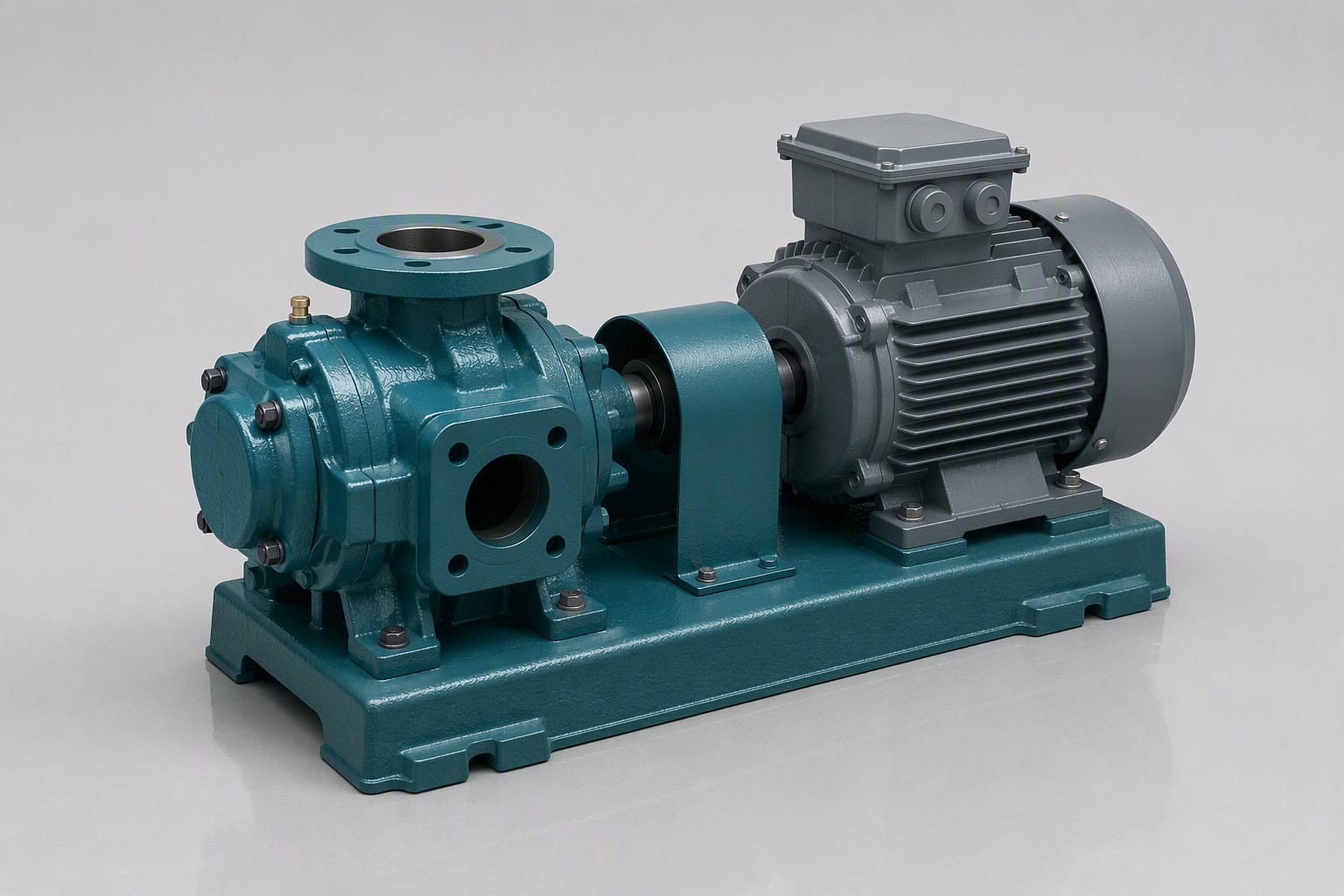
Both Are Positive Displacement Pumps
Each shaft revolution moves a nearly fixed volume, so flow stays fairly constant as discharge pressure changes — unlike a centrifugal pump, where flow falls as head rises. That is why both technologies suit viscous liquids: duties above roughly 150 cSt are usually better served by positive displacement pumps than by centrifugal designs, which lose efficiency as viscosity climbs.
How Each Design Moves Liquid
KCB external gear pump
The KCB gear pump working principle is built on two externally meshing gears inside a close-clearance casing: liquid fills the tooth spaces, is carried around the outside of the gears, and is squeezed out where the teeth re-mesh. Because the teeth run against each other, lubricated by the liquid, a gear pump needs clean, lubricating media — abrasives or water destroy it quickly.
Rotary lobe pump
A rotary lobe pump carries liquid in the spaces between its rotor lobes and the casing, but the lobes are driven by timing gears and never touch each other or the wall. The rotary lobe pump working principle therefore creates positive displacement without metal-to-metal contact in the pumping chamber, giving low shear, gentle handling and the ability to pass soft solids that would jam a gear set.
KCB Gear Pump vs Rotary Lobe Pump at a Glance
External Gear Pump vs Rotary Lobe Pump
| Characteristic | External gear pump (KCB type) | Rotary lobe pump |
|---|---|---|
| Displacement mechanism | Meshing gear teeth | Synchronised tri-lobe rotors |
| Rotor contact | Teeth mesh in liquid | Non-contacting (timing gears) |
| Shear level | Higher at the mesh point | Low — gentle on products |
| Solids tolerance | Poor — clean oils only | Moderate — soft solids possible |
| Dry-run tolerance | Poor | Short periods, seal permitting |
| Flow pulsation | Moderate | Low and smooth |
| Pressure capability | Compact design, higher pressures | Moderate pressures, large displacement |
| Hygiene and CIP | Limited — internal recesses | Hygienic builds clean in place |
| Typical duty | Fuel, heavy and lubricating oil transfer | Food, dairy, cosmetic, polymer, sludge |
Choose with the liquid in front of you: the gear pump is a workhorse for clean oils and fuels, the lobe pump the specialist for products that must leave the outlet as they entered the inlet.
Which One Fits Your Duty?
Start with the liquid. For a clean, lubricating oil or fuel — the KCB gear pump family's natural territory — the compact gear design delivers good efficiency at a lower first cost, and its maintenance is straightforward. Gear pumps have decades of proven service behind them on fuel and lubricating-oil transfer.
If the product is shear-sensitive, food-grade, hygienic or contains soft solids, the balance shifts to the lobe pump. Emulsions, yogurt, cream, syrups and polymer latex keep their structure because the rotors never squeeze the product between metal surfaces, and low-pulsation flow protects the pipework. Stainless hygienic configurations support cleaning-in-place between batches.
Maintenance and Operating Differences
The two designs wear differently. Gear pump wear appears as internal slip: tooth, bush and bearing wear grows the clearances and flow quietly falls, so the fix is a planned overhaul with new gears and bushes. Lobe pump wear concentrates in the timing gears, bearings and shaft seals rather than the chamber, since the non-contacting rotors keep the casing in good condition far longer on clean duty. Both need a functioning relief valve, a protected seal and a short, flooded suction line; sizing steps for either technology are in the KCB gear pump selection guidance.
Quick Selection Checklist
- Clean oil or fuel at moderate-to-high pressure: KCB gear pump.
- Shear-sensitive, hygienic or food product: rotary lobe pump.
- Soft solids present: lobe pump, sized for the solids passage.
- Dry-running risk: avoid both; protect the seal and confirm dry-run capability for the specific configuration.
- Availability: KCB gear pumps and 3RP-style lobe pumps are technical-reference topics here — confirm current model availability and specifications with Qingdao Green Power before procurement.
Frequently Asked Questions
What is the main difference between a KCB gear pump and a rotary lobe pump?
A KCB gear pump moves liquid with two meshing gear teeth, so the teeth run against each other in the liquid and the pump suits clean, lubricating oils at compact higher pressures. A rotary lobe pump uses two synchronised, non-contacting tri-lobe rotors, giving low shear, gentler handling and better tolerance of soft solids and hygienic duties.
When should I choose a rotary lobe pump instead of a KCB gear pump?
Choose a lobe pump when the product is shear-sensitive, food-grade or hygienic — for example dairy, syrups, chocolate, cosmetics or polymer emulsions — or contains soft solids. The non-contacting rotors do not squeeze the product, pulsation is low, and hygienic stainless builds can be cleaned in place.
Which pump reaches higher discharge pressures?
External gear pumps generally reach higher discharge pressures for a given size because the meshing teeth and small clearances seal the displacement tightly, which suits burner feed and oil transfer circuits. Rotary lobe pumps operate at moderate pressures and favour large, gentle displacement. Confirm the pressure rating for the specific model with the manufacturer.
Are KCB gear pumps a current Qingdao Green Power core product?
KCB gear pumps are treated on this site as a technical-reference topic. Confirm current model availability and specifications with Qingdao Green Power before procurement.
Describe your liquid, viscosity, flow and pressure — the engineering team will confirm which technology fits your duty and what is currently available.
Get a Quote
Send your fluid data and duty point. Engineers reply within 24 hours.
Contact Us →💬 WhatsApp NowRelated Products
- Industrial Screw Pump
- Centrifugal Pump
Related Articles
What Is a KCB Gear Pump?
Technology overview
How Does a 3RP Lobe Pump Work?
Lobe pump fundamentals
KCB Gear Pump for High-Viscosity Oil
Application guidance