
Chemical Pump for Lubricating Chemicals
Chemical pump for lubricating chemicals: moving base oils, additive packages and finished lubricants without corrosion or contamination — materials, seals and the viscosity limit where gear or screw pumps take over.
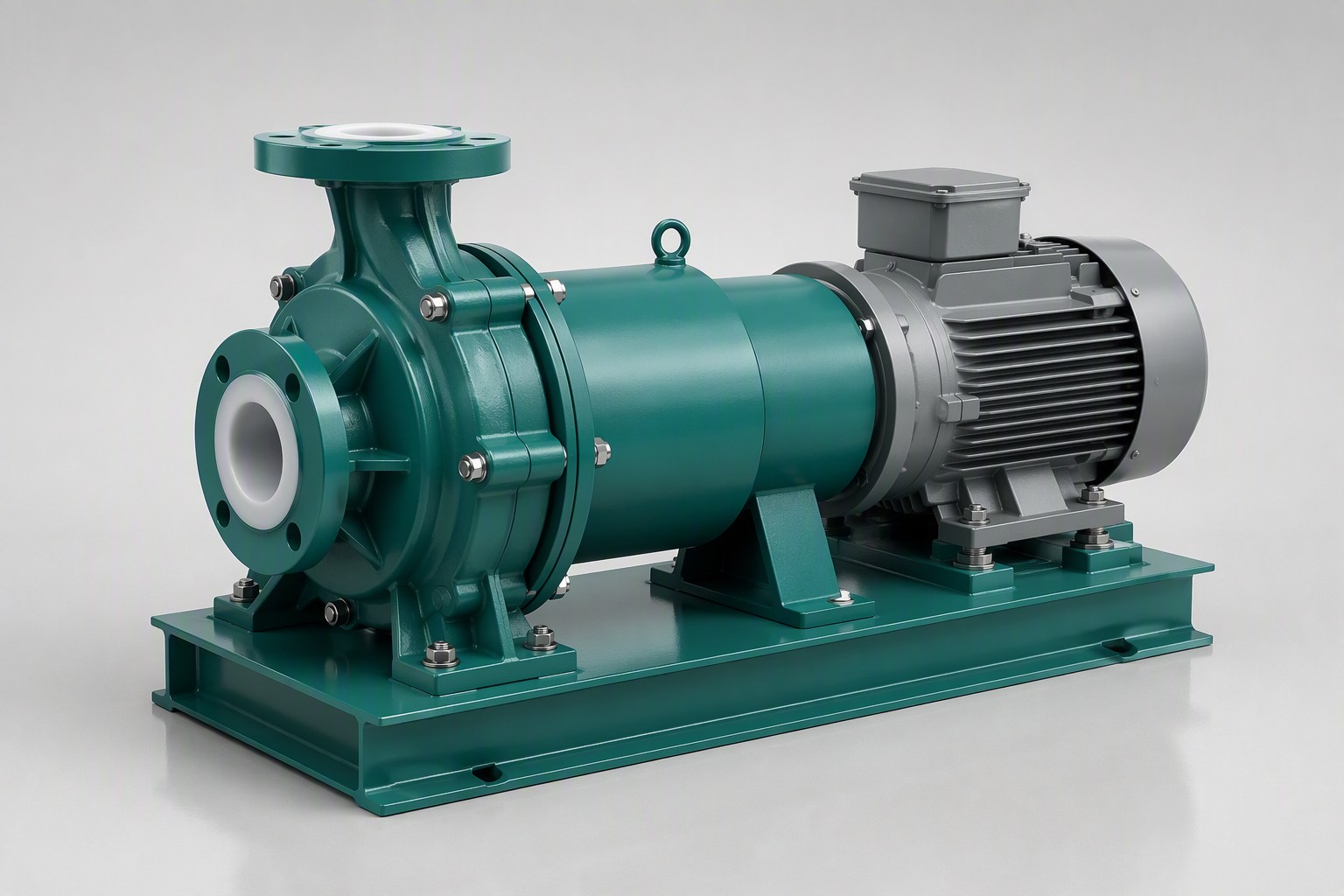
For lubricating chemicals — base oils, additive concentrates and finished lubricants — pump selection is driven by additive chemistry and viscosity. Qingdao Green Power's IH stainless series (SS304/SS316L) handles mild chemicals, dilute acids and alkalis up to 80°C, and the IHF fluoroplastic-lined series (PTFE/FEP/PFA) covers strong acids, strong alkalis and oxidising agents up to 100°C; both are published across 3.5–400 m³/h at 4.5–125 m head. Above about 150 cSt, Qingdao Green Power's guidance for its IS/ISW centrifugal range is to switch to a gear or screw pump.
What Counts as a Lubricating Chemical?
The label covers far more than finished engine oil. In blending plants, terminals and process lines, "lubricating chemicals" usually means several families:
- Base oils — mineral and synthetic stocks (polyalphaolefins, esters), from thin spindle grades to heavy bright stock.
- Additive packages — anti-wear, extreme-pressure (EP), detergent, antioxidant and corrosion-inhibitor concentrates, often acidic or carrying sulfur or chlorine chemistry.
- Finished lubricants — hydraulic, gear, compressor, turbine and engine oils, from ISO VG 2 to VG 1500 and beyond.
- Metalworking fluids — water-miscible cutting fluids, neat oils and solvent-borne rust preventives.
Additive Chemistry Turns Transfer into a Chemical Duty
Neat base oil is not demanding, but the additive package is. EP additives that release chlorine or sulfur, acidic loadings reflected in a high total acid number (TAN), water and emulsifiers in cutting fluids, and the caustic or acid solutions used to flush blending lines can all attack carbon steel and ordinary seal elastomers. That is why a lubricant transfer pump should be specified as a true chemical pump, using the material method in our chemical transfer pump selection guide rather than treated as a generic oil pump.
Chemical Pump Families for Lubricating Chemical Duties
| Characteristic | IH series (stainless) | IHF series (fluoroplastic-lined) |
|---|---|---|
| Wetted materials | SS304 / SS316L | PTFE / FEP / PFA lining over metal casing |
| Typical media | Base oils, mild additive blends, dilute acids and alkalis, emulsions | Aggressive additive concentrates, strong acids, strong alkalis, oxidising agents |
| Max liquid temperature | 80°C | 100°C |
| Published series envelope | Flow 3.5–400 m³/h · Head 4.5–125 m · Temperature -20°C to 100°C | |
| Shaft sealing | Mechanical seal, single or double | |
IH stainless is the economical default for mild media — most base oils and finished oils sit comfortably in SS304 or SS316L — while IHF suits aggressive additive concentrates and acid or caustic cleaning circuits. The choice mirrors the logic in our chemical pump materials and corrosion guide.
Viscosity Limits: When a Centrifugal Pump Gives Way
A centrifugal pump converts impeller velocity into pressure, so friction in a thick liquid makes head and flow fall while efficiency drops. Qingdao Green Power's published guidance for its IS/ISW centrifugal series (1.5–1600 m³/h, temperature ≤80°C) is clear: above about 150 cSt, move to a gear or screw pump. For a blending plant that means:
- Thin, water-like duties — light base oils and dilute cutting fluids move economically with a centrifugal chemical pump, continuously and without pulsation.
- Medium-viscosity lubricants — ISO VG 100–320 hydraulic and gear oils are typical gear-pump territory on clean, filtered service.
- High-viscosity grades — heavy gear oils, bright stock and additive sludge need positive displacement; Qingdao Green Power's G-type single screw pump is published at 0.1–150 m³/h and 0.6–2.4 MPa for high-viscosity oils and resins.
Matching viscosity to technology is covered further in our guide to chemical pump selection based on fluid properties.
Seals and Drives: Preventing the Leak Before It Starts
The dynamic shaft seal is the most common leak point. For most duties a single mechanical seal in compatible materials suffices; where the fluid is aggressive or leakage is unacceptable, a double mechanical seal with a barrier fluid adds containment. When the product is a volatile, solvent-borne additive concentrate, consider a sealless magnetic-drive pump — removing the shaft seal entirely — as discussed in our solvent transfer pump guide. Whichever seal is chosen, the elastomer must match the chemical — fluororubber suits many oils, other media may demand EPDM or perfluoroelastomers — and the full temperature range must be stated.
Selection Checks for a Lubricating Chemical Pump
- Viscosity at the worst case — size for the cold, thick start, not the running average, across every ISO VG grade the line handles.
- Additive chemistry and water content — verify TAN, sulfur or chlorine EP carriers, biocides and any water phase against every wetted material.
- Temperature — normal and maximum, including hot flushing and cleaning cycles between batches.
- Seal and drive type — single, double or sealless magnetic drive depending on the product's toxicity, volatility and value.
- Cleaning compatibility — the pump must survive the caustic or solvent flush between product changes, not just the lubricant itself.
Frequently Asked Questions
What kind of pump is best for transferring lubricating chemicals?
It depends on viscosity and chemistry. Thin, water-like base oils and cutting fluids are served by a centrifugal chemical pump such as Qingdao Green Power's IH stainless (SS304/SS316L, up to 80°C) or IHF fluoroplastic-lined series (up to 100°C for aggressive media). Above about 150 cSt, Qingdao Green Power's published guidance for its centrifugal range is to switch to a gear or screw pump, and its G-type single screw pump is published at 0.1–150 m³/h and 0.6–2.4 MPa for high-viscosity oils. Confirm current model availability and specifications with Qingdao Green Power before procurement.
Can a standard cast-iron or carbon-steel pump transfer lubricant additives?
Not always. Extreme-pressure additives carrying sulfur or chlorine, acidic components, water in cutting-fluid emulsions and cleaning solutions can attack plain steel and standard elastomers. Verify every wetted component — casing, impeller, shaft sleeve, seal faces and O-rings — against the actual additive chemistry before specifying.
What is the difference between the IH and IHF chemical pumps for this duty?
IH is manufactured in SS304 or SS316L for mild chemicals, dilute acids and alkalis up to 80°C — suitable for most base oils and finished lubricants. IHF is lined with PTFE, FEP or PFA for strong acids, strong alkalis and oxidising agents up to 100°C, which fits aggressive additive concentrates and cleaning circuits. Both families share a published envelope of 3.5–400 m³/h flow and 4.5–125 m head.
When does a lubricating-oil duty need a positive displacement pump?
When viscosity exceeds roughly 150 cSt — the limit Qingdao Green Power publishes for its IS/ISW centrifugal range — gear or screw pumps take over because positive displacement flow does not collapse as pressure and viscosity rise. Heavy gear oils, bright stock and additive sludge are typical screw-pump duties; the G-type single screw is published at 0.1–150 m³/h and 0.6–2.4 MPa.
Send the product list — viscosity grades, additive chemistry, temperatures and flow rates — and the engineering team will recommend the chemical pump family and configuration for your blending or transfer line.
Get a Quote
Send your fluid data and duty point. Engineers reply within 24 hours.
Contact Us →💬 WhatsApp NowRelated Products
- Chemical Pump (IH / IHF)
- Centrifugal Pump
Related Articles
Chemical Transfer Pump Selection
Guide and sizing
High-Viscosity Chemical Pump
Thick chemical media
Chemical Pump & Fluid Properties
Compatibility basics