
Chemical Transfer Pump for Solvents
Chemical transfer pump for solvents: how high vapour pressure, low viscosity and flammability drive the specification — NPSH margin, wetted materials, mechanical seals and sealless magnetic-drive options.
A chemical transfer pump for solvents is engineered around high vapour pressure, low viscosity and flammability rather than treated as a routine water duty. Because most solvents flash into vapour easily at the suction side, the installation needs generous NPSH margin — normally a flooded suction with the pump below the source tank — while the thin liquid gives the shaft seal little lubrication, making containment the central selection problem.
Why Solvents Are a Demanding Pumping Duty
Acetone, methanol, ethanol, toluene, xylene and ethyl acetate are thin, low-boiling and often flammable — properties that break the assumptions behind a water duty. Many also change behaviour as temperature rises or as they absorb moisture, so a pump that handles a dry solvent comfortably can cavitate or corrode when the same solvent is wet. A solvent transfer pump is therefore specified from vapour pressure, viscosity, temperature and chemical family, following our guide to chemical pump selection based on fluid properties. Design out these failure modes:
- Cavitation and vapour lock — high vapour pressure makes the liquid flash in the suction line or pump inlet, causing noise, erosion and lost flow.
- Seal leakage — thin, volatile liquid passes a worn seal face and evaporates into fugitive emissions and fire risk.
- Elastomer attack — many solvents swell O-rings, gaskets and seal faces that are perfectly fine for water.
- Corrosion surprises — absorbed moisture or halogenated solvents can corrode a nominally compatible metal.
Give the Pump Real NPSH Margin
NPSH is where solvent transfer problems usually start. Solvent vapour pressure is high and rises quickly with temperature, so the local pressure at the suction nozzle can fall below it while the pump still appears to be working; the liquid flashes, the pump loses prime or runs noisily, and the impeller erodes. The cure is mostly hydraulic:
- Flooded suction — mount the pump below the lowest tank level so static head pushes liquid in, rather than asking the pump to lift a volatile liquid.
- Short, large-bore suction piping — keep velocity low and drop unnecessary fittings, strainers and valves that add pressure loss.
- Temperature and speed — a cool, stable suction temperature and a slower or low-NPSH impeller variant both protect the duty.
Match Materials and Elastomers to the Solvent, Not the Label
A "chemical pump" is not one material: the casing, impeller, shaft sleeve, seal faces, O-rings and gaskets must each resist the actual solvent at its real concentration and temperature. Stainless steel suits many organic solvents, but a solvent that picks up water — or a chlorinated solvent that hydrolyses — changes the picture quickly. Qingdao Green Power's chemical pump range spans the two material families summarised below; the corrosion logic is explained in our article on chemical pump materials and corrosion resistance.
IH Stainless vs IHF Fluoroplastic-Lined for Solvent Service
| Characteristic | IH series (stainless) | IHF series (fluoroplastic-lined) |
|---|---|---|
| Wetted materials | SS304 / SS316L | PTFE / FEP / PFA lining |
| Solvent-service fit | Neutral and mildly aggressive solvents verified compatible with stainless at the duty temperature | Acidic, halogenated or oxidising solvents that attack stainless steel |
| Max liquid temperature | 80°C | 100°C |
| Published series envelope | Flow 3.5–400 m³/h, head 4.5–125 m, temperature -20°C to 100°C; single or double mechanical seal | |
Elastomers are checked separately: a seal can resist a liquid chemically yet still be swollen or hardened by a solvent, so O-ring and gasket grades must be confirmed against the actual liquid.
Contain the Seal: From Mechanical Seals to Sealless Drives
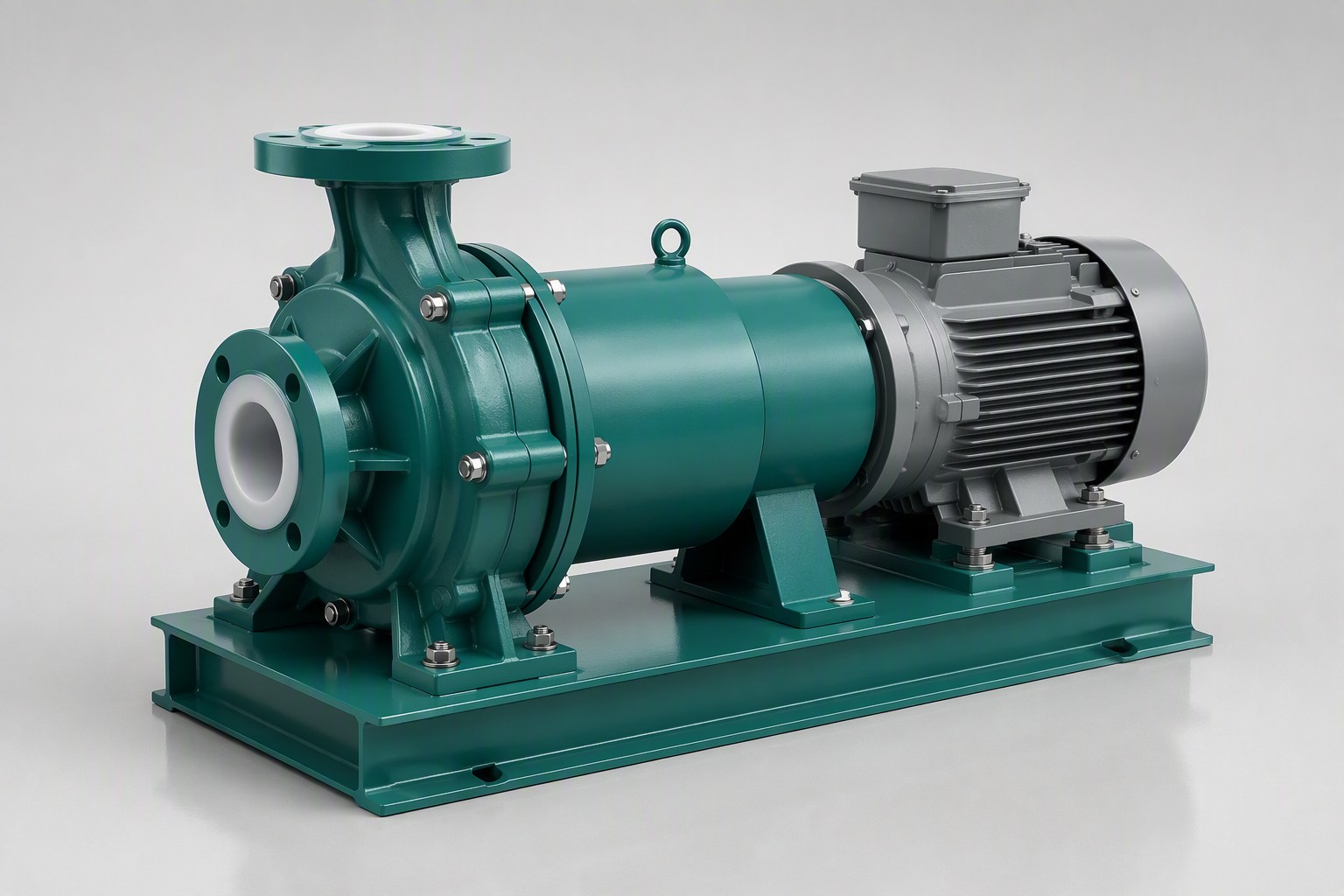
The shaft seal is the most probable leak point on a solvent transfer pump, and on a volatile solvent a small weep becomes a vapour cloud. Two strategies dominate: a correctly specified mechanical seal — single for routine duties, double with a barrier fluid where the solvent is hazardous or the suction is poor — or a sealless magnetic-drive configuration, in which the motor drives the impeller through a magnetic coupling behind a static containment shell. Sealless pumps are widely preferred for fugitive-emission control on flammable and toxic solvents; confirm current model availability and specifications with Qingdao Green Power before procurement.
Flammable Solvents: Motor and Installation Checks
Because most industrial solvents are flammable, the motor and electrical equipment must match the site's hazardous-area classification, the pump and pipework should be bonded and grounded, and the area needs ventilation suited to the solvent's vapour density. These requirements sit outside the pump curve but inside the pump specification.
Know When a Solvent Duty Needs a Different Pump Family
For clean solvents inside centrifugal limits, the chemical centrifugal pump is the economical workhorse — Qingdao Green Power's IS/ISW series is published for water and low-viscosity process liquids, with guidance to change to a gear or screw pump above roughly 150 cSt. Beyond that envelope the fluid dictates the family: polymer- or resin-loaded solvent solutions are viscous (see chemical pumps for resin and polymer), solvent-based adhesives have their own tack and cleaning issues (see adhesive transfer pumps), and pastes belong in the high-viscosity chemical pump discussion. Work through the chemical transfer pump selection process, then confirm the duty point, materials and seal arrangement with the manufacturer.
Frequently Asked Questions
Why do solvents cause pump cavitation more than water?
Most solvents have a high vapour pressure, so the liquid can flash into vapour on the suction side before reaching the impeller. Give the pump enough NPSH margin — normally a flooded suction with the pump below the source tank — so local pressure never falls below the solvent's vapour pressure.
What type of pump is best for transferring solvents?
Clean, low-viscosity solvents are normally transferred by a centrifugal chemical pump for continuous, economical, non-pulsating flow; Qingdao Green Power's IH stainless and IHF fluoroplastic-lined series cover a published 3.5–400 m³/h flow and 4.5–125 m head envelope. Above roughly 150 cSt, or for dosing duties, a positive displacement pump fits better. Confirm current model availability and specifications with Qingdao Green Power before procurement.
When should a solvent pump be sealless (magnetic drive) instead of sealed?
Use a sealless magnetic-drive pump when the solvent is volatile, toxic or flammable and shaft-seal leakage is unacceptable: it removes the dynamic shaft seal — the usual leak point — and contains the liquid behind a static barrier. On a sealed pump, specify a mechanical seal (single, or double with a barrier fluid) matched to the solvent.
Can one stainless steel pump handle every solvent?
No. Compatibility depends on the solvent, its concentration, temperature and water content; some halogenated or acidic solvents and solvent/water mixtures attack stainless steel and standard elastomers. Verify every wetted material — casing, impeller, seal faces, O-rings — and the motor's flammable-atmosphere rating before specifying the pump.
Send the solvent name, temperature, flow and suction arrangement — the engineering team will confirm the NPSH margin, wetted materials and the seal or sealless configuration for your duty.
Get a Quote
Send your fluid data and duty point. Engineers reply within 24 hours.
Contact Us →💬 WhatsApp NowRelated Products
- IH/IHF Chemical Pump
- Centrifugal Pump
Related Articles
Chemical Pump Fluid Properties
Selecting by liquid behaviour
Materials & Corrosion Resistance
Stainless vs lined materials
High-Viscosity Chemicals
Beyond standard centrifugals