
Chemical Pump Materials and Corrosion Resistance
Chemical pump materials and corrosion resistance explained: SS304 and SS316L for dilute acids and alkalis, PTFE/FEP/PFA fluoroplastic linings for strong acids and oxidisers, and compatibility checks for every wetted component.
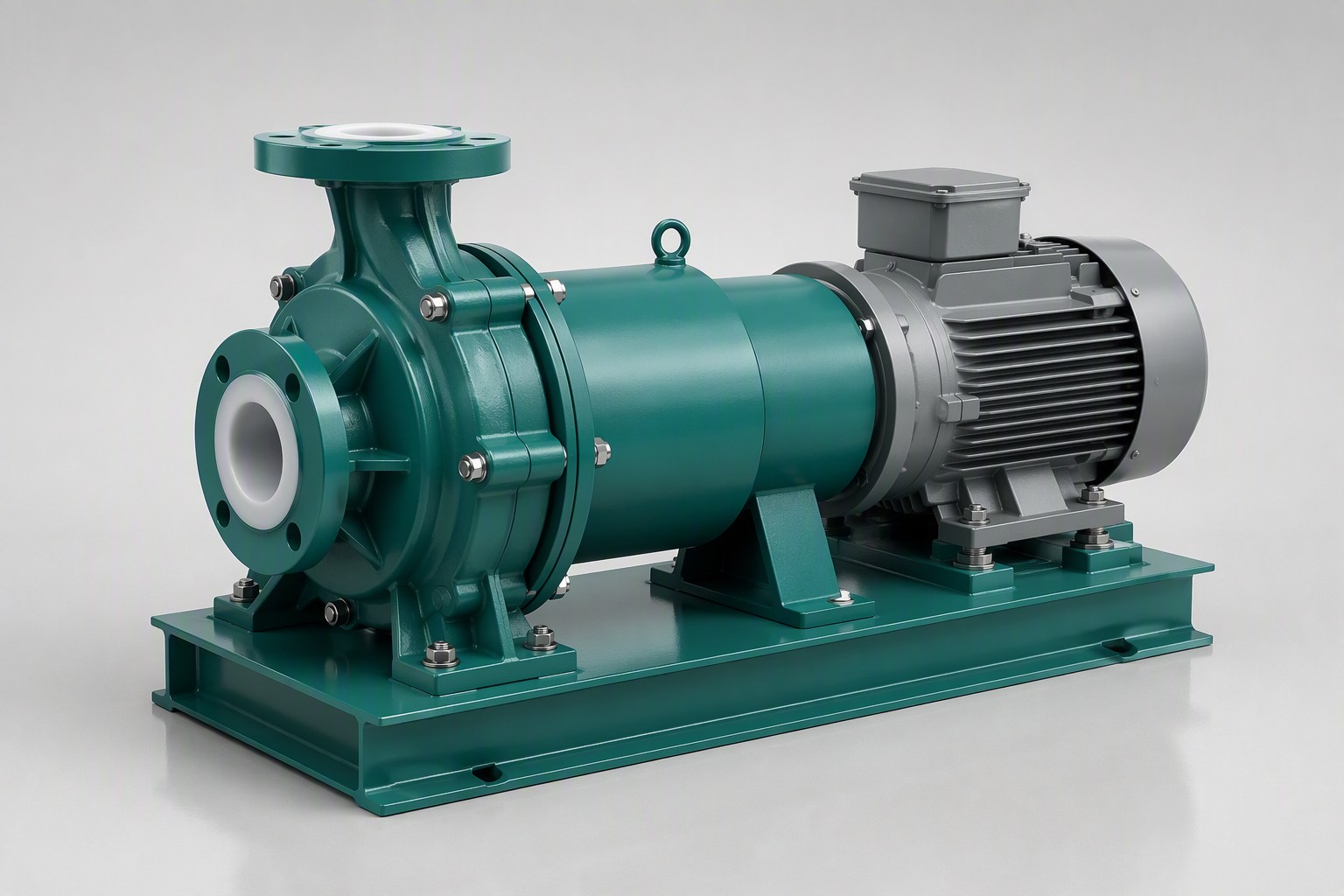
Corrosion resistance in a chemical pump comes from matching every wetted component — casing, impeller, shaft sleeve, seal faces and elastomers — to the chemical, its concentration and its temperature. Qingdao Green Power applies this in two families: the IH series in SS304/SS316L for mild chemicals, dilute acids and alkalis up to 80°C, and the IHF fluoroplastic-lined series (PTFE/FEP/PFA) for strong acids, strong alkalis and oxidising agents up to 100°C.
How Corrosion Attacks a Chemical Pump
Corrosion failures rarely look alike, and recognising the damage mode helps the engineer choose both the material and the pump configuration:
- Uniform corrosion — even surface wasting; choose a material with a low corrosion rate in the medium.
- Pitting and crevice corrosion — localised attack at defects, under deposits or at gaskets; typical of chlorides on hot stainless steel.
- Galvanic corrosion — dissimilar wetted metals in a conductive liquid form a cell; the less noble one corrodes faster.
- Stress corrosion cracking — tensile stress plus chlorides at temperature cracks an otherwise intact alloy.
- Erosion-corrosion — fast flow or suspended solids strip the protective film and speed up attack.
Stainless Steel Wetted Parts: SS304 and SS316L
Austenitic stainless steels are the default wetted material for the IH series, combining corrosion resistance with strength and cleanability. SS304 is the economical general-purpose grade for mild chemicals, dilute acids and alkalis and salt solutions. SS316L adds molybdenum, markedly improving resistance to pitting and crevice corrosion in chloride-bearing media such as brine. Both have limits — hot concentrated acids and strong oxidising chlorides attack them — hence the IH series rating of 80°C for mild chemicals and dilute acids or alkalis.
Fluoroplastic Linings: PTFE, FEP and PFA
When a chemical attacks stainless steel, the economical answer is often a lined pump rather than an exotic alloy. The IHF series protects the metal casing with a fluoroplastic lining — PTFE, FEP or PFA — which resists a broad range of aggressive media, including strong acids such as sulfuric, hydrochloric, hydrofluoric and nitric acid, strong alkalis and oxidising agents, at service temperatures up to 100°C. PFA and FEP are melt-processable grades, while PTFE offers the classic extreme chemical resistance. Fluoroplastics are not indestructible — some small molecules permeate the lining slowly — so verify the chemical, concentration and temperature against the compatibility chart (see chemical pump selection based on fluid properties.
IH Stainless vs IHF Fluoroplastic-Lined Chemical Pump
| Characteristic | IH series (stainless) | IHF series (fluoroplastic-lined) |
|---|---|---|
| Wetted materials | SS304 / SS316L | PTFE / FEP / PFA lining over casing |
| Typical media | Mild chemicals, dilute acids and alkalis, salt solutions | Strong acids (H2SO4, HCl, HF, HNO3), strong alkalis, oxidising agents |
| Max liquid temperature | 80°C | 100°C |
| Published series envelope | Flow 3.5–400 m³/h · Head 4.5–125 m · Temperature -20°C to 100°C | |
| Shaft sealing | Mechanical seal, single or double | |
Every Wetted Component Must Be Compatible
A lined casing does not make the whole pump corrosion-proof: the impeller, shaft sleeve and seal faces also contact the liquid. The mechanical seal — available single or double — is the most leak-critical point, and its faces and elastomers must suit the chemical and temperature. A common mistake is checking only the casing while the seal elastomer degrades in the liquid; double seals with a barrier fluid serve where leakage must be fully contained.
Concentration and Temperature Change the Corrosion Picture
Concentration and temperature decide corrosion: a chemical harmless when dilute can be aggressive when concentrated or hot — dilute sulfuric acid is a routine stainless duty while hot concentrated acid attacks most metals. Hence the IH family is limited to dilute acids and alkalis at 80°C and the IHF family extends strong-acid, strong-alkali and oxidising service to 100°C. State the normal and maximum temperatures and the full concentration range so the engineer judges the worst case, not the average. A complete method for turning the fluid profile into a specification is given in our chemical transfer pump selection guide.
Corrosion-Resistant Selection Checks
- Name the chemical and its concentration — impurities included, since trace chlorides or oxidisers change the material answer.
- State the temperature limits — normal and maximum; corrosion rates rise sharply with temperature.
- Check every wetted component — casing, impeller, shaft sleeve, seal faces and elastomers, not just the headline material.
- Avoid galvanic couples — keep dissimilar wetted metals compatible in the conductive liquid.
- Verify against the compatibility chart — and confirm the final selection with the manufacturer for the current IH/IHF chemical pump range.
Frequently Asked Questions
Which wetted materials does Qingdao Green Power use in its chemical pumps?
The IH series is manufactured in SS304 or SS316L for mild chemicals, dilute acids and alkalis up to 80°C. The IHF series is lined with PTFE, FEP or PFA fluoroplastic for strong acids, strong alkalis and oxidising agents up to 100°C. The published envelope is 3.5–400 m³/h flow and 4.5–125 m head across -20°C to 100°C.
When should I choose SS316L instead of SS304 for a chemical pump?
SS316L contains molybdenum, which improves resistance to pitting and crevice corrosion in chloride-bearing media such as brine. Both grades are austenitic stainless steels with limits — hot concentrated acids and strong oxidising chlorides attack them — and the IH series is published for mild chemicals and dilute acids or alkalis. Confirm the specific duty and current model availability with Qingdao Green Power.
Does a fluoroplastic-lined pump handle every chemical?
No. PTFE, FEP and PFA linings resist a broad range of strong acids, strong alkalis and oxidising agents, but the liner is only one wetted component — the impeller, shaft sleeve, seal faces and elastomers must also be compatible, and some media can permeate the lining at higher temperatures. Verify the chemical and temperature against the compatibility chart and confirm the specification with Qingdao Green Power.
What temperature limits apply to stainless and lined chemical pumps?
For the published Qingdao Green Power families, the IH stainless series (SS304/SS316L) is rated to 80°C for mild chemicals, dilute acids and alkalis, and the IHF fluoroplastic-lined series to 100°C for strong acids, strong alkalis and oxidising agents. The series range is -20°C to 100°C; confirm the duty against the compatibility data before procurement.
Send the chemical, concentration, temperature and duty point — the engineering team will confirm compatible wetted materials and the right IH/IHF configuration.
Get a Quote
Send your fluid data and duty point. Engineers reply within 24 hours.
Contact Us →💬 WhatsApp NowRelated Products
- IH/IHF Chemical Pump
- Industrial Centrifugal Pump
Related Articles
Selection by Fluid Properties
How the liquid chooses the pump
How to Choose a Chemical Transfer Pump
Step-by-step selection guide
High-Viscosity Chemicals
Beyond standard centrifugals