
Chemical Pump Selection Based on Fluid Properties
Chemical pump selection starts with the liquid: how viscosity, corrosivity, temperature, vapour pressure and specific gravity decide whether an IH stainless steel or IHF fluoroplastic-lined chemical pump fits the duty.
Fluid properties decide which chemical pump can handle a duty: corrosivity and temperature fix the wetted materials, while viscosity and vapour pressure determine whether a centrifugal pump is the right technology at all. Qingdao Green Power's chemical pump families follow the same logic — the IH stainless series (SS304/SS316L) serves mild chemicals, dilute acids and alkalis up to 80°C, and the IHF fluoroplastic-lined series (PTFE/FEP/PFA) is specified for strong acids, strong alkalis and oxidising agents up to 100°C.
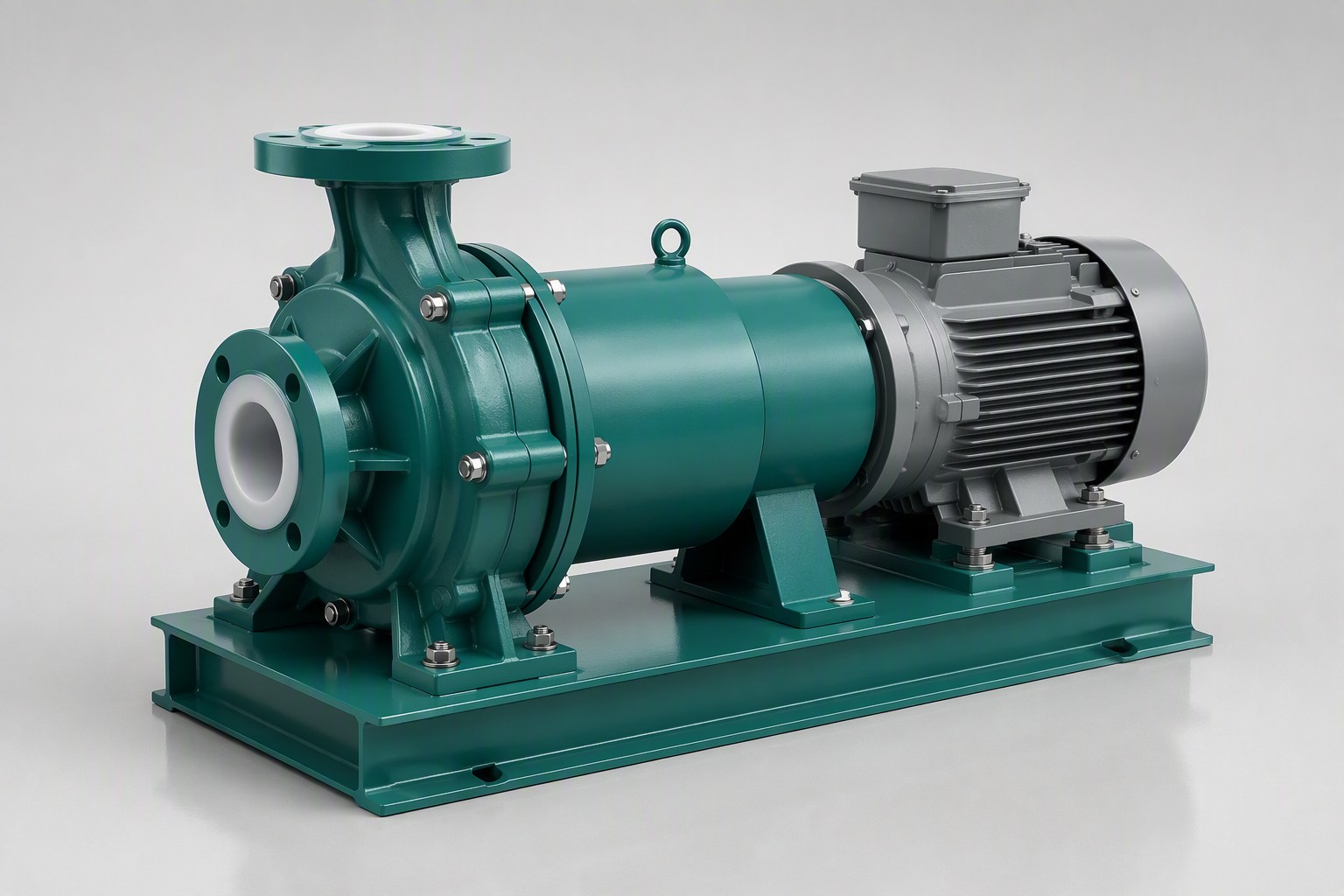
The Fluid Properties That Drive Chemical Pump Selection
A chemical pump is purchased for one specific liquid, and that liquid's properties — not a generic catalogue — should drive the selection. Corrosivity fixes the wetted materials, temperature governs how fast corrosion proceeds, and viscosity and vapour pressure decide whether a centrifugal impeller can move the fluid efficiently at all.
Corrosivity and Temperature Fix the Wetted Materials
Corrosion resistance is the first filter in chemical pump selection, and it is decided by matching the chemical, its concentration and its temperature to suitable materials. Qingdao Green Power publishes two families. The IH series, in SS304 or SS316L, is built for mild chemicals, dilute acids and alkalis up to 80°C. The IHF series carries a PTFE, FEP or PFA fluoroplastic lining, so it can handle strong acids such as sulfuric, hydrochloric, hydrofluoric and nitric acid, strong alkalis and oxidising agents up to 100°C. The link between fluid aggressiveness and pump materials is covered in our guide to chemical pump materials and corrosion resistance.
IH Stainless vs IHF Fluoroplastic-Lined Chemical Pump
| Characteristic | IH series (stainless) | IHF series (fluoroplastic-lined) |
|---|---|---|
| Wetted materials | SS304 / SS316L | PTFE / FEP / PFA lining |
| Typical media | Mild chemicals, dilute acids and alkalis, salt solutions | Strong acids (H2SO4, HCl, HF, HNO3), strong alkalis, oxidising agents |
| Max liquid temperature | 80°C | 100°C |
| Published series envelope | Flow 3.5–400 m³/h · Head 4.5–125 m · Temperature -20°C to 100°C | |
| Shaft sealing | Mechanical seal, single or double | |
Viscosity: When a Centrifugal Impeller Loses Its Grip
Viscosity is the property that most often pushes a chemical duty away from centrifugal technology. A centrifugal pump accelerates liquid with an impeller, and a viscous liquid resists that acceleration, cutting flow, head and efficiency while raising power draw. Below roughly 150 cSt the penalty is modest and the IH/IHF centrifugal stays the economical standard for clean process chemicals; above that level a positive displacement pump is normally more efficient — see our guidance on the chemical pump for high-viscosity fluids. Some chemicals are non-Newtonian, with an apparent viscosity that changes with shear rate, so a single figure may not describe the real duty.
Specific Gravity, Flow and Head Define the Duty Point
Once the technology and materials are fixed, sizing is hydraulics. Flow and discharge head place the duty point on the performance curve, while specific gravity converts head into pressure and shaft power — a denser liquid needs more power at the same head. Temperature acts on every property at once: it lowers viscosity, raises vapour pressure and accelerates corrosion, so state the normal and maximum temperatures rather than one average.
Vapour Pressure and NPSH: Keep the Liquid in the Pump
Every centrifugal pump needs its suction pressure to stay above the liquid's vapour pressure, or the liquid flashes to vapour at the impeller inlet and collapses violently — cavitation that erodes the impeller and damages the seal. Volatile chemicals are therefore a special case: they need generous NPSH margin, flooded suction where possible and often a double mechanical seal to contain fugitive vapour. For low-boiling media, work through our article on chemical transfer pumps for solvents before finalising the seal and suction arrangement.
Other Fluid Properties That Trap the Unwary
- Solids and crystallising media — abrasive particles and crystals erode seal faces and impellers; confirm particle size, hardness and concentration.
- Shear-sensitive chemicals — polymer emulsions and latex can degrade under the high shear of a fast impeller, favouring gentler pump types.
- Dissolved gases — gas released at the impeller eye behaves like cavitation and needs an NPSH margin.
- Reactive or unstable media — monomers, peroxides and self-polymerising chemicals need temperature control and compatible materials throughout the wetted path.
Send the Fluid Profile, Not Just a Pump Name
A quotation is only as good as the duty data behind it. Assemble the full fluid profile — chemical name and concentration, normal and maximum temperature, flow and head, specific gravity, viscosity, vapour pressure or available NPSH, solids content and operating pattern. With that, engineers can confirm the materials, seal and model from the current IH/IHF range; confirm current model availability and specifications before procurement.
Frequently Asked Questions
Which fluid properties matter most when selecting a chemical pump?
The shortlist is corrosivity (chemical identity and concentration), operating temperature, viscosity, specific gravity, vapour pressure and solids content. Corrosivity and temperature set the wetted materials and seal, viscosity and vapour pressure decide whether a centrifugal pump is appropriate, and specific gravity, flow and head set the duty point.
When does high viscosity rule out a standard centrifugal chemical pump?
A centrifugal impeller becomes noticeably less efficient as viscosity rises; above roughly 150 cSt a positive displacement pump is normally the more economical choice. For clean, low- to medium-viscosity chemicals the IH/IHF centrifugal series from Qingdao Green Power remains the standard — confirm the exact duty point before selection.
Why does the maximum pump temperature depend on the wetted material?
Corrosion and material degradation accelerate with temperature, so each wetted material carries a temperature ceiling. The IH stainless series (SS304/SS316L) is rated to 80°C for mild chemicals and dilute acids or alkalis, while the IHF fluoroplastic-lined series extends strong-acid and oxidising service to 100°C. The published series temperature range is -20°C to 100°C.
What information should I send for a chemical pump quotation?
Send the chemical name and concentration, normal and maximum temperature, required flow and discharge head, specific gravity, viscosity, vapour pressure or available NPSH, solids content and operating pattern. Qingdao Green Power selects the model and materials from the current IH/IHF range — confirm current model availability and specifications before procurement.
Send the fluid profile — chemical, concentration, temperature, viscosity, flow and head — and the engineering team will confirm the right materials and model for your duty.
Get a Quote
Send your fluid data and duty point. Engineers reply within 24 hours.
Contact Us →💬 WhatsApp NowRelated Products
- IH/IHF Chemical Pump
- Industrial Centrifugal Pump
Related Articles
How to Choose a Chemical Transfer Pump
Step-by-step selection guide
Materials & Corrosion Resistance
Stainless vs lined materials
Solvent Transfer Pumps
Vapour pressure and NPSH