
Best Pump for High-Viscosity Chemicals
Choosing the best pump for high-viscosity chemicals — G-type single screw pumps for resins and polymers, when IH and IHF centrifugal chemical pumps fit, and the viscosity, corrosion and seal checks that decide the duty.
The best pumps for high-viscosity chemicals are positive displacement machines, led by the G-type single screw (progressive cavity) pump that Qingdao Green Power publishes at 0.1–150 m³/h and 0.6–2.4 MPa. Fixed-volume displacement holds flow steady as viscosity and pressure rise, where a centrifugal impeller loses head and efficiency. Qingdao Green Power's centrifugal guidance is to switch to a gear or screw pump above roughly 150 cSt, so IH and IHF chemical pumps stay practical for thin corrosive liquids.
Why Viscosity Changes the Pump Choice
Viscosity is a liquid's internal resistance to flow, reported in centistokes (cSt) or centipoise (cP). Water sits near 1 cSt, while concentrated resins, polymer melts, adhesives, pigment pastes and slurries reach hundreds of thousands or millions of centipoise.
A centrifugal pump converts impeller velocity into pressure, so thick-liquid friction makes head, flow and efficiency fall together. That is why viscosity, specific gravity and vapour pressure come first in any chemical pump fluid properties review.
G-Type Single Screw: The Positive Displacement Answer
For chemicals too thick for centrifugal action, the G-type single screw pump is a proven answer. A helical metal rotor turns inside an elastomeric stator, forming sealed cavities that travel steadily from suction to discharge, so flow is smooth, nearly pulseless and low in shear — qualities that protect shear-sensitive polymers and pastes.
Qingdao Green Power publishes the G-type at 0.1–150 m³/h and 0.6–2.4 MPa, covering high-viscosity oils and resins above about 1500 cSt, sludge, slurry, shear-sensitive polymers and abrasive liquids, provided solids stay below the minimum flow passage. Three rules protect the machine:
- Never run dry — the rubber stator is destroyed within seconds without liquid.
- Match the stator elastomer — NBR, EPDM or FKM for the chemical and temperature.
- Fit pressure protection — a relief valve guards pump and line at cold startup.
When the IH or IHF Chemical Pump Still Fits
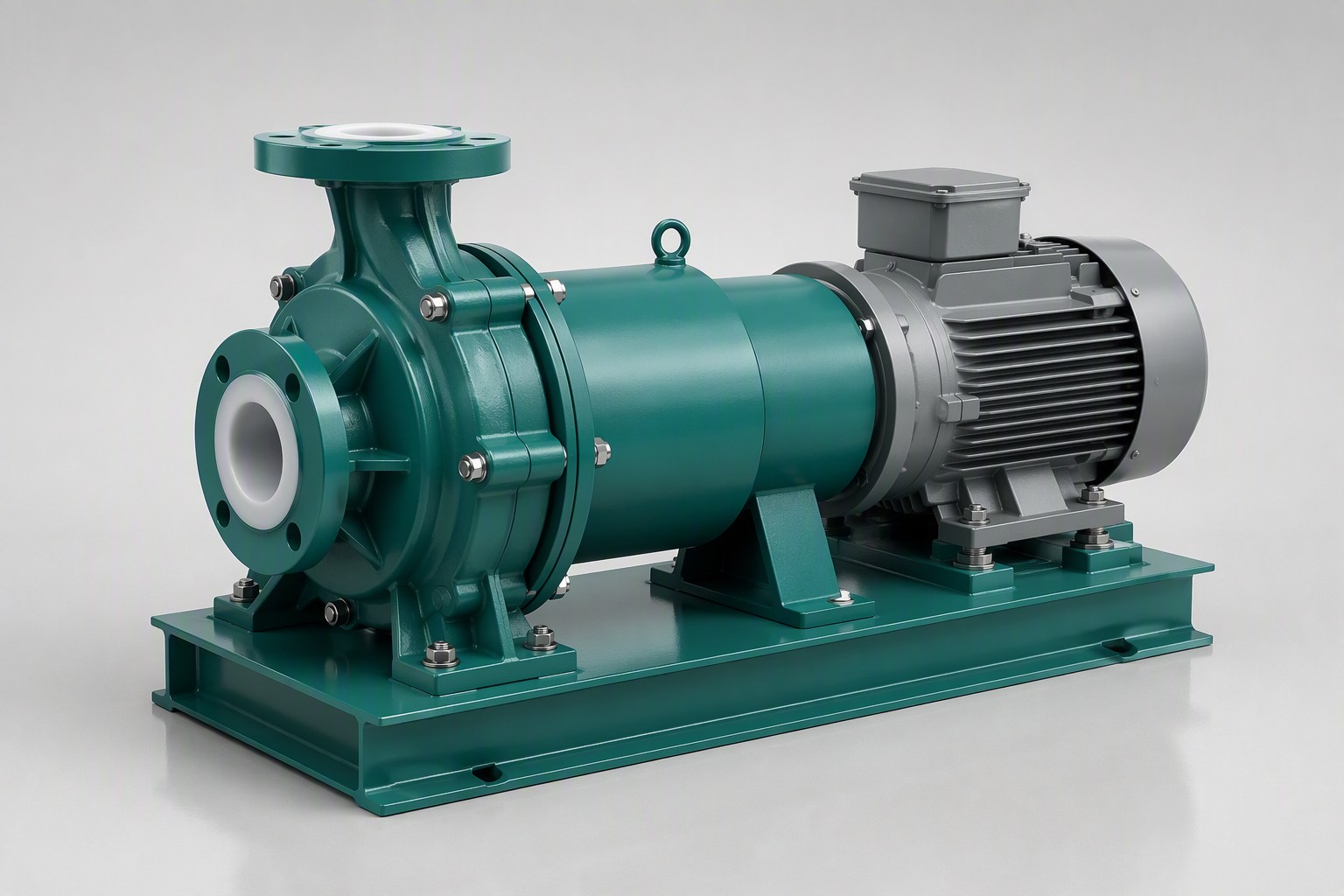
Many chemical duties are thin — dilute acids and alkalis, salt solutions, solvents — and for these, centrifugal chemical pumps deliver large flows cheaply. The IH series (SS304 or SS316L) serves mild chemicals, dilute acids and alkalis up to 80°C; the IHF fluoroplastic-lined series (PTFE, FEP or PFA) handles strong acids such as sulfuric, hydrochloric and hydrofluoric acid, strong alkalis and oxidising agents up to 100°C. The published envelope is 3.5–400 m³/h at 4.5–125 m head, with single or double mechanical seals.
The family is described on the IH and IHF chemical pump product page. Keep the viscosity rule in mind: once a chemical behaves like a heavy syrup, its corrosion-resistant construction belongs on a positive displacement pump, not a centrifugal impeller.
Chemical Pump Technologies Compared for Viscous Duty
| Technology | Typical chemical duties | QGP reference |
|---|---|---|
| IH centrifugal — stainless | Mild chemicals, dilute acids and alkalis | SS304/SS316L up to 80°C |
| IHF centrifugal — lined | Strong acids, strong alkalis, oxidisers | PTFE/FEP/PFA lined up to 100°C |
| G single screw | Resins, polymers, slurries, viscous oils, abrasive media | 0.1–150 m³/h; 0.6–2.4 MPa |
| External gear pump | Clean viscous oils and fuels at medium-high pressure | Confirm current model availability and specifications with Qingdao Green Power |
Corrosion, Seals and Temperature Checks
With viscous chemicals, corrosion and viscosity act together. Wetted materials must resist the chemical at operating temperature — stainless for mild service, fluoroplastic lining where the acid attacks the metal; see our chemical pump materials and corrosion article.
- Sealing: single or double mechanical seals with a flush plan; double seals or quench arrangements protect against polymerising media.
- Temperature control: resins and adhesives that set when cool need jacketed pump heads and heat-traced lines; confirm the cold start.
- Elastomers: stators, O-rings and diaphragms must suit the chemical at its worst temperature — see our adhesive transfer pump notes for sticky media.
Selection Checklist for a High-Viscosity Chemical Duty
- Chemical identity, concentration and temperature — decide corrosion severity and wetted materials first.
- Viscosity at the worst case — a cold, thick start raises torque and suction losses; size for the peak.
- Flow and discharge pressure — PD flow rises with speed; confirm the maximum pressure and relief setting.
- Solids and shear sensitivity — abrasive or fragile products point to a progressive cavity design.
- Seal, elastomer and heating — match wetted polymers and seals to the chemistry.
The method in our chemical transfer pump selection guide applies unchanged when the chemical is viscous.
Frequently Asked Questions
What is the best pump for high-viscosity chemicals?
A positive displacement pump is the best choice because fixed-volume displacement keeps flow stable as viscosity and pressure rise. Qingdao Green Power publishes the G-type single screw (progressive cavity) pump at 0.1–150 m³/h and 0.6–2.4 MPa for high-viscosity oils and resins above about 1500 cSt, sludge, slurry and shear-sensitive polymers; confirm the model and materials for your chemical with Qingdao Green Power before procurement.
Can an IH or IHF centrifugal chemical pump handle viscous liquids?
As centrifugal machines, the IH (SS304/316L) and IHF (PTFE/FEP/PFA-lined) chemical pumps lose efficiency and head as viscosity climbs. They are published at 3.5–400 m³/h and 4.5–125 m head over -20°C to 100°C, but Qingdao Green Power's guidance for its IS/ISW centrifugal range is to switch to a gear or screw pump above about 150 cSt, so viscous chemicals normally point to a positive displacement pump.
How do I choose between an IH stainless steel and an IHF fluoroplastic-lined pump?
Match the wetted material to the chemical. IH stainless (SS304/316L) suits mild chemicals, dilute acids and alkalis up to 80°C; IHF fluoroplastic-lined pumps handle strong acids such as sulfuric, hydrochloric, hydrofluoric and nitric acid, strong alkalis and oxidising agents up to 100°C. Confirm concentration and temperature against the compatibility chart with Qingdao Green Power.
Which pump suits viscous, shear-sensitive chemicals such as resins and polymers?
The G-type single screw pump is published by Qingdao Green Power for high-viscosity oils and resins above about 1500 cSt, shear-sensitive polymers, sludge and slurry, moving fluid through sealed cavities with low shear. The stator elastomer (NBR, EPDM or FKM) must match the chemical and temperature, and the pump must never run dry because the rubber stator is destroyed within seconds.
Send your chemical's name, concentration, viscosity, temperature and duty point — the engineering team will recommend the pump technology, wetted materials and seal arrangement.
Get a Quote
Send your fluid data and duty point. Engineers reply within 24 hours.
Contact Us →💬 WhatsApp NowRelated Products
- Chemical Pump (IH / IHF)
- Centrifugal Pump
Related Articles
Chemical Transfer Pump Selection
Step-by-step process guide
Chemical Pump Materials & Corrosion
Wetted-part selection
Chemical Pump for Solvents
Low-viscosity volatile media