
Chemical Pump for Adhesive Transfer
How to choose a chemical pump for adhesive transfer: viscosity, solvent content and reactivity decide between IH/IHF chemical centrifugals, magnetic-drive designs and screw pumps for adhesive duty.
Adhesive transfer demands a pump chosen for the formulation, not for the word "adhesive". Low-viscosity solvent-borne or water-borne adhesives can be moved by a chemically compatible centrifugal or magnetic-drive pump, while thick pastes, sealants and hot melts need a positive displacement pump. Viscosity, solvent chemistry, temperature and moisture sensitivity set the pump technology, the wetted materials and the seal strategy.
Why Adhesive Transfer Is a Demanding Duty
Adhesives are engineered fluids spanning a huge range — from solvent-thinned contact cements that flow like water to stiff hot-melts, mastics and sealants — and every family brings its own failure mode. Solvent-borne grades attack elastomers and seal faces; reactive systems can cure from atmospheric moisture if left inside a pump between batches; fillers act as mild abrasives; and thick products simply exceed what an impeller can deliver efficiently. Selection therefore starts with the fluid, exactly as in any chemical pump selection based on fluid properties.
Match the Pump Type to the Adhesive Formulation
- Solvent-borne adhesives — thin to medium liquids suited to corrosion-resistant centrifugal or magnetic-drive pumps once the solvent, elastomers and suction are checked.
- Water-borne and emulsion adhesives — low to medium viscosity; compatible stainless pumps with gentle handling and water flushing between grades.
- Hot melts and 100% solids adhesives — molten only at temperature; handled by jacketed positive displacement pumps, not standard centrifugals.
- High-viscosity pastes, sealants and mastics — screw, progressive-cavity or gear pumps displacing a fixed volume per revolution against discharge pressure.
Choose the Wetted Materials for the Solvent and the Chemistry
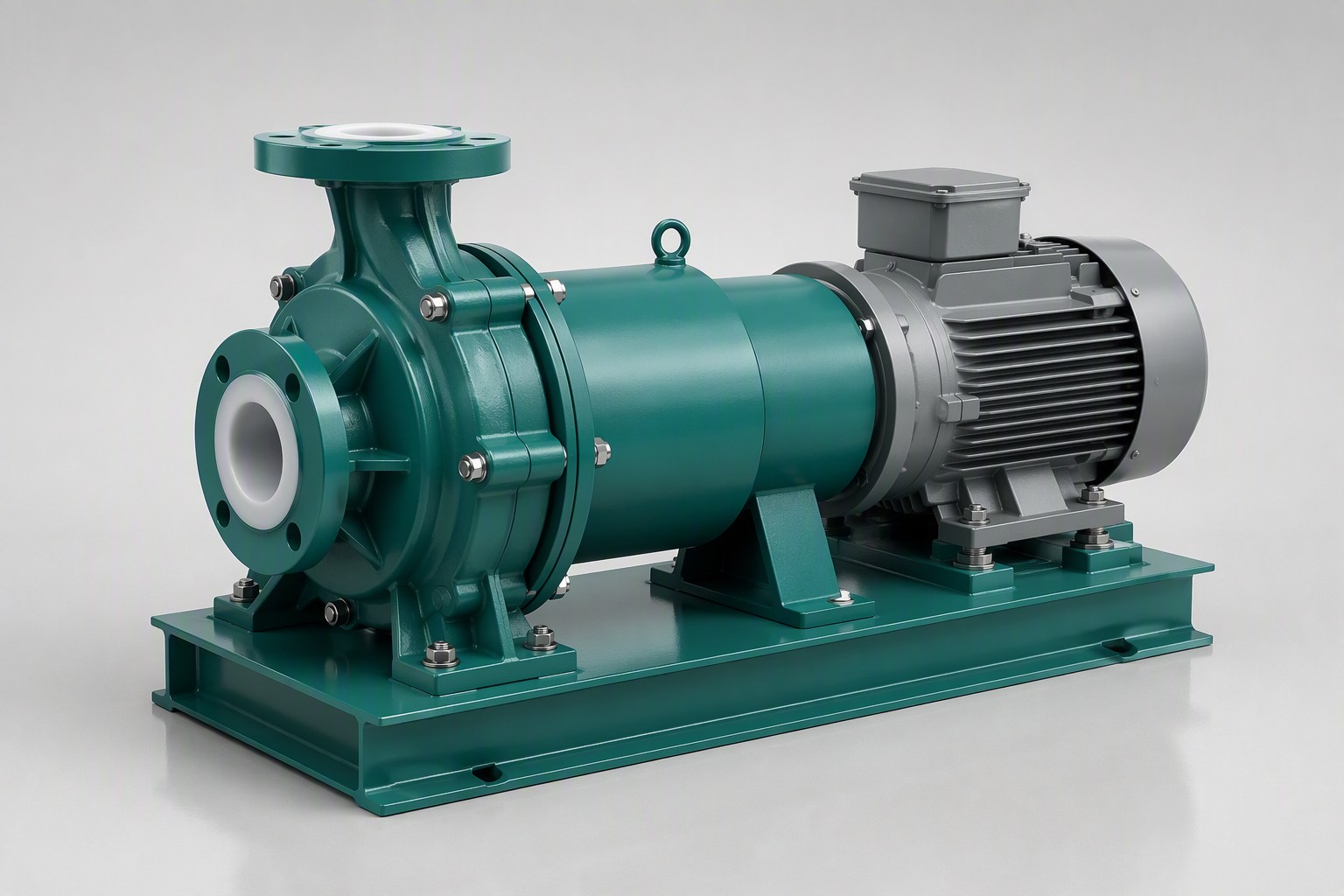
For clean, low-to-medium-viscosity formulations a centrifugal chemical pump is often the economical first choice, so the decision becomes the wetted material. Qingdao Green Power publishes two families in its industrial chemical pump range.
IH Stainless vs IHF Fluoroplastic-Lined Chemical Pump
| Characteristic | IH series (stainless) | IHF series (fluoroplastic-lined) |
|---|---|---|
| Wetted materials | SS304 / SS316L | PTFE / FEP / PFA lining |
| Typical media | Mild chemicals, dilute acids and alkalis, salt solutions | Strong acids such as H2SO4, HCl, HF and HNO3, strong alkalis, oxidising agents |
| Max liquid temperature | 80°C | 100°C |
| Best role | General chemical transfer | Media that attack stainless steel |
The two families share a published series envelope of 3.5–400 m³/h flow and 4.5–125 m head across -20°C to 100°C. Most organic adhesive solvents are not strong acids or alkalis, so SS316L IH stainless is frequently the starting point; the fluoroplastic-lined IHF earns its place when the carrier attacks stainless. Verify the exact formulation, concentration and temperature against the chemical pump materials and corrosion resistance guidance, including seal faces and elastomers.
Plan the Seal Strategy Before the First Batch
The shaft seal is the most common leak point, and adhesives make it worse: tacky products stick to seal faces, solvents attack elastomers, and moisture-curing systems can set solid in the seal chamber when the pump stands idle. IH and IHF pumps are offered with single or double mechanical seals; a double seal with a barrier fluid suits hazardous solvents or a possible dry start-up. Where even a small leak is unacceptable — reactive or odorous adhesives — a magnetic-drive pump removes the dynamic seal entirely. Purge moisture-curing grades before stops and confirm the seal plan with the manufacturer.
When Adhesive Viscosity Exceeds Centrifugal Limits
Centrifugal pumps lose efficiency quickly as viscosity climbs; above roughly 150 cSt a positive displacement pump is the more efficient option. For the thick end of the spectrum — sealants, mastics, uncured PU pastes and filled formulations above 1500 cSt — Qingdao Green Power's G-type single screw pump fits, with a published range of 0.1–150 m³/h at 0.6–2.4 MPa. The elastomeric stator handles viscous, slightly abrasive media gently, but the stator grade (NBR, EPDM or FKM) must match the solvent and temperature, and the pump must never run dry — the stator is damaged within seconds without liquid. See the high-viscosity chemical pump guide for related resin and polymer duties.
Adhesive Transfer Pump Selection Checklist
- Viscosity at pumping temperature — centrifugal below ~150 cSt; gear or screw above it.
- Solvent and chemistry — wetted materials, seal faces and elastomers must resist the full formulation.
- Temperature — hot melts need jacketed, heated pump and piping; check the seal limit.
- Moisture and curing risk — dry seals, barrier fluid or a purge for reactive grades.
- Solids and fillers — abrasive fillers favour hardened internals and larger clearances.
- Suction and NPSH — thick adhesives need flooded or assisted suction; never starve a PD pump.
Frequently Asked Questions
What type of pump is best for transferring adhesives?
It depends on the formulation. Low-viscosity solvent-borne or water-borne adhesives can be pumped with a chemically compatible centrifugal or magnetic-drive pump, while high-viscosity pastes, sealants and hot melts need a positive displacement pump such as a gear or screw pump. Match the wetted materials and seal to the solvent and chemistry, and confirm the duty with the pump supplier.
Can Qingdao Green Power chemical pumps handle adhesive transfer?
Qingdao Green Power's IH stainless (SS304/316L) and IHF fluoroplastic-lined chemical pumps cover a published series range of 3.5–400 m³/h flow and 4.5–125 m head, and suit clean, low-to-medium-viscosity adhesive formulations once solvent compatibility is verified. For very viscous adhesives the G-type screw pump (0.1–150 m³/h, 0.6–2.4 MPa) is the alternative. Confirm the chemical compatibility and current model availability with Qingdao Green Power for your specific adhesive.
Why do adhesive transfer pumps fail at the seal?
Adhesives dry, crystallise or cure in the seal chamber, and solvent-borne or reactive systems attack seal elastomers. Moisture-curing adhesives such as polyurethane can set when they contact atmospheric humidity inside the pump. Use a compatible seal flush plan, correct seal face and elastomer grades, keep the pump from running dry, and purge or clean it before long stops.
Can a centrifugal pump transfer high-viscosity adhesive?
Only within limits. Centrifugal efficiency falls quickly as viscosity rises — as a rule of thumb, above roughly 150 cSt a gear or screw pump is more efficient. Very thick adhesives, sealants and hot melts are normally handled by positive displacement pumps that deliver a fixed flow per revolution and tolerate high discharge pressure.
Send the adhesive family, solvent, viscosity at pumping temperature, flow and pressure — the engineering team will confirm the wetted materials, seal plan and pump configuration for your duty.
Get a Quote
Send your fluid data and duty point. Engineers reply within 24 hours.
Contact Us →💬 WhatsApp NowRelated Products
- IH/IHF Chemical Pump
- Centrifugal Pump
Related Articles
Chemical Transfer Pump Selection
From chemical to configuration
High-Viscosity Chemicals
Beyond standard centrifugals
Resin & Polymer Transfer
Related viscous chemical duties