
Chemical Pump for Resin and Polymer Transfer
How to choose a chemical pump for resin and polymer transfer: match wetted materials to the reactive chemistry and viscosity — IH stainless or IHF fluoroplastic-lined centrifugals for liquid resins, and progressive cavity screw pumps for viscous polymer duties.
Resins and polymers are moved safely by matching the pump family to the fluid: a fluoroplastic-lined or stainless centrifugal chemical pump for low-viscosity liquid resins and reactive monomers, and a single-screw positive displacement pump when the polymer is viscous, shear-sensitive or abrasive. Wetted materials, seals and stator elastomers must resist the monomers, catalysts and solvents in the recipe, and the pump must never be allowed to stagnate with a reactive resin inside.
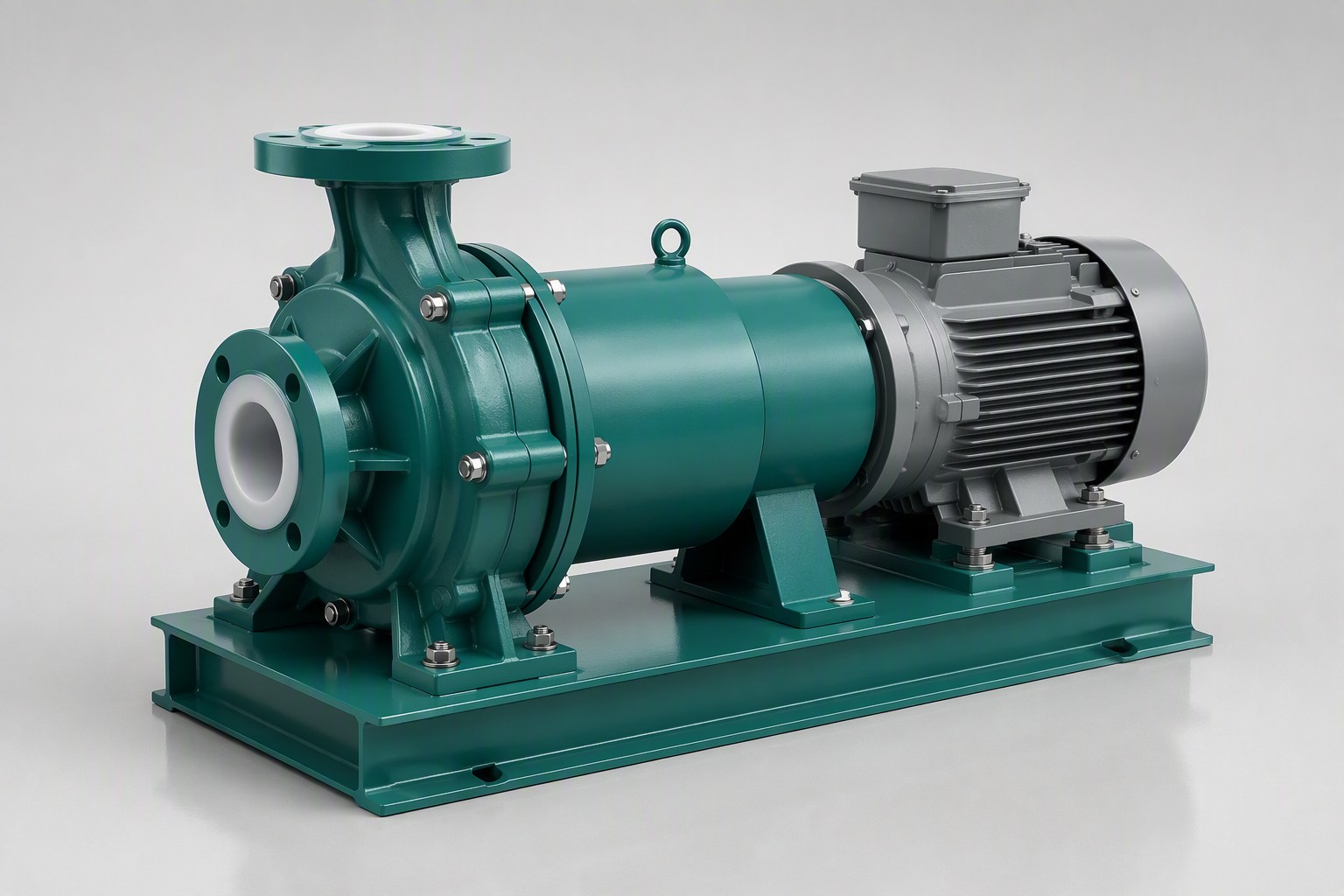
Why Resin and Polymer Transfer Is Not an Ordinary Pumping Duty
Resin streams change character through the process: a reactor feed may be a low-viscosity monomer while the product leaving the kettle is a thick, tacky melt or dispersion. The fluid must be defined at the actual transfer condition — viscosity, temperature, chemistry and solids — as explained in our guide to chemical pump selection based on fluid properties. Typical complications include:
- Viscosity spread — from free-flowing monomers and varnishes to pastes and melts above several thousand centipoise.
- Reactive chemistry — monomers, hardeners, organic peroxides, acid catalysts and solvents that attack common metals and elastomers.
- Temperature limits — many resins cure or set faster when warm, so pumping temperature is often kept low and flushing is routine.
- Shear and abrasion — filled polymers and pigment dispersions can be damaged or abrasive in the wrong pump.
Match the Wetted Materials to the Resin Chemistry
Resin formulations routinely contain aggressive ingredients, so the first decision is corrosion resistance. Qingdao Green Power publishes two complementary families in its industrial chemical pump range. The IH series, in SS304 or SS316L, handles mild chemicals, dilute acids and alkalis up to 80°C. Where the liquid attacks stainless steel — strong acids, oxidising agents, chlorinated monomers or catalyst systems — the IHF series with PTFE, FEP or PFA linings extends service to 100°C. Both share a series envelope of 3.5–400 m³/h flow and 4.5–125 m head across -20°C to 100°C. A fuller treatment of metal versus lined construction is in our article on chemical pump materials and corrosion resistance.
Centrifugal vs Single-Screw Pump for Resin and Polymer Duty
| Characteristic | IH / IHF centrifugal chemical pump | G-type single screw pump |
|---|---|---|
| Best viscosity range | Low to medium — free-flowing resins and monomers | High viscosity, pastes and shear-sensitive polymers |
| Typical flow | 3.5–400 m³/h | 0.1–150 m³/h |
| Discharge | Head 4.5–125 m | Pressure 0.6–2.4 MPa |
| Corrosion control | SS304/316L or PTFE/FEP/PFA lining | Stator elastomer (NBR/EPDM/FKM) matched to chemical |
| Key risk | Seal leakage on aggressive media | Never run dry — stator is destroyed in seconds |
Centrifugal Chemical Pumps for Liquid Resins
When the resin or monomer is clean and free-flowing at pumping temperature, a centrifugal chemical pump gives continuous, non-pulsating flow at low cost per cubic metre. Wetted materials follow the chemistry: IH stainless for general-purpose unsaturated polyester, alkyd and acrylic systems, and IHF lined construction when strong-acid catalysts, oxidisers or solvent blends would corrode the metal. The impeller accelerates liquid from the suction eye and the volute converts velocity into pressure, so head — not pressure rating — is the sizing quantity; select within the 3.5–400 m³/h and 4.5–125 m series envelope and confirm the duty point on the actual curve.
Single-Screw Pumps for Viscous and Shear-Sensitive Polymers
Once viscosity climbs — hot-melt adhesives, concentrated polymer solutions, filled casting resins — a positive displacement pump takes over. The G-type single screw (progressive cavity) principle uses a helical metal rotor turning inside an elastomeric stator; sealed cavities move the product steadily from suction to discharge with low shear and a metered, pulsation-free flow of 0.1–150 m³/h at 0.6–2.4 MPa. Because the stator is the moving seal, its material must be matched to the monomers, solvents and temperature of your recipe, and it tolerates abrasive fillers better than gear designs. Never run the pump dry, and confirm the model, stator grade and speed for your viscosity — more in our high-viscosity chemical pump guide.
Seals, Flushing and Temperature Control
Resin that sets inside a pump is expensive to remove, so the peripheral design matters as much as the hydraulics:
- Shaft seals — single or double mechanical seals depending on leakage risk; a double seal with barrier fluid is favoured for hazardous monomers and solvents.
- Flush and drain — plan solvent or hot-oil flushing between batches and slope lines to drain so reactive material does not stagnate.
- Temperature — keep pumping temperature below the cure or gel point; confirm any heat tracing does not raise local resin temperature.
- Elastomer compatibility — seal faces, O-rings and stator materials must be checked against the full formulation, not just the base resin.
Frequently Asked Questions
Can a standard stainless steel chemical pump transfer resin and polymer?
Only when the material is free-flowing and the chemistry is mild. The IH series in SS304/316L suits mild chemicals, dilute acids and alkalis up to 80°C. Formulations with strong-acid catalysts, oxidisers or chlorinated monomers can attack stainless steel and need an IHF fluoroplastic-lined pump. Always verify the full recipe against the wetted-material compatibility chart.
When should I use a screw pump instead of a centrifugal pump for polymers?
When the polymer is viscous, shear-sensitive or contains abrasive fillers. The G-type single screw pump delivers a steady 0.1–150 m³/h at 0.6–2.4 MPa and moves high-viscosity media gently, but it must never run dry because the elastomeric stator is destroyed within seconds. Confirm the current model and stator grade with Qingdao Green Power for your viscosity.
What flow and head range do Qingdao Green Power chemical pumps cover for resin transfer?
The IH and IHF centrifugal series are published at 3.5–400 m³/h flow and 4.5–125 m head across -20°C to 100°C. The actual model must be selected from the performance curve for your flow, head and liquid — confirm current model availability and specifications with Qingdao Green Power before procurement.
How do I prevent resin from curing inside the pump?
Flush the pump and lines after each batch, slope piping to drain, and keep the liquid below its cure or gel temperature. Choose seal and stator elastomers that resist the monomers and solvents in the recipe, and consider a double mechanical seal with barrier fluid for hazardous formulations. Confirm the flushing procedure with the pump supplier.
Send the resin or polymer type, viscosity, temperature and flow — the engineering team will confirm the wetted materials and pump configuration for your duty.
Get a Quote
Send your fluid data and duty point. Engineers reply within 24 hours.
Contact Us →💬 WhatsApp NowRelated Products
- IH/IHF Chemical Pump
- Centrifugal Pump
Related Articles
High-Viscosity Chemicals
Beyond standard centrifugals
Materials & Corrosion Resistance
Stainless vs lined materials
Adhesive Transfer Pump
Sticky, tacky media handling