
Positive Displacement Pumps in Chemical Processing: How to Choose
Positive displacement pumps in chemical processing explained: which PD families suit viscous chemicals, dosing, slurries and high-pressure transfer, and when they outperform centrifugal chemical pumps.
A positive displacement (PD) pump moves chemical liquids by trapping a fixed volume and forcing it from suction to discharge on every revolution or stroke, so flow follows speed while discharge pressure rises to match the system. In chemical processing, PD pumps earn their place where liquids are too viscous for a centrifugal pump, where flow must be dosed or metered, where high pressure is needed at modest flow, or where the medium carries solids.
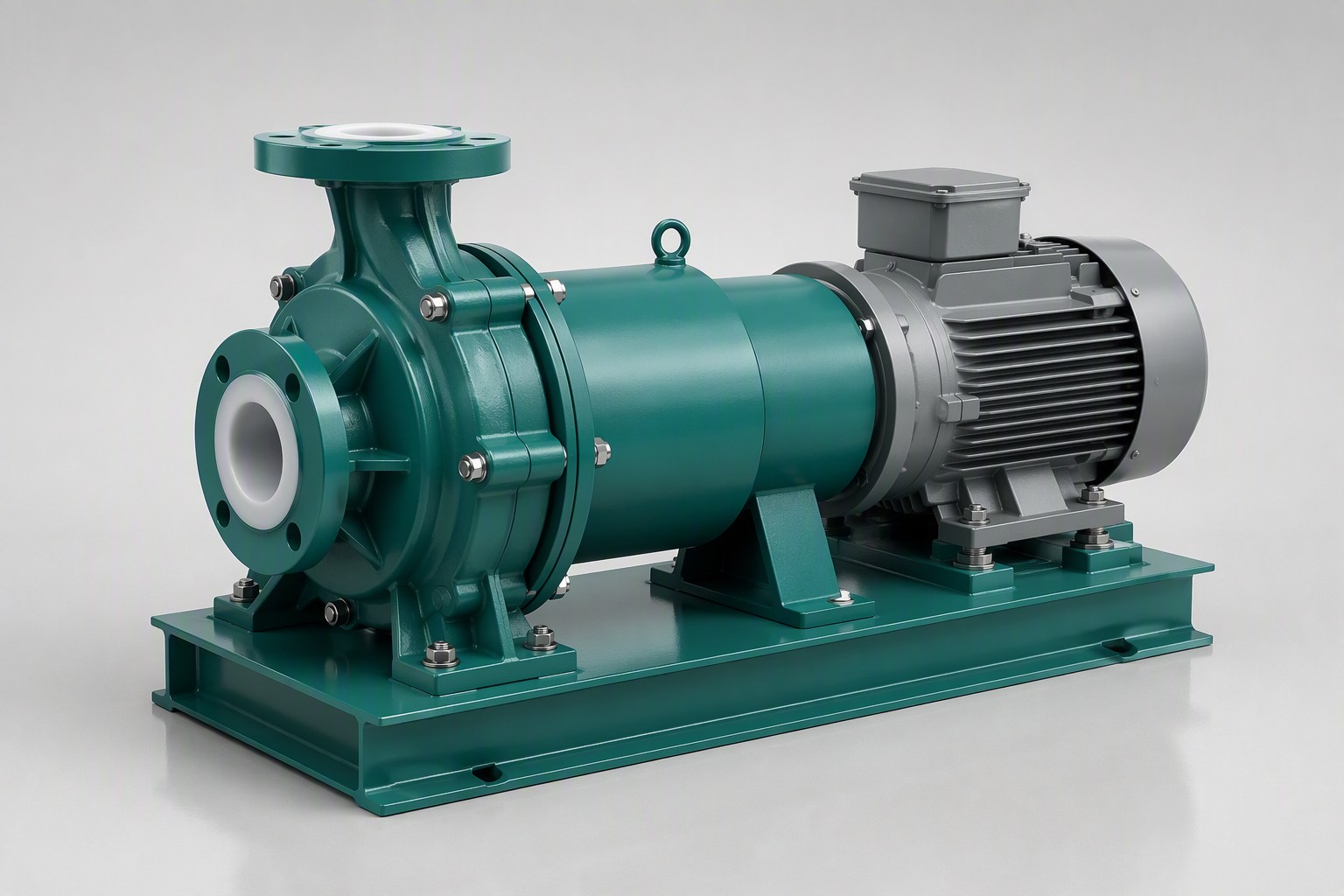
Why Positive Displacement Pumps Are Used in Chemical Plants
In a chemical plant every transfer between reactors, tanks, filters and dosing skids has its own flow and pressure character. A PD pump displaces nearly the same volume every revolution, minus small internal slip, so capacity is set by speed rather than piping resistance. That explains the classic PD roles: repeatable batch charging, ratio control of additives, pressure feeding through filters and heat exchangers, and lifting liquid from drums or sumps with a self-priming action within the vacuum limit. A relief or bypass valve must protect the line, and the liquid — name, concentration, temperature, viscosity, solids — must be defined first, as set out in the guide to chemical pump selection based on fluid properties.
The Main PD Pump Families for Chemical Duty
Chemical processing uses several positive displacement families, each trapping volume in a different way:
PD Pump Families in Chemical Processing
| PD family | How it displaces liquid | Typical chemical duty |
|---|---|---|
| External gear pump | Meshing gears carry liquid between teeth and casing | Clean viscous oils, fuels and solvents at higher pressures |
| Single-screw / progressive cavity pump | Helical rotor in an elastomeric stator, moving sealed cavities forward | Viscous resins, slurries, sludge and abrasive chemicals, with gentle continuous flow |
| Rotary lobe pump | Non-contacting lobes carry trapped volumes around the casing | Shear-sensitive latex, emulsions and polymer dispersions |
| Diaphragm / metering pump | A reciprocating diaphragm displaces a precise stroke volume | Dosing acids, alkalis, inhibitors and catalysts at repeatable rates |
Each family trades pressure capability, gentleness, solids tolerance and cost differently. Qingdao Green Power publishes the G-type single-screw (progressive cavity) series at 0.1–150 m³/h and 0.6–2.4 MPa — a representative PD envelope for viscous, solids-laden media; confirm current model availability and specifications before procurement.
Chemical Duties That Call for Positive Displacement
- High-viscosity chemicals, resins and polymers — above roughly 150 cSt a centrifugal pump loses head and efficiency quickly; see the guidance on pumps for high-viscosity chemicals.
- Dosing and metering — PD flow is governed by speed, keeping chemical feed rates repeatable and proportional to process demand.
- Abrasive slurries and crystallising media — progressive cavity and similar designs move solids-laden liquids at low internal velocity to limit wear.
- Self-priming drum and tank transfer — batch plants regularly empty containers and sumps without a flooded suction.
- Shear-sensitive products — latex, emulsions and polymer dispersions keep their quality when displaced gently rather than accelerated through an impeller.
Matching Wetted Materials and Seals to the Chemical
Positive displacement does not excuse corrosion engineering: body, rotors and seals must survive the chemical at working temperature and concentration. The guidance on chemical pump materials and corrosion resistance applies unchanged — SS304/SS316L for mild chemicals and dilute acids or alkalis, lined constructions for strong acids, and elastomers matched to chemical and temperature: the stator of a progressive cavity pump, for example, is normally available in NBR, EPDM or FKM.
The shaft seal is the most common leak point: mechanical seals, single or double, suit most chemical PD duties, while seal-less magnetic-drive designs remove the dynamic seal where leakage must be contained. Seal elastomer grades need the same compatibility check.
PD vs Centrifugal in a Chemical Plant: Where to Draw the Line
Positive displacement does not replace the centrifugal pump, still the workhorse for bulk thin-liquid transfer. Qingdao Green Power's IH stainless and IHF fluoroplastic-lined chemical pumps cover 3.5–400 m³/h at 4.5–125 m head — IH (SS304/316L) for mild chemicals up to 80°C, IHF (PTFE/FEP/PFA lining) for strong acids, alkalis and oxidising agents up to 100°C. In line with published guidance for the wider centrifugal pump range, above about 150 cSt a gear or screw pump is the efficient choice. Where flow must stay repeatable regardless of back-pressure, dosing accuracy matters, or the liquid is abrasive, PD wins even at low viscosity — and both often sit side by side in one plant.
Information to Send When Specifying a PD Chemical Pump
- Fluid identity — chemical name, concentration, temperature range and impurities.
- Viscosity at pumping temperature — including cold start, which sets shaft power.
- Flow and pressure — normal, minimum and maximum flow, discharge pressure and relief setting.
- Solids or abrasives — size, hardness and concentration may rule families in or out.
- Materials and seal preference — wetted metals or linings, elastomer grade, single or double mechanical seal.
Every PD selection reduces to the chemistry of your liquid and the shape of your duty: confirm current model availability and specifications with Qingdao Green Power before procurement.
Frequently Asked Questions
Which positive displacement pump is best for high-viscosity chemicals?
For viscous, shear-sensitive or abrasive chemical media a single-screw (progressive cavity) design is a strong first choice — the Qingdao Green Power G-type series is published at 0.1–150 m³/h with pressures of 0.6–2.4 MPa and suits resins, pastes, slurries and sludge. External gear pumps suit clean viscous oils at higher pressures, and rotary lobe pumps handle shear-sensitive media gently. Confirm current model availability and specifications with Qingdao Green Power before procurement.
When should a chemical plant choose a positive displacement pump instead of a centrifugal chemical pump?
Choose PD when viscosity is high — centrifugal performance falls off above roughly 150 cSt — when flow must be dosed or metered by speed, when high pressure is needed at modest flow, or when the liquid is abrasive or must be lifted from a dry suction. For thin corrosive liquids, IH stainless (SS304/316L, up to 80°C) and IHF fluoroplastic-lined (up to 100°C) centrifugal pumps remain the economical bulk-transfer choice across 3.5–400 m³/h and 4.5–125 m head.
Can a progressive cavity pump run dry?
No. In a single-screw progressive cavity pump the steel rotor runs inside an elastomeric stator, and the stator is destroyed within seconds without liquid lubrication. The pump must never be run dry, and the stator material — normally NBR, EPDM or FKM — must be compatible with the chemical and its temperature.
Do PD pumps used on chemicals need a relief valve?
Yes. Because a PD pump keeps displacing its full volume as discharge pressure climbs, a blocked line can overpressurise the pump, seals and piping. Install a relief or bypass valve set below the maximum allowable pressure, returning bypassed liquid to the suction side.
Send the chemical name, concentration, temperature, viscosity and duty point — the engineering team will confirm the PD family, wetted materials and drive configuration for your process.
Get a Quote
Send your fluid data and duty point. Engineers reply within 24 hours.
Contact Us →💬 WhatsApp NowRelated Products
- IH/IHF Chemical Pump
- IS/ISW Centrifugal Pump
Related Articles
Chemical Transfer Pump Selection
Centrifugal workhorses
High-Viscosity Chemicals
Where PD pumps take over
Materials & Corrosion Resistance
Match wetted parts