
How to Choose the Right Industrial Pump for Your Application
How to choose an industrial pump: define the duty point, match the pump type to liquid viscosity and chemistry, and size the model against verified centrifugal, screw, chemical and thermal-oil pump envelopes.
Choosing the right industrial pump starts with the liquid, not the catalogue: define the flow, head, temperature, viscosity and chemistry of the duty, then match a pump family to it. A clean thin fluid below roughly 150 cSt suits a centrifugal pump; viscous, abrasive or shear-sensitive media need a positive displacement machine such as a screw or gear pump; corrosive chemicals require matched wetted materials; and hot heat-transfer fluids have their own dedicated pump family.
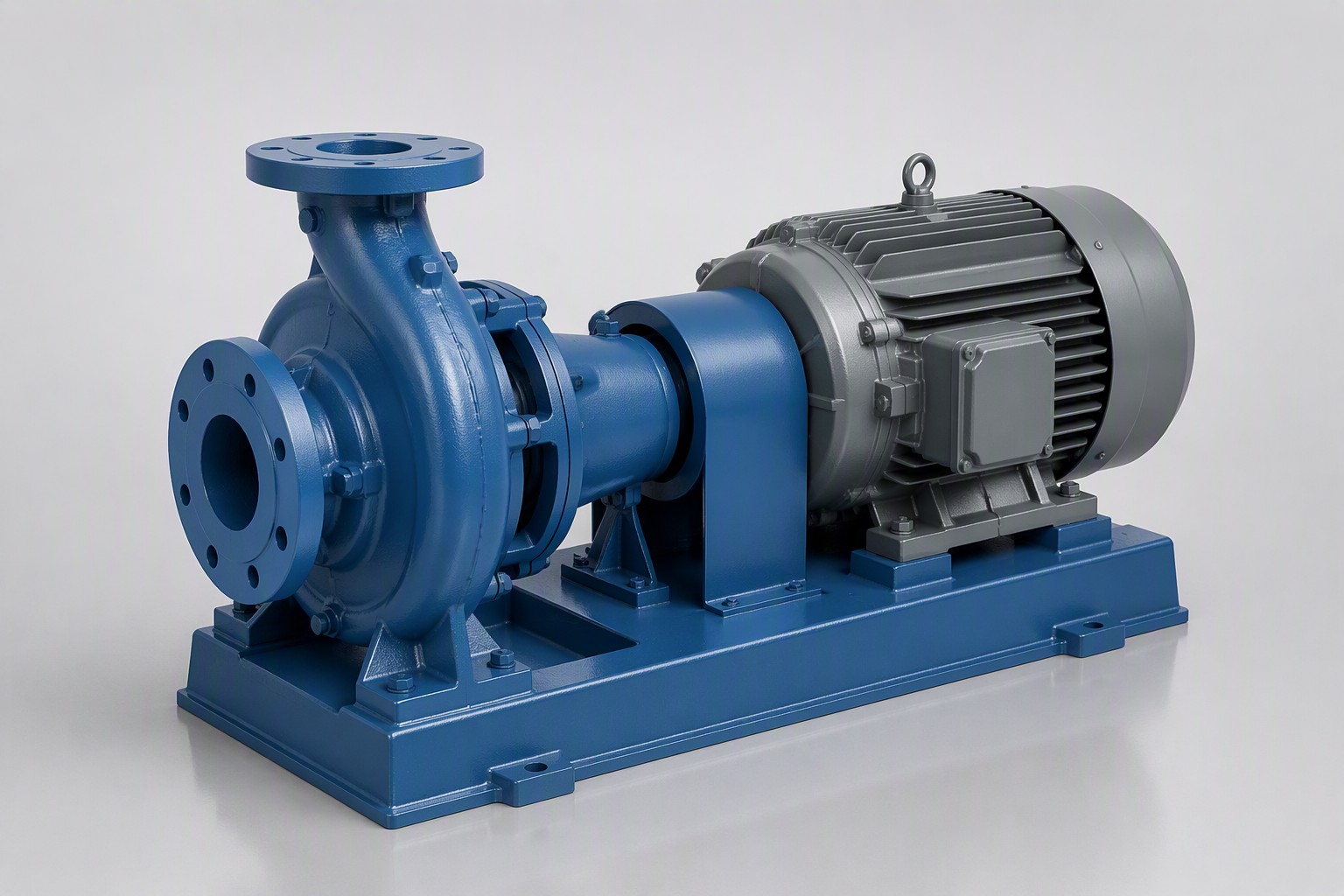
Step 1: Define the Duty Before You Choose the Pump
Every industrial pump is specified against a duty point, never against a generic description of what it should move. Write down the flow rate in normal and peak conditions, the total dynamic head or discharge pressure, and the full set of liquid properties — name, temperature, specific gravity and viscosity — because any one of them can rule out whole families of pumps. Add the solids content, vapour pressure and shear sensitivity of the medium, then the suction conditions, including the available NPSH at the pump flange. This is the same data set Qingdao Green Power uses to build a quotation, and it forces a disciplined comparison instead of a guess.
Step 2: Choose the Pump Technology — Centrifugal or Positive Displacement
The biggest fork in pump selection is viscosity. A centrifugal pump accelerates liquid with a rotating impeller and converts velocity into pressure, giving the smooth, continuous, non-pulsating flow that suits water and most process liquids. Viscous drag, however, multiplies friction losses inside the casing, so efficiency falls away as the fluid thickens; the practical crossover sits near 150 cSt. Above that level a positive displacement (PD) pump is the correct technology — it traps a fixed volume per revolution, so flow stays stable against pressure. The detailed trade-offs are covered in our comparison of positive displacement versus centrifugal pumps and of rotary lobe versus gear pumps.
- Water, cooling circuits and thin process liquids — a centrifugal pump is the economical first choice.
- Viscous oils, resins and pastes — a screw or lobe pump keeps flow stable at high viscosity.
- Slurries, sludge and abrasive media — a progressive-cavity style screw pump tolerates solids.
- Shear-sensitive food and polymer products — a low-shear PD rotor is gentler than any centrifugal.
- Corrosive or aggressive chemicals — the pump type and wetted materials must both match the medium.
Step 3: Match a Verified Pump Family to the Service
Once the technology direction is fixed, compare published envelopes rather than marketing labels. Qingdao Green Power's current ranges cover the main industrial services within verified limits:
Qingdao Green Power Pump Families — Published Envelopes
| Pump family | Published envelope | Typical service |
|---|---|---|
| IS/ISW centrifugal pump | Flow 1.5–1600 m³/h · head 2–125 m · up to 80 °C | Water and low-viscosity process liquids |
| IH/IHF chemical pump | Flow 3.5–400 m³/h · head 4.5–125 m · -20 °C to 100 °C | Mild chemicals (IH, SS304/SS316L) to strong acids and alkalis (IHF, fluoroplastic-lined) |
| G and 3GB screw pump | G: 0.1–150 m³/h, 0.6–2.4 MPa · 3GB: 2.4–241.7 m³/h, oils to 350 °C | High-viscosity and abrasive media; low-viscosity oil at high temperature |
| RY thermal oil circulation pump | Flow 1–500 m³/h · 1–12.5 bar · -20 °C to 350 °C | Heat transfer fluid (HTF) only — not water, chemicals or abrasives |
| 2BV liquid ring vacuum pump | Flow 0.45–8.33 m³/min · ultimate vacuum 0.097 MPa abs | Wet and condensable process gas |
Most mis-specification happens when a duty crosses a family boundary: a too-viscous fluid assigned to a centrifugal, an aggressive chemical given to a plain stainless pump, or a water duty mistakenly sent to a thermal-oil pump, which is not suitable for water, chemicals or abrasive media. Browse the industrial centrifugal pump, screw pump, chemical pump, thermal oil circulation pump and vacuum pump pages for each family's detail.
Step 4: Size the Model on the Worst Duty, Then Check NPSH
With a shortlist in hand, verify each model on its performance curve at the worst operating condition, not the average. Confirm that the pump delivers the required head at the required flow, then examine the suction side: available NPSH must exceed the pump's required NPSH with a safety margin at the highest liquid temperature, or the impeller will cavitate, lose capacity and erode. Finally, check the motor power at the densest and most viscous condition, including cold start, and select the drive voltage, frequency and enclosure class for the site.
Step 5: Seals and Wetted Materials Follow the Liquid
After type and size, reliability is decided by the shaft seal and the wetted materials. Mechanical seals dominate modern industrial pumps, with single seals for clean fluids and double seals with a barrier fluid where leakage must be contained or the medium is hazardous; packed glands still appear on some heavy-viscosity services. Wetted materials must resist corrosion at the real concentration and temperature — stainless steel (SS304/SS316L) covers mild chemicals and dilute acids, while fluoroplastic-lined pumps handle strong mineral acids, strong alkalis and oxidising agents. Elastomer grades must survive both the medium and the temperature, and a hot thermal-oil duty brings its own sealing and cooling rules that a standard water pump cannot meet.
Follow the Application-Specific Selection Guides
The same method — liquid first, then technology, then size — runs through every service. Start from the industrial pump overview to place the families side by side, use the industrial pump types guide to understand each machine, and go deeper with the high-viscosity pump and viscous fluid pump selection guides when the fluid is thick. Whichever direction the duty takes, confirm the current model availability and specifications with Qingdao Green Power before procurement.
Frequently Asked Questions
What decides which industrial pump type I should choose?
The liquid decides: clean thin fluids below roughly 150 cSt suit a centrifugal pump, while viscous, abrasive or shear-sensitive media need a positive displacement pump such as a screw or gear type. Corrosive chemicals demand matched wetted materials, hot heat-transfer fluid needs a dedicated thermal-oil pump, and wet process gas needs a vacuum pump. Confirm the duty point and current model availability with Qingdao Green Power.
At what viscosity should I move from a centrifugal to a positive displacement pump?
Practically around 150 cSt: above that level viscous drag cuts centrifugal efficiency sharply, and a gear or screw pump keeps flow stable against pressure. Qingdao Green Power publishes the G-type single screw pump at 0.1–150 m³/h and 0.6–2.4 MPa for high-viscosity and abrasive media; confirm the model for your duty with Qingdao Green Power.
What data should I prepare for an industrial pump quotation?
Flow rate in m³/h, total head in metres or discharge pressure, liquid name and temperature, specific gravity, viscosity, any solids content, available NPSH, motor voltage and protection class, and the installation layout. Qingdao Green Power sizes quotations from exactly this data set.
Which Qingdao Green Power ranges cover the main industrial services?
IS/ISW centrifugal pumps at 1.5–1600 m³/h flow, 2–125 m head and up to 80 °C for water and thin process liquids; IH/IHF chemical pumps at 3.5–400 m³/h and 4.5–125 m head for mild to aggressive chemicals; G and 3GB screw pumps for viscous and hot-oil duties; RY thermal-oil pumps for heat-transfer fluid from -20 °C to 350 °C; and 2BV liquid ring vacuum pumps for wet gas. Confirm current availability and specifications with Qingdao Green Power before procurement.
Send the liquid data and duty point — flow, head, temperature, viscosity and chemistry — and the engineering team will recommend the pump family, model and configuration that fits your application.
Get a Quote
Send your fluid data and duty point. Engineers reply within 24 hours.
Contact Us →💬 WhatsApp NowRelated Products
- Centrifugal Pump
- Screw Pump
- Chemical Pump
- Thermal Oil Circulation Pump
Related Articles
PD vs Centrifugal Pumps
Which technology fits?
Industrial Pump Types
Families explained
Viscous Fluid Pump Selection
When liquids thicken