
Industrial Pump Types and Their Applications
Industrial pump types explained: how centrifugal and positive displacement pump families work, the common centrifugal, gear, screw and lobe types, and how each is matched to water, chemical, oil and viscous duties.
Industrial pump types divide into two operating families: centrifugal (kinetic) pumps, which spin an impeller to accelerate thin liquid into pressure, and positive displacement pumps, which trap a fixed volume of liquid and force it out on every revolution. Standard types have grown around each family according to viscosity, pressure and solids: end-suction, inline, multistage and self-priming centrifugal pumps; gear, screw and lobe pumps; plus special-duty chemical, thermal oil and vacuum types.
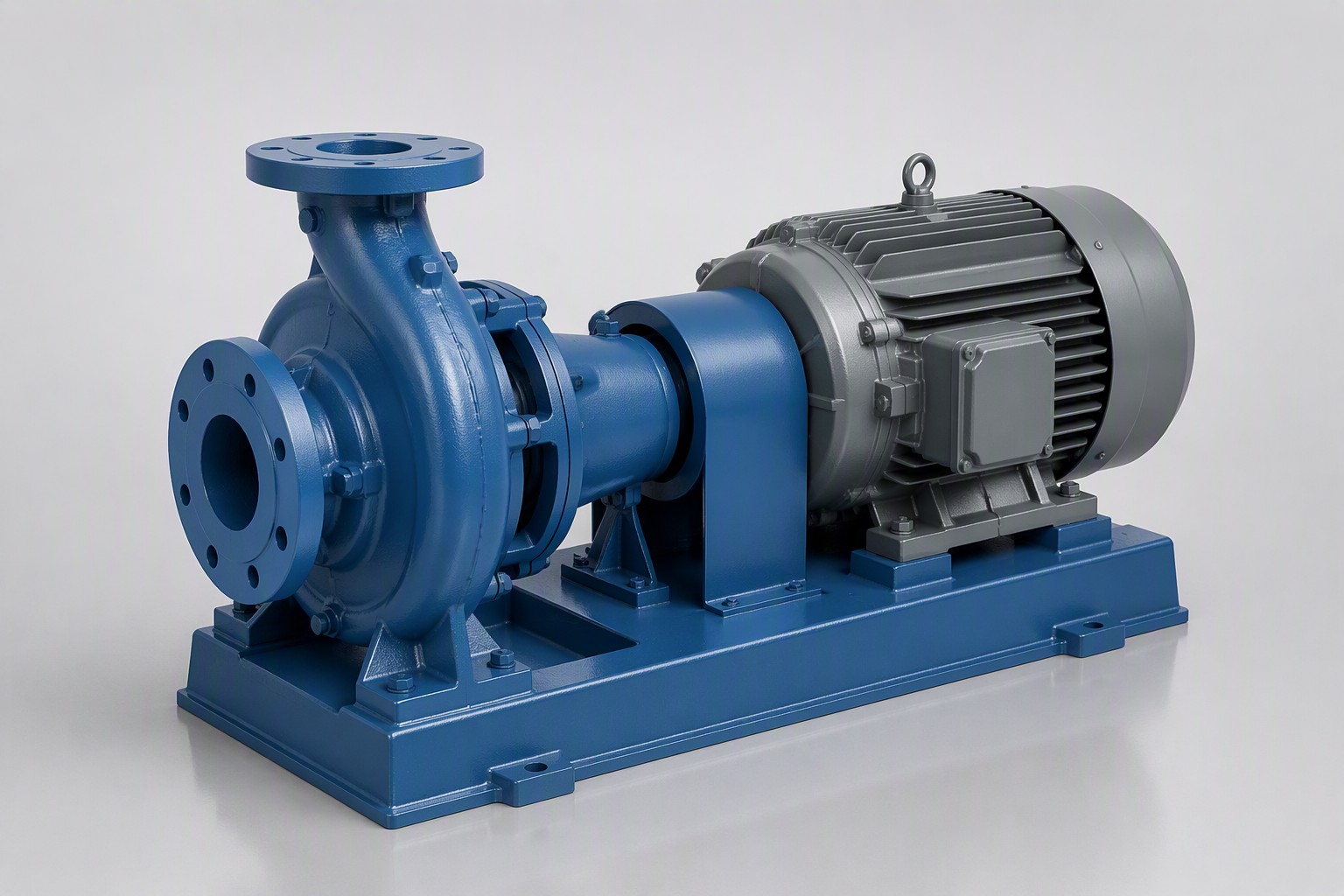
Two Families Define Every Industrial Pump Type
Every industrial pump type belongs to one of two families. A centrifugal pump adds velocity with a rotating impeller and lets the casing convert that velocity into pressure; at a fixed speed it delivers whatever flow the system allows, suiting clean, thin liquids that need continuous flow. A positive displacement pump displaces nearly the same volume each revolution regardless of discharge pressure, so flow follows speed while pressure rises to match the system — hence the relief valve and the PD dominance on viscous media. The crossover sits at roughly 150 cSt, above which a gear, screw or lobe pump is the better tool.
Centrifugal Pump Types: End-Suction, Inline, Multistage and Self-Priming
The centrifugal family covers most water, cooling, transfer and boosting duties in a plant. End-suction and inline pumps handle general water and process service, multistage designs stack impellers for boiler-feed heads, self-priming variants lift liquid from below the pump, and solids-handling types move wastewater. Qingdao Green Power's IS/ISW series is published at 1.5–1600 m³/h, heads of 2–125 m and power to 250 kW for water and low-viscosity liquids up to 80°C. Its verified centrifugal range covers the common sub-types:
Common Centrifugal Pump Types and Typical Duty
| Type | Design feature | Typical application |
|---|---|---|
| IS end-suction | Horizontal, base-mounted | Water and process transfer |
| ISW inline | Compact inline | HVAC, circulation, boosting |
| ZX self-priming | Suction lift 5–6.5 m | Sump and tank transfer |
| ZW solids-handling | Open impeller | Wastewater, dirty liquids |
| CYZ fuel service | Self-priming, fuel-rated | Oil and fuel transfer |
| CDL multistage | Vertical multistage | Boiler feed, high-rise boosting |
See how positive displacement compares with centrifugal pumps before committing to a family — the operating principle decides curve behaviour, priming, pulsation and viscosity limit.
Positive Displacement Pump Types: Gear, Screw and Lobe
Positive displacement pump types earn their place wherever liquid is too viscous, too shear-sensitive or too thick for an impeller. The main rotating designs are:
- Gear pumps use meshing teeth to trap and carry liquid and suit clean oils, fuels and moderate viscosities at higher pressures.
- Screw pumps move liquid along one or more screw rotors. The G-type single screw (progressive cavity) pump handles high-viscosity, shear-sensitive and abrasive media such as sludge and slurry — Qingdao Green Power publishes it at 0.1–150 m³/h and 0.6–2.4 MPa — while the 3GB triple screw type serves low-viscosity oil at high temperature, up to 350°C. Screw pumps must never run dry: the rubber stator is destroyed within seconds. See the industrial screw pump range for heavy duties.
- Rotary lobe pumps use two synchronised, non-contacting rotors that trap liquid between the lobes and the casing; low shear and gentle handling make them the first choice for food, hygienic and polymer products. See the rotary lobe vs gear pump comparison.
Special-Duty Types: Chemical, Thermal Oil and Vacuum Pumps
Beyond the general families, several industrial pump types answer specific process problems. Chemical pumps solve corrosion: Qingdao Green Power offers IH stainless (SS304/SS316L) machines for dilute acids and mild chemicals and IHF fluoroplastic-lined pumps for strong acids and alkalis, spanning 3.5–400 m³/h at heads of 4.5–125 m. Thermal oil circulation pumps move heat transfer fluid from -20°C to 350°C — the RY series runs 1–500 m³/h at 1–12.5 bar with air-cooled housings, no external cooling water. Vacuum pumps create the vacuum used in filtration, distillation and degassing: the 2BV liquid ring type reaches 0.097 MPa absolute at 0.45–8.33 m³/min and tolerates wet, condensable vapours.
How to Match an Industrial Pump Type to Your Application
Start from the liquid and the duty, not from a catalogue. The deciding checks are stable across every manufacturer:
- Viscosity: below about 150 cSt consider centrifugal; above it move to gear, screw or lobe types — see viscous fluid pump selection.
- Flow and head: define the whole operating range; centrifugal types suit steady high flow, PD types suit metered flow and pressure.
- Liquid chemistry: match wetted materials and seals to corrosion and temperature before anything else.
- Solids and shear: open impellers pass solids, screw pumps handle slurries, lobe pumps protect shear-sensitive products.
- Suction and layout: check NPSH, priming for elevated tanks, and footprint for inline versus base-mounted machines.
A full industrial pump selection then weighs efficiency, life-cycle cost and serviceability; the industrial pump guide explains the sizing inputs in depth.
Frequently Asked Questions
What are the main industrial pump types?
Industrial pump types fall into two families: centrifugal pumps, which spin an impeller to move thin, low-viscosity liquids at continuous, non-pulsating flow, and positive displacement pumps, which trap a fixed volume per revolution and handle viscous media and higher pressures. Common centrifugal types include end-suction, inline, multistage and self-priming; the main PD types are gear, screw and lobe, with special-duty chemical, thermal oil and vacuum types alongside.
What is the difference between centrifugal and positive displacement pump types?
A centrifugal pump accelerates liquid with an impeller and, at fixed speed, delivers whatever flow the system allows while head stays relatively fixed. A positive displacement pump displaces nearly the same volume every revolution, so flow follows speed and pressure rises to the system demand (hence the relief valve). In practice centrifugal types suit high-flow, low-viscosity water duties, while PD types take over for viscous media and higher pressures.
Which industrial pump type is best for high-viscosity liquids?
Above roughly 150 cSt a centrifugal pump loses efficiency quickly, so choose a positive displacement pump — gear, screw or lobe type. Qingdao Green Power's G-type single-screw pump is published at 0.1–150 m³/h and 0.6–2.4 MPa for heavy oils, resins, sludge and slurry, and the 3GB triple screw type serves low-viscosity oil at temperatures up to 350°C.
What industrial pump types does Qingdao Green Power offer?
Qingdao Green Power's verified range covers IS/ISW centrifugal pumps (1.5–1600 m³/h), IH stainless and IHF fluoroplastic-lined chemical pumps (3.5–400 m³/h), G-type screw pumps, RY thermal oil circulation pumps (1–500 m³/h) and 2BV liquid ring vacuum pumps (0.45–8.33 m³/min). Confirm current model availability and specifications with Qingdao Green Power before procurement.
Not sure which pump type fits your liquid? Send the fluid name, viscosity, temperature, flow and head — the engineering team will match the right industrial pump type to your duty.
Get a Quote
Send your fluid data and duty point. Engineers reply within 24 hours.
Contact Us →💬 WhatsApp NowRelated Products
- Industrial Centrifugal Pump
- Industrial Screw Pump
Related Articles
Industrial Pump Selection
How to choose the right machine
PD vs Centrifugal Pump
Which technology fits?
High-Viscosity Pumps
Handling thick liquids