
What Is an Industrial Pump and How Does It Work?
Industrial pump basics: how centrifugal and positive displacement pumps work, the main industrial pump types and their typical duties, and how flow, head and viscosity guide the choice.
An industrial pump is a mechanical machine that converts motor energy into liquid flow and pressure to move water, chemicals, oils, slurries and other process fluids through pipes and systems. Every industrial pump belongs to one of two engineering families — centrifugal (kinetic) pumps, which spin an impeller, and positive displacement pumps, which trap a fixed volume of liquid and force it out. Matching the family to the liquid's flow rate, head, viscosity and temperature is the essence of industrial pump selection.
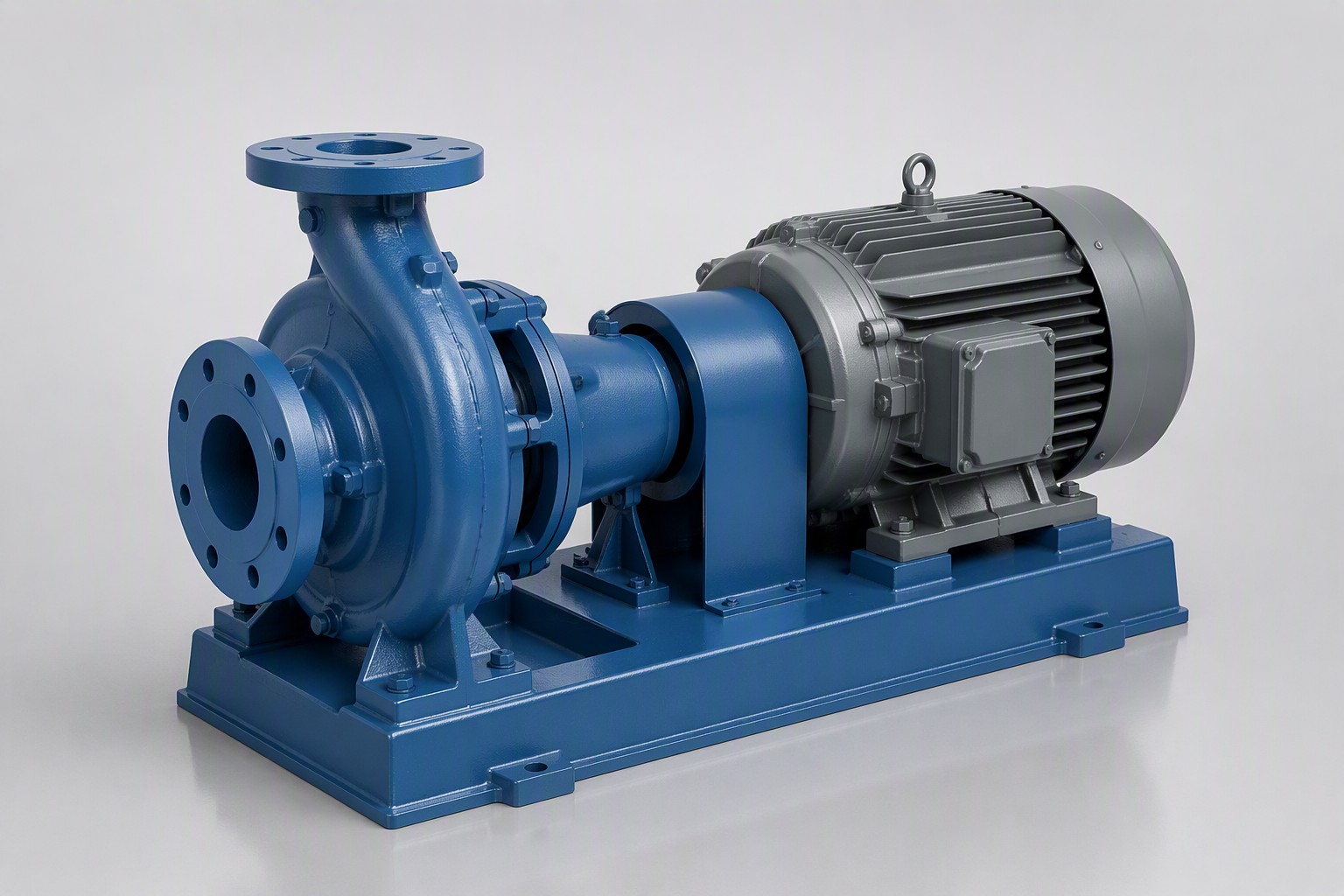
What Is an Industrial Pump?
An industrial pump is a machine that adds energy to a liquid so that it can be moved through pipes, lifted against gravity, pushed into vessels against pressure, or circulated around a closed system. Pumps sit at the heart of nearly every fluid process — water supply, chemical reaction, oil transfer, boiler feeding and wastewater handling — and each one is selected for a specific duty point: the required flow rate and the total head (or discharge pressure) the pump must overcome.
The most useful way to organise industrial pumps is by operating principle. The full family tree is mapped in our industrial pump types article; the short version is that every pump is either centrifugal, because it accelerates the liquid with a rotating impeller, or positive displacement, because it traps a fixed volume of liquid and pushes it out. That single distinction drives most selection decisions, and it also explains how an industrial pump works.
How an Industrial Pump Works: Two Principles
Everything else on a pump — casing shape, seal type, wetted materials, driver and control — hangs off these two operating principles.
The centrifugal (kinetic) principle
In a centrifugal pump, an impeller spins inside a casing. Liquid enters the impeller eye at the centre, the rotating vanes fling it outward at high velocity, and the volute (or diffuser) converts that velocity into pressure. The result is a continuous, non-pulsating flow that suits water and low-viscosity process liquids. Qingdao Green Power publishes its IS/ISW industrial centrifugal pump range at 1.5–1600 m³/h flow, 2–125 m head and liquid temperatures up to 80 °C.
The positive displacement (PD) principle
A positive displacement pump traps a fixed volume of liquid between moving parts and displaces it from the suction to the discharge port on every cycle, so flow is largely proportional to shaft speed and holds steady even as discharge pressure changes. Rotary PD machines — gear, screw, lobe and vane pumps — dominate industrial duty; a single-screw (progressive cavity) pump such as the Qingdao Green Power G-type is published at 0.1–150 m³/h and pressures of 0.6–2.4 MPa for high-viscosity and slurry media. As viscosity climbs above roughly 150 cSt, centrifugal performance falls sharply and a PD pump becomes the economical choice, as our high-viscosity pump guide explains.
Common Industrial Pump Types and Typical Duties
Most plants run a mix of machines because each liquid behaves differently. The table maps the main industrial pump families to the Qingdao Green Power series and the published, verified ranges:
Industrial Pump Types at a Glance
| Pump type | Operating principle | Typical duty | Qingdao Green Power series (verified range) |
|---|---|---|---|
| End-suction centrifugal | Impeller adds kinetic energy | Water and thin process liquids, ≤80 °C | IS/ISW: 1.5–1600 m³/h, head 2–125 m |
| Chemical centrifugal | Impeller, corrosion-resistant wetted parts | Acids, alkalis and aggressive chemicals | IH stainless / IHF fluoroplastic-lined: 3.5–400 m³/h, head 4.5–125 m |
| Single-screw (progressive cavity) | Rotor inside an elastomeric stator | High-viscosity, slurry and shear-sensitive media | G-type: 0.1–150 m³/h, 0.6–2.4 MPa |
| Triple-screw | Three intermeshing screws | High-temperature oil | 3GB: 2.4–241.7 m³/h, up to 350 °C |
| Thermal oil circulation | Centrifugal with air-cooling fins | Heat transfer fluid from -20 °C to 350 °C | RY: 1–500 m³/h, 1–12.5 bar |
| Liquid ring vacuum | Rotating liquid ring compresses gas | Wet gas and condensable vapour suction | 2BV: 0.45–8.33 m³/min, down to 0.097 MPa absolute |
For a head-to-head view of the two dominant families, read positive displacement vs centrifugal pump; for pumps dedicated to a single medium, the chemical pump and thermal oil circulation pump product pages carry the series details.
How to Choose the Right Industrial Pump
Choose the machine after the liquid, not before it. Work through the duty inputs in order and the correct family emerges almost by itself:
- Flow and head: fix the average and peak flow in m³/h and the total head or discharge pressure, including friction losses and static lift.
- Viscosity: below roughly 150 cSt a centrifugal pump performs economically; above it, step across to a gear or screw machine — see the viscous fluid pump selection article for the crossover rules.
- Chemistry and temperature: corrosive liquids set the wetted materials (stainless steel or fluoroplastic lining), and hot media such as thermal oil set the seal and cooling design.
- Suction conditions: available NPSH must exceed the pump's requirement, or the pump will cavitate; below-grade tanks may call for a submerged machine.
- Duty profile: continuous transfer, batch dosing and dry-run risk each favour different configurations, seal types and protection devices.
When the duty point is complete, the engineering team at Qingdao Green Power will shortlist the matching pump family and configuration — the full method is covered in our industrial pump selection guide. Published ranges change as models are upgraded, so confirm current model availability and specifications with Qingdao Green Power before procurement.
Frequently Asked Questions
What is an industrial pump?
An industrial pump is a mechanical machine that converts the energy of a motor or other driver into liquid flow and pressure, moving water, chemicals, oils, slurries or other process fluids through pipes and systems. Industrial pumps fall into two broad families — centrifugal (kinetic) pumps and positive displacement pumps — and the right choice depends mainly on flow, head, viscosity and the liquid's properties.
How does an industrial pump work?
A centrifugal pump spins an impeller that throws the liquid outward, building velocity that the casing converts into pressure; it suits clean, thin, low-viscosity liquids needing continuous, non-pulsating flow. A positive displacement pump traps a fixed volume of liquid and forces it out against the discharge pressure, so flow stays steadier on viscous media and at higher pressures — between them the two principles cover nearly every industrial duty.
What is the difference between centrifugal and positive displacement pumps?
Centrifugal pumps suit water and low-viscosity process liquids at continuous, non-pulsating flow — Qingdao Green Power's IS/ISW series is published at 1.5–1600 m³/h with 2–125 m head and temperatures up to 80 °C. Above roughly 150 cSt centrifugal efficiency falls sharply and a positive displacement pump such as a gear or screw pump becomes the better choice; the G-type single-screw pump is published at 0.1–150 m³/h and 0.6–2.4 MPa.
What industrial pump types does Qingdao Green Power offer?
Qingdao Green Power's verified product line covers centrifugal pumps for water and process liquids (IS/ISW, 1.5–1600 m³/h), chemical pumps (IH stainless and IHF fluoroplastic-lined, 3.5–400 m³/h), screw pumps (G-type single screw, 0.1–150 m³/h, and 3GB triple screw), RY thermal oil circulation pumps and 2BV liquid ring vacuum pumps. Confirm current model availability and specifications with Qingdao Green Power before procurement.
Describe your liquid — viscosity, temperature, flow and pressure — and the engineering team will recommend the pump technology and configuration that fits your duty.
Get a Quote
Send your fluid data and duty point. Engineers reply within 24 hours.
Contact Us →💬 WhatsApp NowRelated Products
- IS/ISW Centrifugal Pump
- IH/IHF Chemical Pump
- G & 3GB Screw Pump
- 2BV Vacuum Pump
Related Articles
Industrial Pump Selection
Turn duty data into a shortlist
Industrial Pump Types
The full family tree
PD vs Centrifugal Pump
Which technology fits?