
Positive Displacement Pump vs Centrifugal Pump: What Is the Difference?
Positive displacement pump vs centrifugal pump compared: flow and pressure behaviour, the viscosity crossover near 150 cSt, efficiency, priming and control, plus a practical selection path.
A positive displacement (PD) pump traps a fixed volume of liquid and pushes it out on every cycle, while a centrifugal pump spins liquid with an impeller and converts that velocity into pressure. PD flow follows shaft speed and stays nearly constant as discharge pressure changes; centrifugal flow at fixed speed follows the pump-curve/system-curve balance. The practical crossover is viscosity: above roughly 150 cSt, centrifugal performance falls away and a gear or screw pump is the efficient choice.
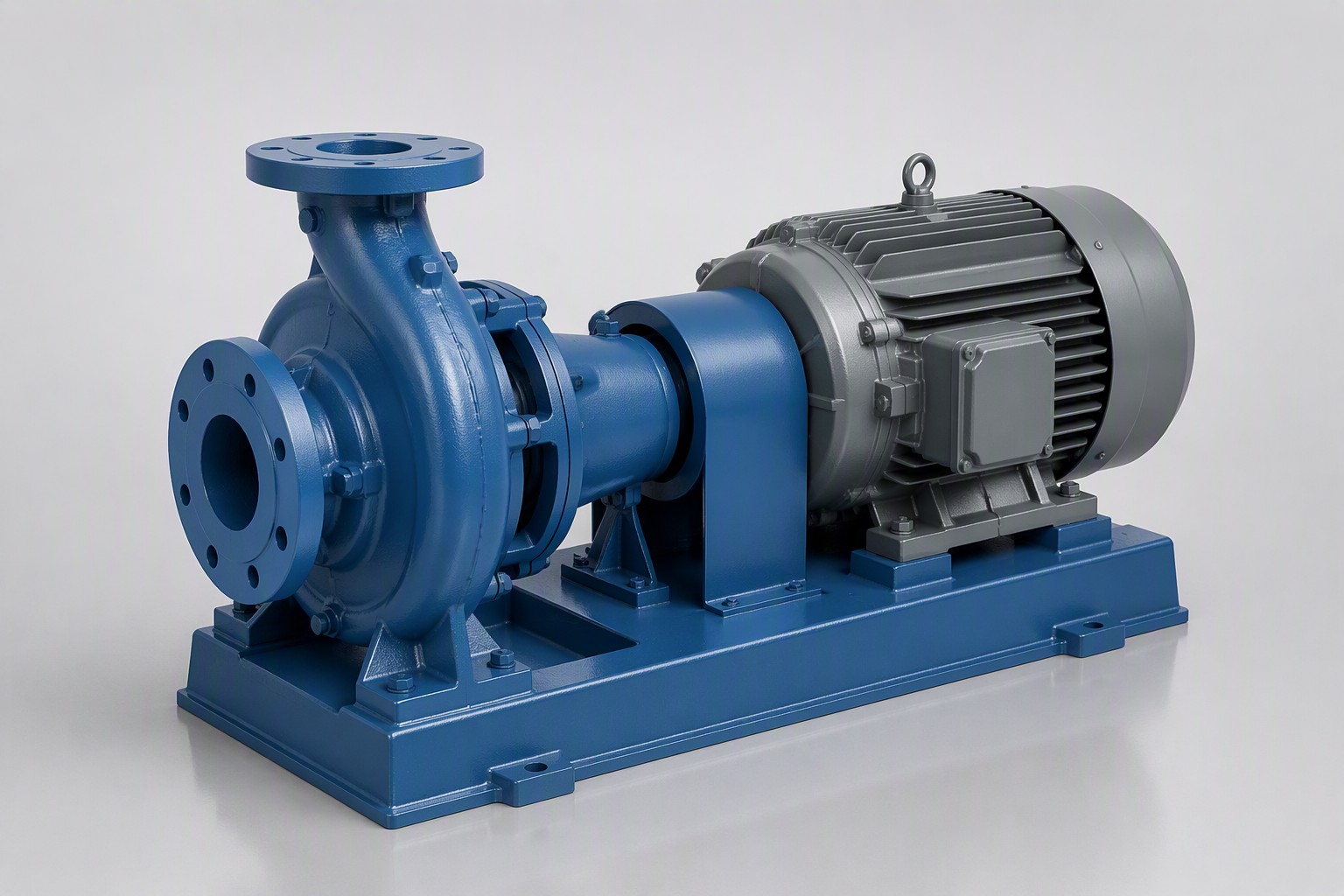
How Each Pump Technology Moves Liquid
A centrifugal pump spins liquid outward with an impeller, and the casing converts that kinetic energy into pressure. It runs on its characteristic curve: the working point sits where the pump curve crosses the piping's system curve, so opening a valve raises flow and closing it pushes flow toward shut-off.
A positive displacement pump works on the opposite logic: its rotors, screws, lobes or reciprocating element trap a defined volume and sweep it to the discharge, so flow per revolution is nearly fixed — only internal slip leaks back across the clearances. Capacity is set by speed, while discharge pressure rises until it balances the system, limited by the relief valve and the driver.
Positive Displacement vs Centrifugal at a Glance
Engineering Comparison: Positive Displacement vs Centrifugal Pump
| Dimension | Positive displacement pump | Centrifugal pump |
|---|---|---|
| Pressure source | Trapped volume forced out of the discharge | Impeller velocity converted to pressure in the casing |
| Flow at fixed speed | Nearly constant, set by speed minus slip | Follows the pump curve vs the system curve |
| Higher viscosity | Slip falls; efficiency holds on heavy fluids | Head, flow and efficiency fall sharply |
| Pressure | Rises to match the system; relief valve needed | Set by the impeller curve; falls as flow rises |
| Flow control | Speed or bypass — never throttle the discharge | Throttle valve or variable speed |
| Suction | Self-priming within its vacuum limit | Needs a flooded/primed suction and NPSH margin |
| Typical service | Viscous liquids, dosing, high pressure at low flow | High-flow transfer of thin liquids |
What the Curves Say About Flow and Pressure
A centrifugal pump delivers a steeply drooping head-capacity curve, so a small change in system resistance moves flow a long way, and efficiency is high only near the best-efficiency point. A PD pump has a nearly flat capacity line: flow changes little with pressure while efficiency holds across a wide band. So when the process needs constant, repeatable flow under varying back-pressure, PD wins — protected by a relief valve, never by throttling.
Viscosity Is Where the Two Technologies Diverge Most
Viscosity magnifies every difference between the designs. Inside a centrifugal pump, friction losses grow as the liquid thickens: head and flow fall, efficiency collapses and power can climb. Qingdao Green Power guidance for its IS/ISW centrifugal series (1.5–1600 m³/h, heads of 2–125 m, liquids up to 80°C) is to switch to a gear or screw pump above about 150 cSt. A PD pump displaces volume instead of accelerating it and sees slip fall as viscosity rises, which makes heavy oils and resins its natural territory: the G-type single-screw series covers 0.1–150 m³/h at 0.6–2.4 MPa, and the 3GB triple-screw series 2.4–241.7 m³/h for hot oils.
Efficiency, Pulsation, Suction and Control in Practice
- Efficiency versus pressure: a centrifugal pump is efficient near its best-efficiency point; a PD pump keeps high efficiency across a wide pressure band, valuable when the process sets the pressure.
- Pulsation: centrifugal flow is continuous; PD flow pulses with the pumping elements — reciprocating types most, gear and screw designs least — so dampeners are used on metering lines.
- Priming and NPSH: a centrifugal impeller cannot pull a vapour column up a dry line, so the pump needs a flooded or primed suction with enough NPSH margin. PD pumps expand a trapped cavity to create suction and lift liquid within their vacuum limit.
- Dry running: neither technology tolerates it. Centrifugal machines overheat at the seal and wear rings; a single-screw PD pump is destroyed within seconds because its rotor runs against a rubber stator.
- Wear and slip: widening clearances in a PD pump raise slip and slowly cut capacity; centrifugal wear lowers head and shifts the curve.
A Practical Decision Path
Start with the liquid: viscosity, solids content, shear sensitivity and vapour pressure narrow the technology before any price comparison. Then fix the duty — flow range, discharge pressure and whether it changes during operation. Continuous high-volume transfer of a thin liquid favours a simpler, cheaper centrifugal pump; constant flow under varying pressure, viscous or abrasive media, or dosing favour a PD pump. The industrial pump types map and the industrial pump selection guidance walk through the steps; the engineering team will confirm the suitable class and model for your duty point before procurement.
Frequently Asked Questions
Is a positive displacement pump more efficient than a centrifugal pump?
It depends on the duty. A centrifugal pump is efficient only near its best-efficiency point and loses efficiency as viscosity rises, while a PD pump holds flat efficiency across a wide pressure band. Above roughly 150 cSt the PD machine is usually the more efficient choice; on thin, high-flow water duties the centrifugal pump is ahead.
How does viscosity change which pump technology is right?
As viscosity rises, friction losses inside a centrifugal pump grow quickly — head, flow and efficiency all fall — while a PD pump displaces volume and sees less internal slip in thicker liquid. Qingdao Green Power guidance for its IS/ISW centrifugal series is to switch to a gear or screw pump above about 150 cSt; the G-type single-screw series covers 0.1–150 m³/h at 0.6–2.4 MPa for viscous media.
Can I throttle the discharge of a positive displacement pump to control flow?
No. A PD pump keeps displacing its full volume as the discharge is restricted, so throttling makes pressure climb until the relief valve opens, the driver stalls or the line fails. Control PD flow with speed or a bypass that returns excess liquid to the suction side.
Why are positive displacement pumps self-priming while centrifugal pumps are not?
A PD pump creates suction by expanding a trapped cavity, so it can draw liquid up a dry suction line within its vacuum limit. A centrifugal impeller cannot pull a vapour column and must be flooded or primed, with enough NPSH margin to avoid cavitation — which is why PD pumps are chosen for drum, tank and underground-sump unloading.
Tell us the liquid — viscosity, temperature, solids, required flow and discharge pressure — and the engineering team will confirm whether a centrifugal or positive displacement pump is the economical fit for your duty.
Get a Quote
Send your fluid data and duty point. Engineers reply within 24 hours.
Contact Us →💬 WhatsApp NowRelated Products
- G & 3GB Screw Pump
- IS/ISW Centrifugal Pump
Related Articles
Rotary Lobe vs Gear Pump
PD sub-types compared
Industrial Pump Types
Full technology map
Viscous Fluid Pump Selection
When viscosity decides